
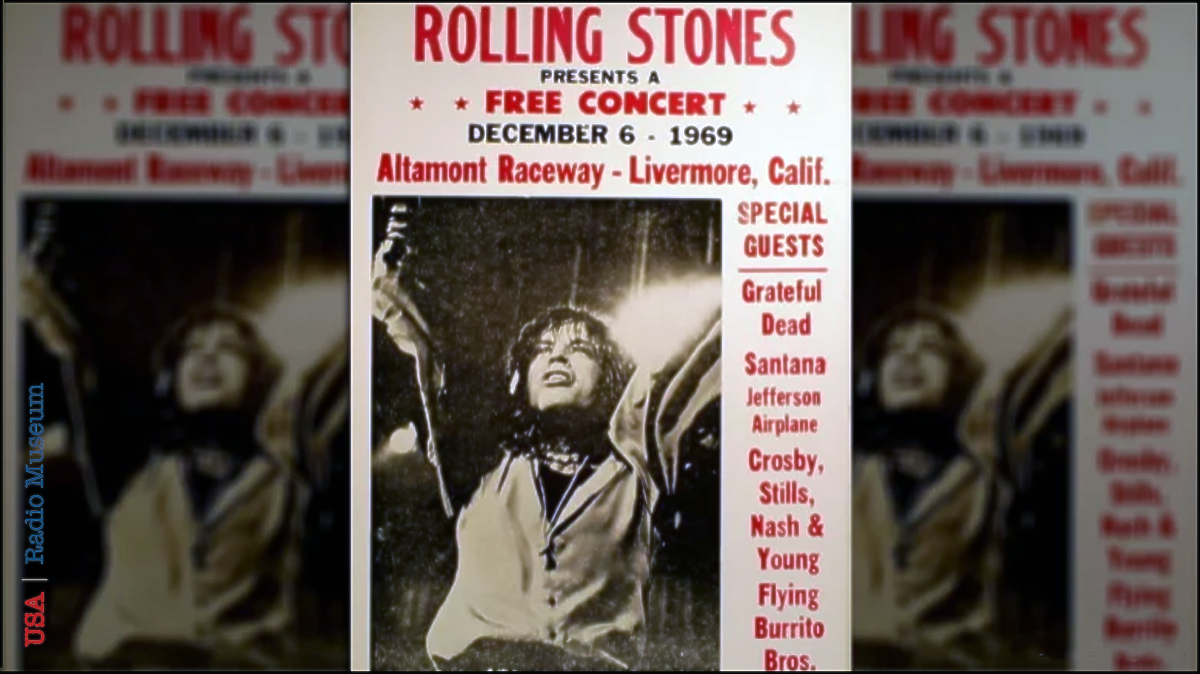
Introduction: From Woodstock to Altamont The summer of 1969 had given the world Woodstock, a sprawling, muddy miracle of peace and music that seeme
Introduction: From Woodstock to Altamont
 The summer of 1969 had given the world Woodstock, a sprawling, muddy miracle of peace and music that seemed to embody the counterculture dream. Just four months later, on December 6, 1969, the Altamont Speedway Free Festival in California was intended to be its West Coast counterpart. Instead, it became a nightmare. What was meant to be a celebration of music and community ended in chaos, violence, and death. Altamont has since been remembered not as a triumph, but as the moment the 1960s lost its innocence. — USA RADIO MUSEUM
_____________________
The Conception of Altamont
The Rolling Stones had just completed their American tour and wanted to close it with a grand gesture—a free concert for their fans. The idea was hastily conceived, inspired by Woodstock’s success. The venue shifted multiple times before settling on Altamont Speedway, a racetrack east of San Francisco, only days before the event.
The lineup was stellar: Santana, Jefferson Airplane, The Flying Burrito Brothers, Crosby, Stills, Nash & Young, and The Rolling Stones. The promise was irresistible—a free festival featuring some of the era’s greatest acts. But the rushed planning, lack of infrastructure, and questionable security arrangements set the stage for disaster.
The Hells Angels and Security
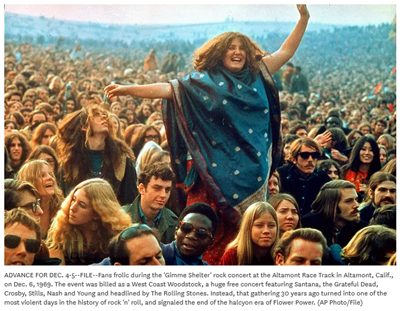
(Credit: San Francisco Chronicle)
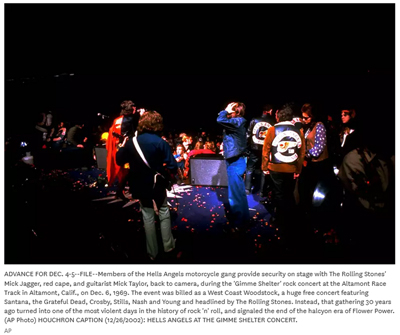
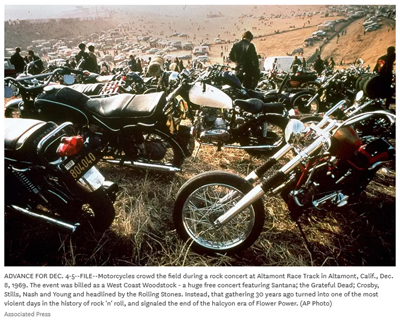
Perhaps the most infamous decision was the hiring of the Hells Angels motorcycle club to provide security. Accounts differ on the arrangement—some say they were paid $500 worth of beer, others claim it was a more formal deal—but the result was the same: a volatile mix of alcohol, aggression, and authority.
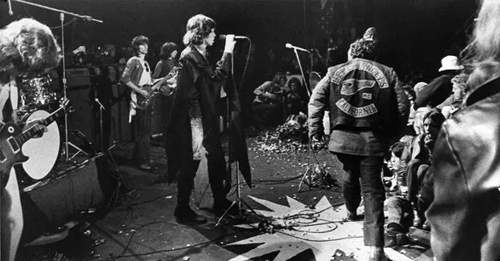
The stage itself was only four feet high, leaving performers exposed to the surging crowd. As tensions mounted, the Angels responded with fists, pool cues, and intimidation. What might have been a manageable situation with professional security became a powder keg.
The Day Unfolds
The festival drew an estimated 300,000 people. From the start, the atmosphere was tense. Fights broke out near the stage, and Jefferson Airplane’s set was interrupted when singer Marty Balin was knocked unconscious by a Hells Angel. Crosby, Stills, Nash & Young refused to play until order was restored.
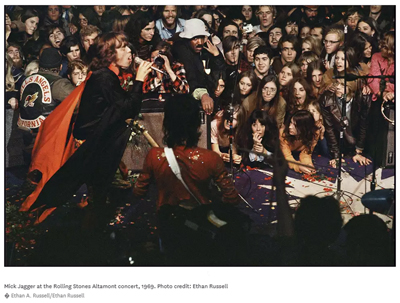
By the time The Rolling Stones took the stage in the fading light, the crowd was restless, the Angels were drunk, and the mood was ominous. Mick Jagger, arriving by helicopter, was punched in the face before even reaching the stage. The band pressed on, unaware of the tragedy about to unfold.
The Death of Meredith Hunter
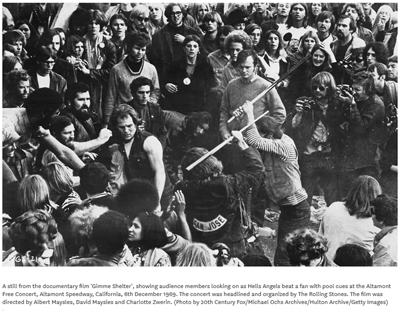
(Credit: San Francisco Chronicle)
During “Under My Thumb,” 18‑year‑old Meredith Hunter approached the stage. Accounts say he was agitated, possibly under the influence, and visibly carrying a revolver. As he moved closer, Hells Angels intervened. In full view of the crowd, Hunter was stabbed and beaten to death. The incident was captured on film in the documentary Gimme Shelter, forever etching the horror into rock history.
Hunter’s death was the most shocking of the day, but not the only tragedy. One man drowned in a drainage canal, two men were killed in a hit‑and‑run accident, and amid the chaos, two babies were born. Altamont was a surreal mix of life and death, joy and terror.
_____________________
Sidebar: Beer‑Only Security Payout for Hell’s Angels Protection?
It remains one of the most infamous decisions in rock history. To police a crowd of nearly 300,000 at Altamont Speedway, the Rolling Stones agreed to pay the Hells Angels not in cash, but in beer—$500 worth of it. What seemed like a casual arrangement quickly spiraled into disaster. Fueled by alcohol and armed with intimidation, the Angels turned the stage into a battleground.
Mick Jagger, punched in the face before even reaching the stage, pleaded with the crowd to stop fighting as Angels surged across the platform. Jefferson Airplane’s Marty Balin was knocked unconscious. One man drowned, two were killed in a hit‑and‑run, and 18‑year‑old Meredith Hunter was fatally stabbed in front of the band. Another concertgoer was dragged onto the stage and mauled.
The beer‑for‑security deal became a symbol of Altamont’s reckless improvisation—a decision that left the Stones haunted and the counterculture scarred. What was meant to safeguard the music instead unleashed violence that forever changed the legacy of the sixties.
_____________________
The Stones on Stage: Shock and Helplessness
(Credit: San Francisco Chronicle)
The Rolling Stones were caught in the middle of the melee —
• Mick Jagger’s Pleas: As violence erupted during “Sympathy for the Devil,” Jagger halted the song, imploring the crowd: “Brothers and sisters, let’s stop fighting.” Later, during “Under My Thumb,” he repeated his appeals as Hunter was attacked. His voice carried desperation, but the chaos drowned him out.
• Band’s Dilemma: The Stones debated stopping the set but feared that ending abruptly might spark a riot. They pressed on, visibly shaken, trying to hold the crowd together with music.
The decision to continue playing was not indifference—it was survival. The band understood that abandoning the stage might unleash even greater violence.
[USARM Note: One of the earlier accounts published in the aftermath of the Altamont tragedy can be found in the January 21, 1970 issue of Rolling Stone, read it online, HERE.]
Immediate Aftermath
In the days following Altamont, the Stones expressed horror and regret —
• Public Statements: Jagger admitted they had underestimated the risks of hiring the Hells Angels and the lack of proper planning. Keith Richards later described Altamont as “the worst day” of their career.
• Captured in Film: The documentary Gimme Shelter immortalized their stunned reaction. In one chilling scene, the band watches footage of Hunter’s death in silence, their faces registering shock and disbelief.
The Stones were not callous—they were shaken to their core. Altamont became a wound that never fully healed.
Legal Proceedings
• Focus on the Hells Angels: The homicide case centered on Alan Passaro, the Hells Angel who stabbed Hunter. He was charged with murder but acquitted in 1971 after the jury accepted that Hunter had brandished a revolver.
• No Charges Against the Stones: The Rolling Stones were never summoned to appear before authorities or in court. Responsibility was placed on the Angels, not the band.
This distinction mattered: while the Stones were morally haunted, they were not legally culpable. The tragedy was treated as a homicide involving the Angels, not the musicians.
The Music Amid the Chaos
Despite the violence, the music played on. Santana delivered a fiery set, Jefferson Airplane fought through interruptions, and Crosby, Stills, Nash & Young offered harmonies against the backdrop of disorder. The Flying Burrito Brothers brought country‑rock to the stage, and finally, The Rolling Stones attempted to salvage the night.
Songs like “Sympathy for the Devil” and “Gimme Shelter” took on chilling resonance. Jagger’s pleas for peace became part of the performance itself, a desperate attempt to hold back the tide.
Cultural Impact: The End of the Sixties Dream
(Credit: San Francisco Chronicle)
Altamont, as 1969 was coming to a close, has often been described as the “death of the 1960s.” Where Woodstock symbolized peace and love, Altamont revealed the darker undercurrents of the counterculture—violence, disorganization, and the fragility of idealism.
The event forced musicians, promoters, and fans to confront the realities of mass gatherings. It underscored the need for professional security, careful planning, and respect for the power of music to stir emotions. For The Rolling Stones, Altamont became a cautionary tale, haunting their legacy even as they continued to dominate rock.
Viewing Guide: Gimme Shelter and the Shadow of Altamont
When Albert and David Maysles set out to film the Rolling Stones’ 1969 American tour, they expected to capture triumph. What they delivered instead was one of the most haunting concert documentaries ever made. Gimme Shelter, released in 1970, is not just a record of music—it is a record of history, a film that immortalizes the moment the counterculture dream collapsed at Altamont Speedway.
The documentary begins with the Stones riding high, their tour unfolding with swagger and spectacle. But as the narrative shifts to Altamont, the tone darkens. The cameras capture the tension in real time: the crowd pressing against the stage, the Hells Angels swinging pool cues, Jefferson Airplane’s Marty Balin knocked unconscious, and finally, the fatal stabbing of Meredith Hunter. The violence is not hidden—it unfolds before the lens, unflinching and unforgettable.
[A USARM Note: Here is an excellent documentary of the Altamont Raceway concert you can view on YouTube, click HERE].
(Credit: San Francisco Chronicle)
Perhaps the most chilling sequence comes not on stage but in the editing room. The film shows Mick Jagger and Charlie Watts watching the footage of Hunter’s death. Their silence is devastating. Jagger’s face tightens, Watts stares in disbelief. It is a moment of reckoning, as the band confronts the reality of what happened under their watch. For audiences, it is equally sobering: the dream of peace and love colliding with the brutal truth of human frailty.
Critics hailed Gimme Shelter as a masterpiece of vérité filmmaking, but its legacy is inseparable from the tragedy it depicts. For the Stones, it was a mirror held up to their darkest hour. For history, it became the definitive record of Altamont, ensuring that the violence and loss would never fade into myth.
Today, Gimme Shelter remains essential viewing—not only for fans of the Rolling Stones, but for anyone seeking to understand the fragile line between music as transcendence and music as chaos. It is a film that refuses to let us look away, reminding us that history is not only about the songs we sing, but the shadows they sometimes cast.
Legacy and Reflection
More than half a century later, Altamont remains a defining moment in pop music history. It is studied not only as a concert gone wrong but as a cultural turning point. The optimism of the 1960s gave way to the realism of the 1970s. The dream of peace and love was tempered by the recognition of human frailty.
 For the USA Radio Museum, Altamont is a story worth telling—not to sensationalize, but as an afterthought, to ponder the lessons learned. It reminds us that music is powerful, but power must be handled with care, especially when the number of concert-goers may become beyond control. It shows that history is not only about triumphs but also about tragedies that shape our collective memory. And this is one of them.
Conclusion: Altamont’s Place in History
December 6, 1969, will forever be remembered as the day the music turned dark. Altamont was meant to be a gift, a celebration, a West Coast Woodstock. Instead, it became a symbol of chaos, violence, and, beyond a concert stage, the end of innocence. For this never happened before.
Yet even in tragedy, Altamont holds meaning. It reminds us that music is not separate from life—it reflects our hopes, our flaws, and our struggles. The Rolling Stones, Jefferson Airplane, Santana, and others gave their art to the crowd, but history gave us a lesson: peace and love require more than slogans; they require care, responsibility, and respect for precious life.
For the Rolling Stones, Altamont was not just a concert—it was a reckoning. The music played on, but innocence was lost, and what might have been an extraordinary musical finale to the 1960s instead died that night beneath the California sky.
_________________________
Contact: jimf.usaradiomuseum@gmail.com
_________________________
A USARM Viewing Tip: On your PC? Mouse/click over each image for expanded views. On your mobile or tablet device? Finger-tap all the above images inside the post and stretch image across your device’s screen for LARGEST digitized view. Then click your brower’s back arrow to return to the featured post.
© 2025 USA Radio Museum. All rights reserved.

[…] December 6 at Altamont Speedway climaxed with the Rolling Stones, flanked by Santana, Jefferson Airplane, Grateful Dead, CSNY, and Flying Burrito Brothers. Hells Angels as security sparked fights from the start. What began hopeful devolved into brawls, stabbings, and a death amid 300,000 in a dusty racetrack hellscape.[21][22] […]