
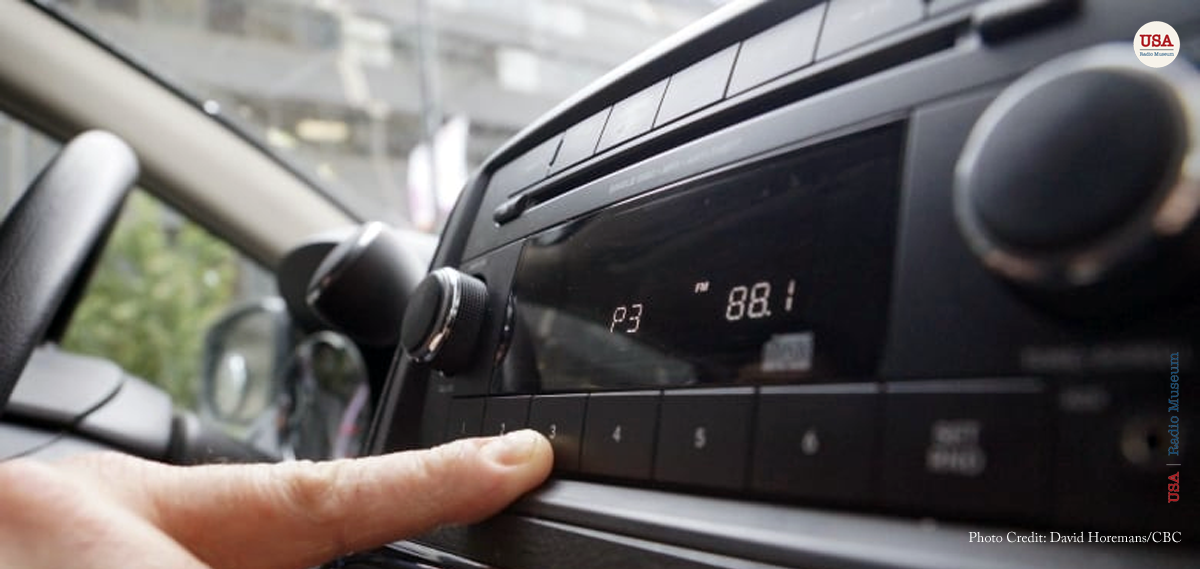
Can You Imagine America Without AM Radio in Its Cars? Congress Now Faces a Critical Choice: Protect AM Radio or Weaken America’s First‑Alert System
Can You Imagine America Without AM Radio in Its Cars?
Congress Now Faces a Critical Choice: Protect AM Radio or Weaken America’s First‑Alert System
A USA Radio Museum Editorial
Can you imagine a future where AM radio — the signal that carried America through wars, storms, elections, and everyday life — simply vanishes from the dashboard? For generations, the car radio has been the most democratic medium in the country: free, reliable, and always there when people needed it. But today, as traditional radios disappear from American homes, the automobile has become the last place where most people still access AM radio at all.
T wo decades ago, nearly every household in the United States owned at least one radio. Today, that number has fallen dramatically, with in‑home radio ownership dropping from roughly 96% in the early 2000s to around 60%. At the same time, more than 70% of all AM/FM listening now happens in the car — not in the living room, not in the kitchen, not on a nightstand. For millions of Americans, the car radio is the radio.
This shift makes the recent trend among some automakers to remove AM radio from new vehicles especially alarming. Eliminating AM radio doesn’t just erase a legacy technology — it severs a critical lifeline. AM remains the backbone of the Emergency Alert System, the trusted companion of rural and agricultural communities, and the home of in‑language, religious, cultural, and community‑based programming that no other medium replicates.
The AM band is not some some relic of its past. Radio was born AM. It is a living, essential service. And removing it from vehicles would impact not only listeners, but the broadcasters, public‑safety agencies, farmers, first responders, and community voices who depend on it every day.
That is why the USA Radio Museum stands firmly with the growing national coalition urging Congress to protect AM radio in America’s cars. The stakes are clear: public safety, cultural preservation, and the future of accessible information all hang in the balance.
Keeping AM Radio in America’s Cars: A Public Safety Imperative
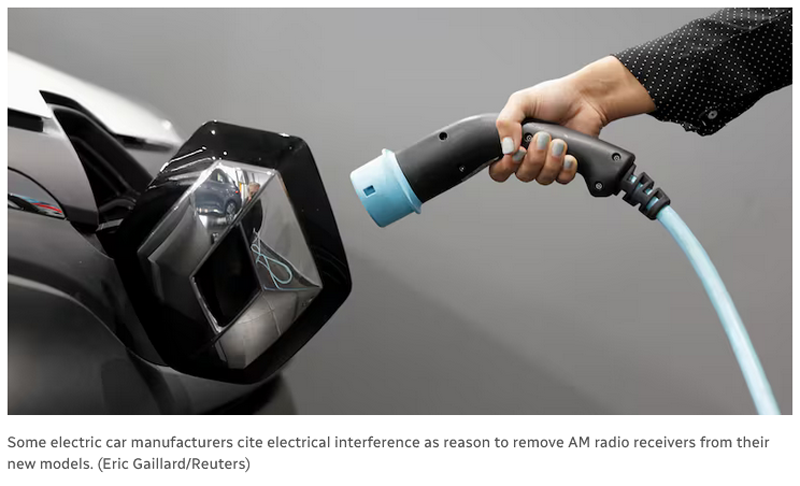
Credit: www.cbc.ca
For more than a century, AM radio has been one of the nation’s most reliable lifelines — a medium that has carried urgent warnings, local reporting, community voices, and cultural identity across every corner of the United States. Today, that legacy faces a profound challenge as some automakers move to remove AM radio from new vehicles, including electric models and potentially future internal‑combustion cars.
The USA Radio Museum joins broadcasters, emergency managers, agricultural organizations, and community advocates nationwide in underscoring a simple truth: AM radio remains essential to America’s public safety infrastructure.
International Perspective & Technical Context
CBC News — “Some carmakers are removing AM radios from dashboards. How big of a loss will it be?”
Mouhamad Rachini, of CBC Radio, May 24–25, 2023 Provides expert commentary from Canadian broadcasters and consultants on:
- Automakers removing AM receivers from EVs
- Technical interference concerns
- AM’s long‑distance reach and importance in rural regions
- The cost and infrastructure challenges of AM broadcasting
- The cultural and nostalgic value of AM radio
- The role of AM in emergency communication This article offers a valuable international comparison that reinforces AM radio’s global relevance and the consequences of its removal.
Why AM Radio Still Matters
The Backbone of Emergency Communication
AM radio is the foundational layer of the Emergency Alert System. When power grids fail, cell towers go dark, and broadband networks collapse, AM signals continue to travel hundreds of miles — often becoming the only source of verified information for days at a time. For millions of Americans, especially in rural regions, the car radio is the most dependable receiver they own.
A Trusted Source for News, Culture, and Community
Tens of millions of listeners rely on AM radio every week for national and local news, sports, talk programming, and entertainment. AM stations also serve communities often overlooked by other media:
- In‑language programming for immigrant and multilingual audiences
- Religious and cultural broadcasts
- Hyper‑local reporting that reflects the identity of neighborhoods and small towns
Critical to America’s Agricultural Heartland
Farmers and ranchers depend on AM radio for real‑time weather alerts, crop reports, market updates, and emergency information. In many rural areas, AM remains the most consistent and accessible medium.
Policy‑Focused Response
Another critical dimension that deserves far more attention is the economic and regulatory impact on AM station owners and license holders. For decades, federal policy has treated AM radio as an essential public‑interest service — one that justifies significant investment, licensing fees, and compliance obligations. Broadcasters have spent millions acquiring and maintaining AM facilities under the assumption that the automotive dashboard would remain a guaranteed point of access for the public.
If automakers remove AM radio from new vehicles, that long‑standing policy framework collapses. The value of AM licenses — which the FCC regulates as scarce public resources — would decline sharply. Stations that have operated in good faith under federal rules would face sudden, unanticipated losses through no fault of their own. This is not just a technological shift; it is a policy failure with real economic consequences for small businesses, minority‑owned stations, rural broadcasters, and community‑service outlets.
In effect, removing AM from cars would function as a de facto curtailment of a federally regulated medium, undermining decades of public‑interest obligations and destabilizing an entire sector of the broadcast economy. That is why the AM Radio for Every Vehicle Act is not merely about preserving a legacy technology — it is about ensuring regulatory consistency, protecting licensed broadcasters from avoidable economic harm, and maintaining the integrity of the nation’s emergency‑communications infrastructure.
The Legislative Response: The AM Radio for Every Vehicle Act
Growing concern over the removal of AM receivers from new vehicles has sparked a bipartisan, bicameral effort in Congress.
Automakers Begin Removing AM Radio — and the Backlash That Followed
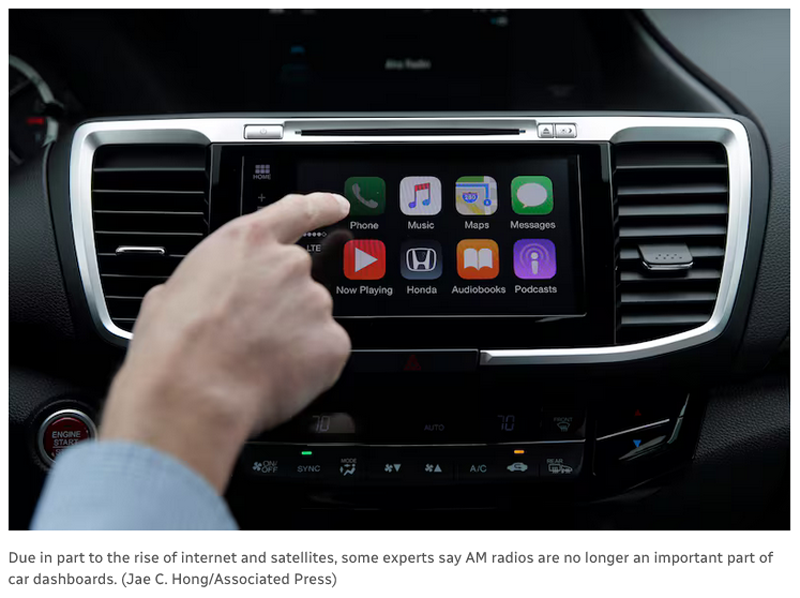
Photo Credit: www.cbc.ca
Beginning around 2023, several major automakers — including Tesla, BMW, Porsche, Audi, and Volvo — removed AM radio receivers from certain new models, particularly electric vehicles. The decision sparked immediate pushback from broadcasters, emergency‑management advocates, and longtime listeners who rely on AM’s long‑distance reach and resilience during emergencies. In May 2023, the concern grew significant enough that a bipartisan group of U.S. lawmakers introduced legislation urging the National Highway Traffic Safety Administration to require AM radio in all new vehicles at no additional cost. Their message was clear: removing AM radio from dashboards threatens a vital public‑safety resource.
Senate Action
On January 29, 2025, Senators Ted Cruz (TX) and Ed Markey (MA), joined by 41 cosponsors, introduced S. 315 — the AM Radio for Every Vehicle Act. Just one week later, on February 5, the Senate Commerce Committee advanced the bill by voice vote. Today, more than 60 Senators support the legislation.
House Action
Also on February 5, Representatives Gus Bilirakis and Frank Pallone introduced the companion bill, H.R. 979, in the House of Representatives. With over 260 cosponsors, the bill would:
- Require the U.S. Department of Transportation to mandate AM radio capability in all new vehicles manufactured or imported into the United States
- Ensure AM radio is easily accessible to drivers
- Require clear consumer labeling for any vehicle sold without AM radio before the new rule takes effect
Broad National Support
More than 125 organizations — including the National Emergency Management Association, American Farm Bureau Federation, AARP, Native Public Media, SAG‑AFTRA, and the National Association of Black Owned Broadcasters — have endorsed the legislation. Their support reflects AM radio’s irreplaceable role in public safety, rural life, cultural preservation, and community connection.
As former FEMA officials have warned: “Eliminating AM radio will put public safety at risk.”
The Bottom Line
AM radio is not a relic. It is a resilient, indispensable public service — one that continues to protect lives, inform communities, and preserve the diverse voices that define America.
Congress should enact the AM Radio for Every Vehicle Act to ensure that AM radio remains a standard feature in every vehicle on America’s roads. The stakes are clear: public safety, national preparedness, and the cultural fabric of our communities depend on it.
______________________________
Sources & Credits
Supporting data and references for “The Last Radio in the House Is in the Car — And It’s at Risk”
Radio Listening, Reach, and Industry Trends
- Statista – U.S. Radio Industry Statistics & Facts Provides national data on radio reach, weekly listening, and long‑term industry trends, including the continued strength of AM/FM listening across the United States.
- Pew Research Center – Key Facts About U.S. Radio Listeners Offers research‑based insights into radio consumption patterns, listener demographics, and the state of radio as a mass‑reach medium.
- Musical Pursuits – Radio Statistics (2026) Includes contemporary listening statistics, generational listening habits, and data on radio’s dominance as a commuting medium.
Radio Ownership Trends
- Statista – U.S. Radio Industry Overview Contains historical and current data illustrating the decline of in‑home radio ownership and shifts in listening behavior.
Public Safety & Emergency Communications
- National Emergency Management Association & FEMA Statements Public commentary from emergency management leaders emphasizing AM radio’s role as the backbone of the Emergency Alert System and its reliability during power and cellular outages. (Referenced through legislative summaries and public statements cited in congressional materials.)
Legislative Context
- Congressional Activity on the AM Radio for Every Vehicle Act (S. 315 / H.R. 979) Publicly available legislative summaries and congressional records documenting bipartisan support, committee actions, and bill provisions.
Industry & Community Impact
- National Association of Broadcasters (NAB) Advocacy materials outlining the importance of AM radio to rural communities, agricultural sectors, multilingual broadcasters, and underserved audiences.
Broadcast Ownership & Diversity Context
- FCC Biennial Ownership Report (2025) Provides data on ownership trends across AM and FM stations, highlighting the importance of preserving diverse broadcast voices.
How These Sources Support the Article
- Decline of in‑home radios is supported by long‑term industry data from Statista and Pew.
- Car radio as the dominant listening environment is reinforced by commuting‑focused listening statistics from Musical Pursuits.
- Tens of millions of weekly AM listeners is consistent with national reach data from Statista and Pew.
- AM radio’s role in emergency communication is supported by FEMA and NEMA public statements.
- Legislative details come from publicly available congressional summaries of S. 315 and H.R. 979.
- Community and agricultural reliance on AM is documented in NAB advocacy materials and industry analyses.
______________________________
Contact: jimf.usaradiomuseum@gmail.com
______________________________
A USARM Viewing Tip: On your PC? Mouse/click over each image for expanded views. On your mobile or tablet device? Finger-tap all the above images inside the post and stretch image across your device’s screen for LARGEST digitized view. Then click your brower’s back arrow to return to the featured post.
© 2026 USA Radio Museum. All rights reserved.

But not only that Jim without AM there wouldn’t be FM, movies, television, and even cable, Trump, Orban, and other are trying to “Cleanse” the mess to make this planet Medialess.
[…] specifically, has a large protection space unaffected by cell service. House radio possession is dropping quickly, leaving the automotive as the one out there radio in lots of circumstances. Each automotive ought […]