
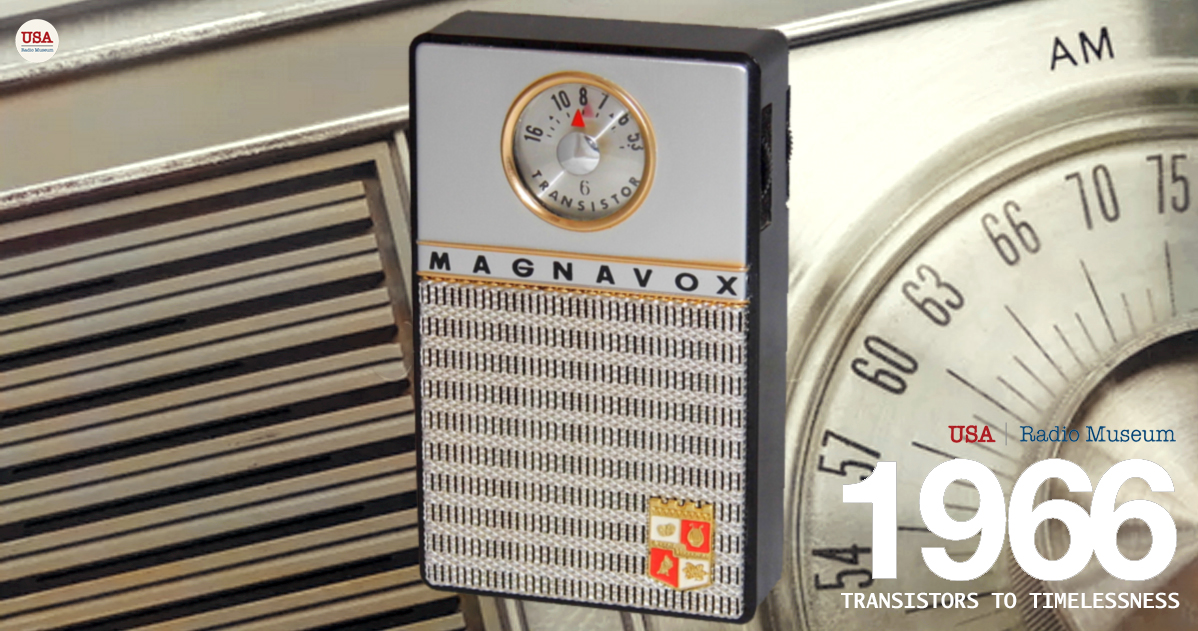
FOREWORD FROM THE CURATOR Revisiting the Year When Pop Grew Up — And Radio United America With Its New Soundscape By Jim Feliciano, Co-Curator,
FOREWORD FROM THE CURATOR
Revisiting the Year When Pop Grew Up — And Radio United America With Its New Soundscape
By Jim Feliciano, Co-Curator, USA Radio Museum
Every time I revisit the music of 1966, I’m transported back to a very specific feeling — that electric sense of discovery that only radio could deliver. While 1965 has always been my personal favorite year for Top 40 music, the truth is that 1966 was the year when everything I loved about that sound came into full bloom. What we first heard taking shape in ’65 — the new harmonies, the bold production choices, the sense that pop music was stretching its wings — matured dramatically just twelve months later. In 1966, it didn’t just grow; it soared.
Growing up in the Motor City in the 1960s, I remember the thrill of hearing those records for the first time, often through the tiny speaker of a transistor radio that never left my side. There was something magical about the way those songs arrived — not as isolated tracks, but as part of a living, breathing broadcast. A DJ’s voice would fade, the jingle would hit, and suddenly you were inside a moment that felt bigger than you. The Beatles, The Supremes, The Beach Boys, The Stones — they weren’t just artists. They were companions, narrators, and sometimes even teachers.
What stands out most, looking back sixty years later, is how quickly the sound evolved. One week you’d hear something familiar; the next, something that felt like it came from the future. And radio — with its personality, its immediacy, its ability to make the world feel smaller — was the perfect vessel for that evolution. It brought the country together in a way that’s hard to describe unless you lived it. You didn’t just hear the music. You felt it. You lived with it.
For me, 1966 represents the moment when pop music reached its zenith — emotionally, creatively, and culturally. It was the year when the artists took bigger risks, the producers pushed the studio to its limits, and the listeners — all of us — were ready for something deeper and more daring. It was a year when the soundtrack of America didn’t just reflect the times; it helped shape them.
As we mark the 60th anniversary of 1966, I’m reminded of how lucky we were to experience that moment in real time — and how important it is to preserve it. That’s the mission of the USA Radio Museum: to keep these sounds, these stories, and these memories alive for anyone who wants to understand how radio shaped the culture of a nation.
1966 still sings.
1966: The Year Pop Music Found Its Voice — And America Found Its Sound
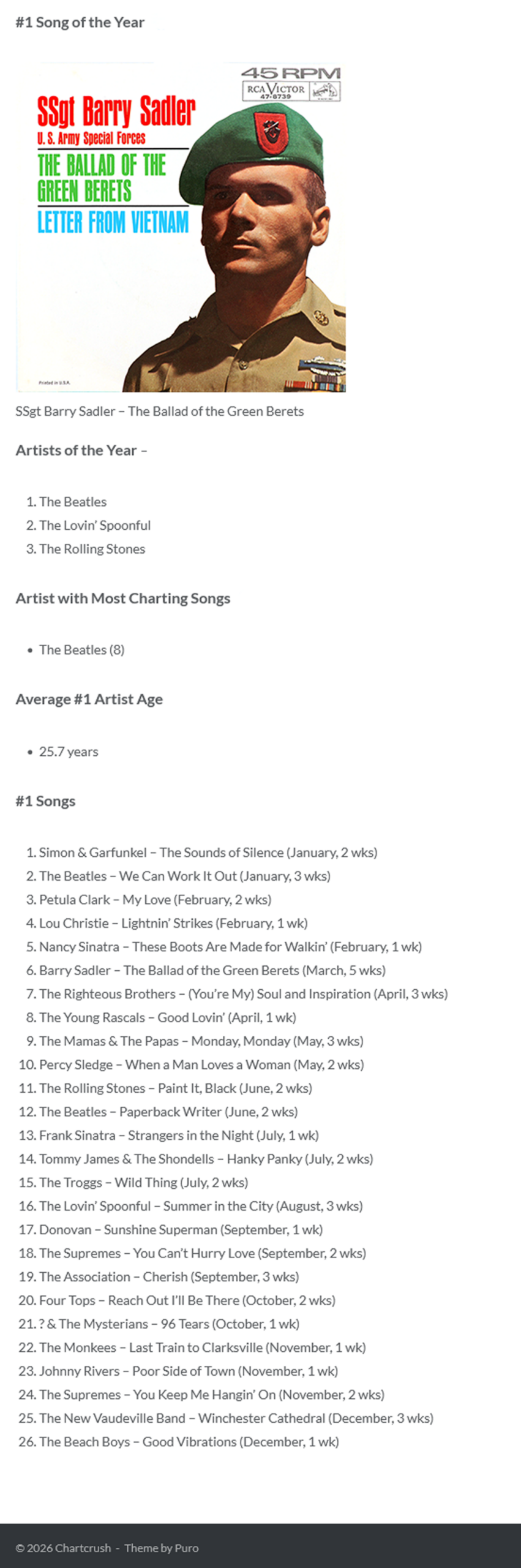
Credit: Chartcrush
By 1966, American pop music had entered a moment of astonishing transformation. What began as a burst of creative energy in 1965 — new voices, new textures, new ambitions — blossomed into a fully realized musical revolution. The year stands today as one of the most pivotal in modern music history, a crossroads where innovation met mass appeal, and where the Top 40 format became the beating heart of a nation plugged into its radios.
This was the year when genres didn’t just coexist — they collided, cross‑pollinated, and reshaped one another. The Beatles pushed pop into the realm of art with Revolver, a record that redefined what a three‑minute single could dare to be. Motown reached its golden peak, delivering a run of immaculate hits that blended sophistication with irresistible groove. The Beach Boys unveiled Pet Sounds, a lush, emotional masterpiece that elevated the possibilities of studio craft. Stax Records brought Southern soul roaring into the mainstream with a rawness and humanity that felt like America speaking through a microphone.
Meanwhile, the British Invasion continued to evolve beyond its early beat‑group roots, folk rock found its electric footing, and rhythm and blues surged with new urgency and depth. And through it all, Top 40 radio — vibrant, personality‑driven, and omnipresent — served as the great unifier. From Los Angeles to Detroit, from Chicago to New York, millions of listeners tuned in daily to hear the soundtrack of a rapidly changing world. DJs became cultural guides, countdowns became communal rituals, and the Billboard Hot 100 became the scoreboard of a generation hungry for something new.
1966 wasn’t simply a year of hits. It was a year of arrival — a moment when pop music matured, diversified, and embraced a bold new sonic identity. The songs of 1966 didn’t just reflect the times; they shaped them. They offered escape, inspiration, and connection during a decade defined by upheaval. And thanks to the power of American radio, these sounds reached every car, every kitchen, every transistor tucked under a teenager’s pillow.
The Sound of a Changing America: How 1966 Redefined Pop’s Identity
By the start of 1966, the American soundscape was buzzing with possibility. The previous year had cracked open the door to experimentation, but 1966 kicked it wide open. What emerged was a thrilling, unpredictable blend of artistry and accessibility — a moment when musicians, producers, and radio programmers collectively realized that the pop single could be both commercially irresistible and creatively daring.
And those memorable Top 40 instrumental hits. Here’s but a few from that year: “Wade In The Water” by The Ramsey Lewis Trio, “Zorba The Greek'” by Herb Alpert, “No Matter What Shape You’re Stomach’s In” by The T-Bones, “Wipeout” by The Surfaris (re-issued), “Summer Samba” by Walter Wanderley, and later on in the year, “Music To Watch Girls By” by The Bob Crewe Generation. All timeless instrumental hits from 1966.
Top 40 Radio: The Great American Amplifier
If 1966 had a heartbeat, it pulsed through the nation’s Top 40 stations. Radio wasn’t just a delivery system; it was the cultural glue binding together a country in motion. Teenagers in California heard the same songs as families in Ohio, truck drivers in Texas, and college students in Boston. The format’s tight rotations and charismatic DJs created a shared national soundtrack.
Stations like WABC, KHJ, WLS, and WKNR became powerhouses, each shaping regional tastes while feeding into a broader national consensus. The “Boss Radio” sound — fast‑paced, personality‑driven, and meticulously programmed — ensured that the hits of 1966 didn’t just chart; they landed.
The Beatles and the Art of Reinvention
No group embodied the creative leap of 1966 more dramatically than The Beatles. With Revolver, they shattered the boundaries of what pop music could be. Psychedelia, classical strings, tape loops, Indian instrumentation — all of it found a home on a record that still clocked in under 35 minutes. And while they were reinventing the very language of pop in the studio, they were simultaneously dominating the charts. According to ChartCrush, The Beatles scored eight chart-topping hits on the Billboard Hot 100 in 1966 — more than any other act that year. It was a rare moment when the most innovative band in the world was also the most commercially unstoppable. In a year defined by bold ideas and rapid evolution, The Beatles managed to be both the avant‑garde and the mainstream, helping cement 1966 as one of the most transformative years in modern music history.
[A USARM Note: For the Billboard Top 100 Hits of 1966, according to the fabulous Chartcrush website, go HERE]
The Beach Boys and the Emotional Frontier
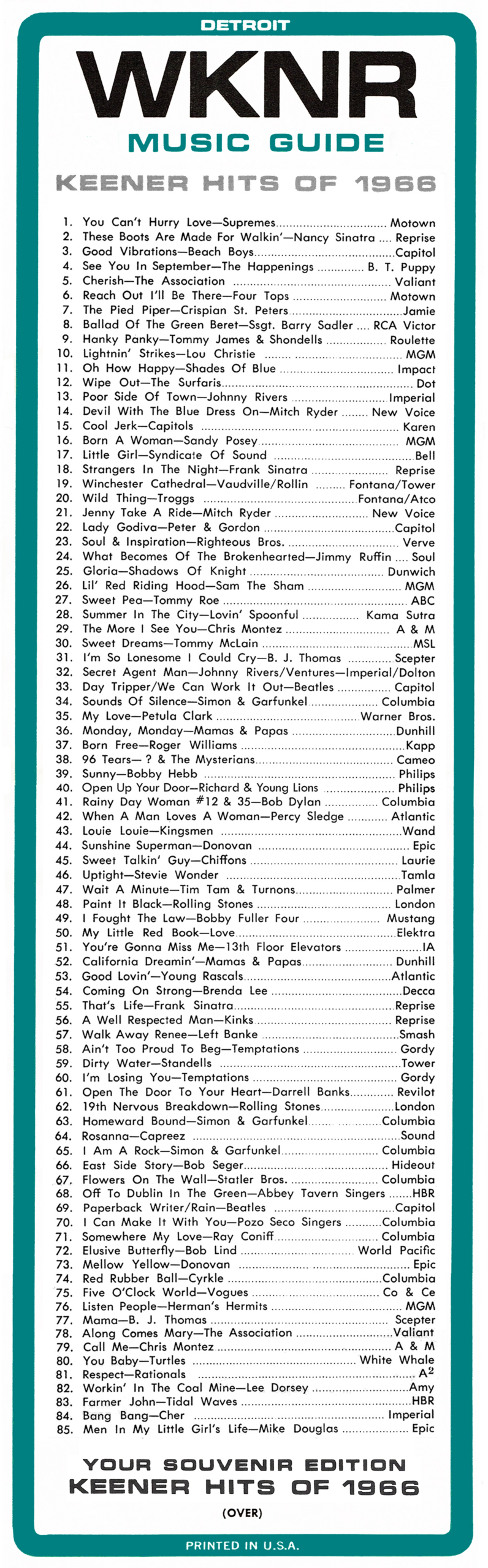
The WKNR Top 113 Hits of 1966 (A Side). Credit: Motor City Radio Flashbacks
Across the Atlantic, Brian Wilson was crafting Pet Sounds, a deeply personal, harmonically rich album that blended orchestral arrangements with emotional vulnerability. Songs like “God Only Knows” and “Wouldn’t It Be Nice” weren’t just hits; they were emotional experiences.
Motown’s Golden Peak
Motown’s 1966 output reads like a greatest‑hits anthology. The Supremes, The Temptations, The Four Tops, Stevie Wonder — each delivered singles that blended emotional immediacy with musical sophistication. These records crossed racial boundaries and brought people together on the dance floor and through the speakers of every Top 40 station in the country. It’s been said the Gordy stables at Motown Records peaked its zenith by producing and releasing more records and albums than ever before in 1966.
Stax and the Rise of Southern Soul
Stax Records in Memphis delivered raw, unfiltered emotion. 1966 was a breakout year for the label, with artists like Otis Redding, Sam & Dave, and Carla Thomas bringing Southern soul into the national spotlight.
The British Invasion Evolves
By 1966, the British Invasion was no longer a novelty — it was a force. Artists like Petula Clark, Peter & Gordon, Tom Jones, they continued churning out the hits. Bands like The Rolling Stones, The Kinks, and The Who embraced more complex songwriting and production. The last three aforementioned bands hinting at the harder, more experimental rock that would define all three in the late ’60s.
The Monkees Arrive: A New Pop Phenomenon (Fall 1966)
As 1966 moved into fall, American pop culture welcomed a fresh burst of energy with the arrival of The Monkees. Their NBC television series premiered in September and instantly connected with a young, transistor‑radio generation hungry for color, humor, and catchy songs. Within weeks, their debut single “Last Train to Clarksville” shot to No. 1, and their first album became one of the year’s top sellers.
What made The Monkees’ breakthrough so striking was the way they bridged television and radio, becoming one of the first true multimedia pop acts. Their music fit seamlessly into the bright, upbeat sound dominating the Top 40 in late 1966, adding a new voice to an already vibrant musical landscape.
But even with their explosive debut, The Monkees entered a year overwhelmingly defined by The Beatles’ artistic reinvention and chart dominance. Their arrival added excitement and momentum to 1966 — a reminder of how wide and dynamic the pop universe had become — but it was The Beatles who ultimately shaped the year’s creative and commercial center.
The Billboard Hot 100: A Year Written in Singles
If albums expanded the artistic vocabulary of pop, the Billboard Hot 100 told the story of how those ideas reached the public — one single at a time. The diversity of the year’s hits is staggering: sunshine pop, soul, garage rock, baroque pop, folk rock, psychedelia, and novelty records all jostled for space on the same countdowns.
A Democratic Hit Parade
Frank Sinatra topped the charts with “Strangers in the Night.” The Mamas & The Papas delivered West Coast cool. The Rolling Stones brought in the studio a more signature swagger. The Association offered tenderness with “Cherish.” And garage‑rock upstarts like ? and the Mysterians proved that raw energy could triumph over polish.
The Studio as an Instrument
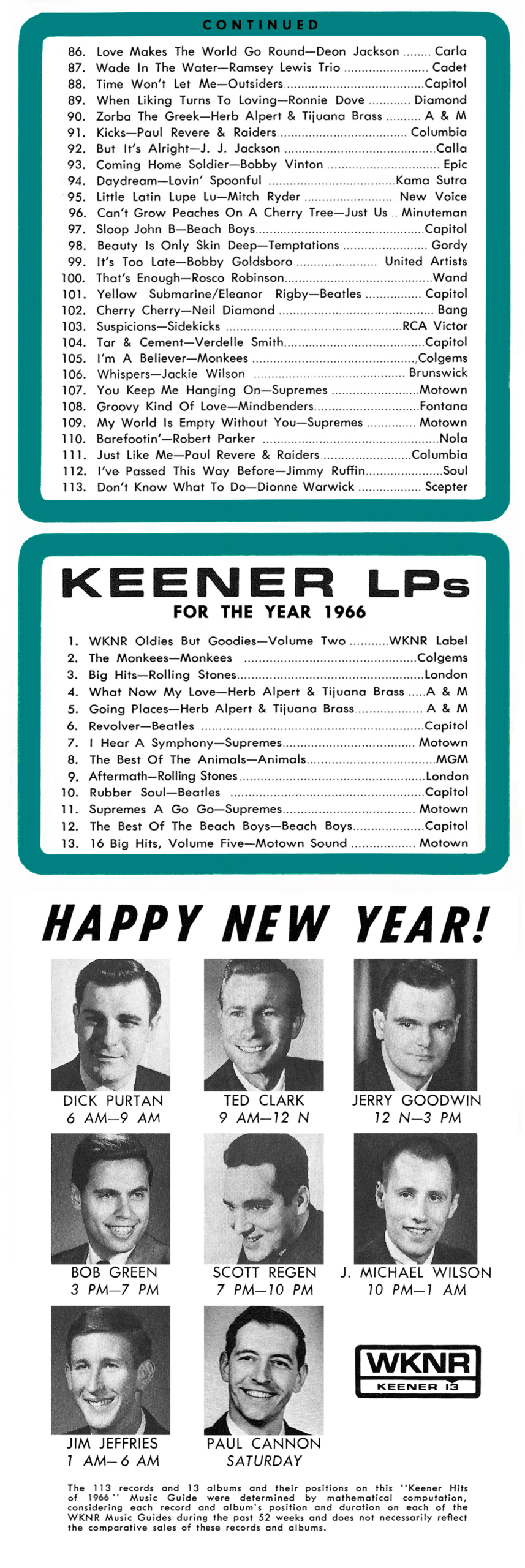
The WKNR Top 113 Hits of 1966 (B Side). Credit: Motor City Radio Flashbacks
1966 was also the year when the studio became a laboratory. Producers like Brian Wilson, George Martin, and Holland‑Dozier‑Holland crafted records with a level of detail and ambition that rivaled film soundtracks.
Radio’s Role: How DJs, Stations, and Transistors Made 1966 a National Experience
If the artists supplied the spark, radio supplied the oxygen. DJs became trusted voices. Transistor radios became cultural icons. And the Top 40 format became the architecture of modern listening.
Radio didn’t just broadcast the music of 1966 — it bound the country together through it.
A Culture in Transition: Why 1966 Sounded the Way It Did
America in 1966 was suspended between eras — the optimism of the early ’60s and the turbulence to come. Pop music became the outlet for that tension. Youth culture surged. Technology advanced. Global influences converged. And the idea that pop could be “serious” took hold.
1966 was the year when pop music grew up without losing its sense of wonder.
The Legacy of 1966: How One Year Shaped the Future of Popular Music
The legacy of 1966 is unmistakable. The innovations that emerged during that single year became the very foundation of modern pop. It was the moment when the recording studio evolved from a simple capture space into a creative instrument in its own right, allowing producers and artists to sculpt sound with unprecedented imagination. Musicians began to see themselves not just as performers, but as auteurs — architects of their own artistic identities. The pop single, once viewed as disposable entertainment, became both art and expression, capable of emotional depth and cultural impact. Radio, meanwhile, served as the great American amplifier, carrying these new ideas into every corner of the country and uniting listeners through a shared sonic experience. And as influences crossed oceans and borders, 1966 helped establish a truly global pop language. Every major musical movement that followed — from progressive rock to hip‑hop to electronic music — can trace part of its lineage back to the breakthroughs of that remarkable year.
Sixty Years Later: 1966 Still Sings (1966–2026)
As we recall and observe in 2026, the sixty‑year distance between us and 1966 feels both vast and intimate. The world has changed in unimaginable ways — yet the music of that year remains alive, urgent, and emotionally resonant.
For the USA Radio Museum, commemorating 1966 is more than an anniversary. It is a celebration of radio’s power to preserve memory, to connect generations, and to keep the heartbeat of a remarkable year echoing across time. The hits that filled America’s Top 40 in 1966 didn’t fade; they echoed forward, inspiring the wave of new artists and groups who would come to define the sound of 1967.
Sixty years later, 1966 is not a relic. It is a living force — a year whose sound still inspires, whose innovations still guide, and whose spirit still reminds us why that one seminal year in ’60s pop music history still matters to so many of us today.
______________________________
Contact: jimf.usaradiomuseum@gmail.com
______________________________
A USARM Viewing Tip: On your PC? Mouse/double-click over the images for expanded views. On your mobile or tablet device? Finger-tap all the above images inside the post and stretch image across your device’s screen for LARGEST digitized view. Then click your browser’s back arrow to return to the featured post.
© 2026 USA Radio Museum. All rights reserved.

But what the kids and the teens of the ’60’s that a new radio sibling will arrive and changed music, stories, news, sports, traffic, weather, personality, and of course jingles forever, that radio sibling……………………………..IS FM!