
When a Century’s Voice Goes Silent: An Elegy for CBS News Radio A USARM Editorial There are silences that feel ordinary—pauses between programs,
When a Century’s Voice Goes Silent: An Elegy for CBS News Radio
A USARM Editorial
 There are silences that feel ordinary—pauses between programs, the quiet after a commercial break, the soft fade of a station ID. And then there are silences that feel like the end of something larger. On May 22, 2026, when CBS News Radio airs its final broadcast, America will experience the latter.
A silence that marks the end of a century.
A silence that closes a chapter written in static, courage, and truth.
A silence that leaves an insurmountable void.
CBS News Radio is not simply a division being shut down. It is a voice that has narrated the American story for nearly 100 years. Its departure is not just a corporate decision—it is a cultural loss, a historical fracture, and a moment that demands reflection from those who understand what radio has meant to this country.
We are losing more than a newscast.
We are losing a companion.
A Voice That Grew Up With America

The Columbia Broadcasting System logo, 1930s.
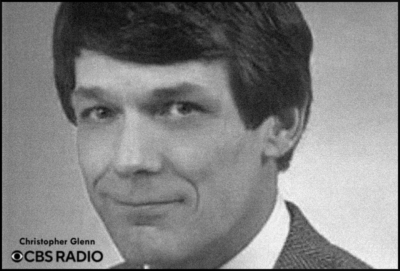
CBS News was born in radio. It was the medium that carried Edward R. Murrow’s voice across the Atlantic as bombs fell on London. It was the medium that introduced America to Robert Trout, the first true news anchor. It was the medium that gave us Douglas Edwards, Dallas Townsend, Christopher Glenn—voices that became part of our daily lives.
The World News Roundup, launched in 1938, survived world wars, recessions, assassinations, and revolutions in technology. It was the longest‑running news broadcast in the world. It was a living thread connecting generations.
And now, that thread is being cut.
A Slow Unraveling, Not a Sudden Fall
The end of CBS News Radio did not arrive overnight. It followed a long, painful erosion of the CBS News division itself. In 2025, after the Skydance acquisition, the first tremors began:
The unraveling began in August 2025, when Skydance Media’s Ellison family completed its acquisition of Paramount Global. The deal was pitched as a bold, future‑focused realignment—leaner, more agile, more digital. But inside CBS News, the message was unmistakable: cuts were coming.
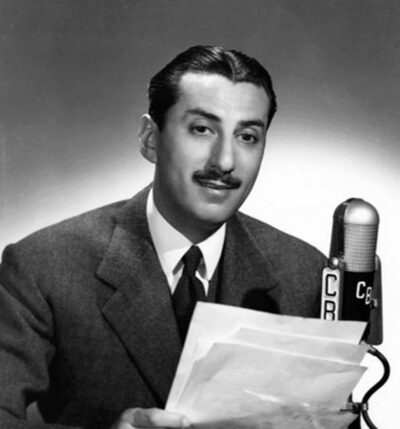
CBS Robert Trout.
By October 2025, the first wave hit. Approximately 100 jobs were eliminated across the news division. These were not peripheral roles. They included anchors, correspondents, producers, and entire teams whose work had defined CBS’s coverage for years. The Saturday edition of CBS Mornings—a steady performer with loyal viewers—was gutted and folded into weekday operations. Anchors Dana Jacobson and Michelle Miller, along with executive producer Brian Applegate, were shown the door.
The Johannesburg bureau, a vital outpost for African and Middle Eastern coverage, was shut down entirely. Foreign correspondent Deb Patta, known for her fearless reporting, departed with it. Oversight of the entire region was transferred to London—a symbolic retreat from the global footprint CBS once championed.
The cuts will be massive. ” . . . . The radio block will be taken off the air on May 22, and its 700 affiliated stations have two months to devise a replacement.” This according to News Cast Studio’s website, from October 29, 2025. These will not be routine adjustments. They will be structural amputations.
• 100 jobs eliminated
• The Johannesburg bureau closed
• Streaming shows canceled
• Veteran correspondents and anchors dismissed
• Specialized reporting units scaled back
By early 2026, the newsroom was a shadow of its former self. The digital pivot faltered. Ratings declined. The merger with CNN loomed. And radio—no longer a major revenue generator—became expendable.
But what is expendable to a corporation is often irreplaceable to a culture.
The Digital Bet That Faltered and the Global Footprint That Shrunk
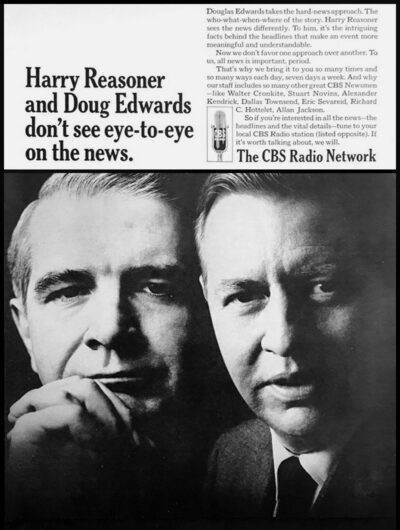
CBS Radio Network, ad, circa 1966.
CBS News’ decline accelerated when its ambitious digital strategy failed to take hold. CBS Mornings Plus and CBS Evening News Plus were launched as streaming‑only extensions of the network’s flagship broadcasts, designed to capture younger audiences and secure CBS’s future in a rapidly shifting media landscape. But the audience never materialized. The collapse of the “Plus” experiment was more than a programming setback — it exposed a deeper strategic vulnerability. CBS was stretching an already strained newsroom across platforms that weren’t generating sustainable revenue, even as linear ratings continued to erode.
At the same time, CBS was retreating from the global presence that once defined its journalistic identity. With fewer correspondents and fewer resources, the remaining international desks were forced to cover vast regions with diminished capacity. What had been a proud hallmark of CBS News — its commitment to covering the world with depth and seriousness — was quietly contracting. Together, the failed digital pivot and the shrinking global footprint signaled a network losing both its strategic direction and its journalistic reach.
Five Reasons: Why This Loss Leaves an Insurmountable Void
1. Because radio is still the nation’s most democratic medium.
 It reaches rural towns, urban neighborhoods, highways, kitchens, and workplaces. It requires no subscription, no broadband, no algorithm. It is the medium that shows up when the power goes out and the world feels uncertain.
CBS was one of the last great national voices in that space.
2. Because the CBS World News Roundup was a living piece of American history.
It was not just a program. It was a ritual. A constant. A reminder that journalism could be steady, serious, and human.
Its silence will echo.
3. Because CBS News Radio represented trust.
In an era of misinformation and fractured media, CBS was a beacon. Its correspondents were trained in verification, restraint, and clarity. They were not influencers. They were journalists.
When that kind of voice disappears, the public loses more than information.
It loses orientation.
4. Because newsroom culture cannot be rebuilt once dismantled.

CBS Douglas Edwards.
A newsroom is a living organism—its values passed down from mentor to mentee, from editor to reporter, from generation to generation. CBS’s radio newsroom carried the DNA of Murrow, Cronkite, and the pioneers who defined American broadcasting.
Once that lineage is broken, it cannot simply be reassembled under a new corporate structure.
5. Because the loss is personal.
For millions of listeners, CBS News Radio was a companion during commutes, storms, sleepless nights, and national crises. It was the voice that told us what had happened, what mattered, and what came next.
You cannot replace a companion with an app.
A Farewell Written in Static
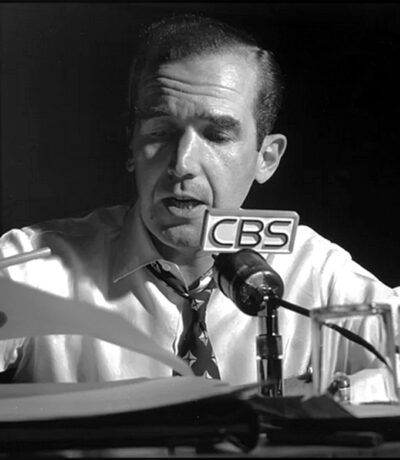
CBS Edward Murrow.
When the final CBS Radio newscast fades on May 22, the silence that follows will not be empty. It will be full—full of memory, full of history, full of the voices that shaped our understanding of the world.
It will be the silence of Murrow’s microphone going dark.
The silence of a newsroom closing its doors.
The silence of a century ending.
And it will be a silence that leaves a void no digital platform can fill.
The Museum’s Goal
As CBS steps away from the medium that made it great, the USA Radio Museum steps forward. Whenever possible, we will continue in preserving the broadcasts, the voices, the reporting, and the legacy of CBS News Radio. We will ensure that future generations understand what CBS News once represented—and what was lost when its radio division fell silent.
And that day is coming fast. Friday, May 22, 2026.
Because when a century’s voice disappears, history depends on those who remember.
And at the USA Radio Museum—we will remember.
______________________________
Sources & Credits:
This editorial draws upon verified reporting from reputable news organizations documenting the restructuring and downsizing of CBS News in 2025–2026. Key factual details were informed by:
• Los Angeles Times reporting by Stephen Battaglio (March 20, 2026), covering CBS News Radio’s shutdown announcement, staff layoffs, the impact on the World News Roundup, and the broader corporate context surrounding Paramount’s proposed merger with Warner Bros. Discovery.
• NewscastStudio (NCS) reporting from October 29, 2025, detailing CBS News’ cancellation of CBS Mornings Plus and CBS Evening News Plus, the closure of the Johannesburg bureau, and the earlier wave of layoffs following the Skydance Media acquisition.
• Publicly available statements from CBS News leadership regarding the digital pivot, newsroom restructuring, and the economic pressures facing the division.
• Historical context from CBS News archives and widely documented accounts of the World News Roundup, Edward R. Murrow’s wartime reporting, and the legacy of CBS Radio journalism.
These sources collectively inform the Museum’s analysis of CBS News Radio’s closure and its significance within the broader history of American broadcasting.
______________________________
Contact: jimf.usaradiomuseum@gmail.com
______________________________
A USARM Viewing Tip: On your PC? Mouse/double-click over the images for expanded views. On your mobile or tablet device? Finger-tap all the above images inside the post and stretch image across your device’s screen for LARGEST digitized view. Then click your browser’s back arrow to return to the featured post.
© 2026 USA Radio Museum. All rights reserved.

Blame Trump and the MAGAs for unleashing the silence Jim, they are trying to “Cleansing” all of entertainment, media, theater of the mind, imagination, and everything else, apparently Trump doesn’t give a doggone about real entertainment or real media anymore.