
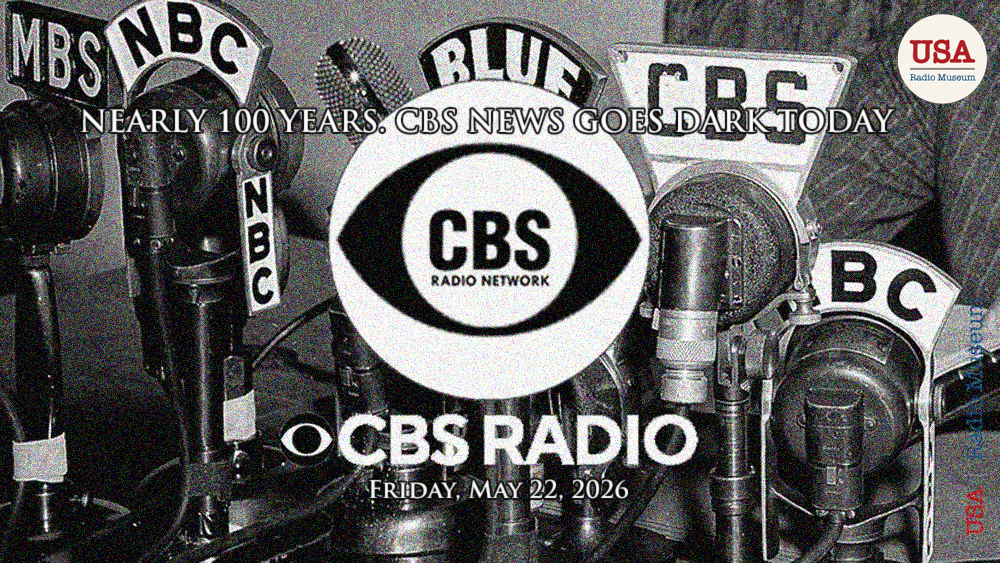
Today CBS News Will Go Dark on the CBS Radio Network A USA Radio Museum Editorial _____________________ There are endings that arri
Today CBS News Will Go Dark on the CBS Radio Network
A USA Radio Museum Editorial
_____________________
 There are endings that arrive with ceremony, and endings that arrive with shock. And then there are endings that feel like a tear in the cultural fabric — a rupture so profound that the silence left behind becomes its own kind of sound. Tonight, Friday, May 22, 2026, at the top of the 11:00 p.m. hour, CBS News Radio will broadcast for the final time. A century‑long voice, a national companion, a defining presence in American journalism will fall silent. The moment will not simply mark the end of a program or a division. It will mark the end of an era that shaped how a nation learned to listen, to understand, and to trust.
CBS News Radio was not merely being discontinued. It was dying. And with its death, a chapter of American broadcasting closes forever.
For nearly one hundred years, CBS News Radio has been the steady pulse beneath the nation’s daily life. It was the voice that carried Edward R. Murrow’s dispatches from a war‑torn London, the voice that introduced Robert Trout’s pioneering anchoring, the voice that brought Douglas Edwards, Dallas Townsend, Christopher Glenn, and so many others into American homes, cars, kitchens, and workplaces. It was the voice that narrated triumphs and tragedies, that steadied the country in moments of crisis, and that offered clarity when the world felt uncertain. It was the voice that taught generations what journalism could be.
The World News Roundup, launched in 1938, was the longest‑running news broadcast in the world. It survived world wars, recessions, assassinations, and revolutions in technology. It survived the rise of television, the birth of cable, the explosion of the internet, and the fragmentation of the digital age. It survived everything except the corporate calculus of 2026. Tonight, that living thread — one of the last unbroken lines connecting modern America to the golden age of broadcasting — will be cut.
The end of CBS News Radio did not arrive suddenly. It came as a slow, painful unraveling that began in August 2025, when Skydance Media’s Ellison family completed its acquisition of Paramount Global. The deal was framed as a bold realignment for a digital future, but inside CBS News the message was unmistakable: cuts were coming. By October, the first wave struck. Approximately one hundred jobs were eliminated across the news division, and these were not peripheral roles. They included anchors, correspondents, producers, and entire teams whose work had defined CBS’s coverage for years. The Saturday edition of CBS Mornings was dismantled. Anchors Dana Jacobson and Michelle Miller, along with executive producer Brian Applegate, were dismissed. The Johannesburg bureau — a vital outpost for African and Middle Eastern coverage — was shut down entirely, and foreign correspondent Deb Patta departed with it. Oversight of the entire region was transferred to London, a symbolic retreat from the global footprint CBS once championed.
The newsroom that remained was thinner, stretched, and increasingly uncertain. CBS’s ambitious digital strategy faltered. Streaming‑only extensions such as CBS Mornings Plus and CBS Evening News Plus failed to attract sustainable audiences. The “Plus” experiment, once heralded as the network’s future, collapsed under the weight of its own expectations. The newsroom was being asked to do more with less, to serve more platforms with fewer people, and to maintain the standards of a legacy institution while navigating the economics of a fractured media landscape. It was an impossible equation.
By early 2026, the decline had accelerated. Ratings slipped. Resources dwindled. The merger with CNN loomed. And radio — no longer a major revenue generator — became expendable. The decision was made quietly, almost clinically: the CBS radio block would be taken off the air on May 22, 2026, and its 700 affiliated stations would have two months to devise a replacement. What was expendable to a corporation was, in truth, irreplaceable to a culture.
The loss of CBS News Radio matters for reasons that extend far beyond nostalgia. Radio remains the most democratic medium in the United States. It reaches rural towns, urban neighborhoods, highways, farms, and factory floors. It requires no subscription, no broadband, no algorithm. It is the medium that shows up when the power goes out, when the internet fails, when the world feels uncertain. CBS was one of the last great national voices in that space — a voice that spoke to all of America, not just the segments that could be monetized.
The World News Roundup was more than a program. It was a ritual. A constant. A reminder that journalism could be steady, serious, and human. Its silence will echo in ways we cannot yet measure. CBS News Radio represented trust at a time when trust in media has become fragile. Its correspondents were trained in verification, restraint, and clarity. They were not influencers. They were journalists. When that kind of voice disappears, the public loses more than information. It loses orientation.
A newsroom is not a collection of desks and equipment. It is a living organism, its values passed down from mentor to mentee, from editor to reporter, from generation to generation. CBS’s radio newsroom carried the DNA of Murrow, Cronkite, Trout, Edwards, and the pioneers who defined American broadcasting. Once that lineage is broken, it cannot simply be reassembled under a new corporate structure. A culture that took decades to build can be dismantled in a matter of months, and once dismantled, it is gone.
And the loss is personal. For millions of listeners, CBS News Radio was a companion — the voice that accompanied morning commutes, late‑night drives, sleepless hours, and moments of national crisis. It was the voice that told us what had happened, what mattered, and what came next. You cannot replace a companion with an app.
Tonight, when the final CBS Radio newscast fades, the silence that follows will not be empty. It will be full — full of memory, full of history, full of the voices that shaped our understanding of the world. It will be the silence of Murrow’s microphone going dark. The silence of a newsroom closing its doors. The silence of a century ending. And it will be a silence that leaves a void no digital platform can fill.
As CBS steps away from the medium that made it great, the USA Radio Museum steps forward. We will strive to preserve the broadcasts, the voices, the reporting, and the legacy of CBS News Radio. We will ensure that future generations understand what CBS News once represented — and what was lost when its radio division fell silent. Because when a century’s voice disappears, history depends on those who remember.
Tonight, CBS News on the CBS Radio Network dies — consigned to history. Tomorrow, the reflections begin: the recalling, the remembering, the honoring of nearly 100 years of broadcasting and the legacy it leaves behind.
_____________________
A CLOSING STATEMENT — 11:00 P.M. E.S.T., MAY 22, 2026
At this hour, a century will close.
 Tonight, and presuming it will be at the top of the 11:00 p.m. hour, Eastern time, CBS News Radio — the voice that carried America through war, peace, triumph, tragedy, and change — will go silent. After its final broadcast, for the first time since 1938, there will be no CBS newscast on the airwaves. No World News Roundup. No correspondent standing by. No familiar cadence of a network that once defined the very idea of broadcast journalism.
A microphone that spoke for nearly one hundred years has gone dark.
This silence is not an absence. It will be an echo chamber — of Murrow’s dispatches from London, of Robert Trout’s pioneering anchoring, of Douglas Edwards’ steady authority, of Dallas Townsend’s clarity, of Christopher Glenn’s warmth. It is the echo of a newsroom that believed journalism was a public trust, not a product line.
Tonight, the United States has lost more than a broadcast. It has lost a companion.
For generations, CBS News Radio was the voice that traveled with us on highways, sat with us in kitchens, steadied us during storms, and guided us through moments when the world felt uncertain. Its departure leaves a void that no algorithm, no app, no digital pivot can fill.
The USA Radio Museum stands tonight in witness and in gratitude. We honor the journalists, engineers, editors, anchors, correspondents, and affiliates who carried this legacy forward. And we commit ourselves to preserving the broadcasts, the voices, and the history that CBS News Radio leaves behind.
The news has died on CBS Radio. But its memory — and its meaning — will not.
_____________________
_____________________
Contact: jimf.usaradiomuseum@gmail.com
_____________________
© 2026 USA Radio Museum. All Rights Reserved.

I Blame the Trumpian Communion Crusade for trying to “Cleanse” and “Purifying” every real true good but organic media and replacing with “MAGA, MAGA, MAGA, MAGA, MAGA, Trump is your only God” slop, Trump and the MAGA’s must end forever.
I worked at CBS Radio for 40 years. That was a well written and accurate editorial. CBS Radio knitted the nation together and was as important to the 20th Century as the transcontinental railroad was to the 19th. Good night and good luck, indeed.