
A genuinely great broadcaster left us ELEVEN YEARS AGO THIS WEEK (2-12-2015). As remarkably gifted as Gary Owens was, he excelled at something far gr
A genuinely great broadcaster left us ELEVEN YEARS AGO THIS WEEK (2-12-2015).
As remarkably gifted as Gary Owens was, he excelled at something far greater: He was a tremendous friend. The man was as welcoming and endearing as it gets. This big time “star” would call me periodically at home just to say hello and occasionally try out new material. Years ago, he sent me an out-of-the-blue card that simply read he was happy we were friends. Gary, however, had it all wrong – it was the other way around! He made everyone else feel special and that is a rare gift.
During my longtime tenure as Adult Contemporary & Hot AC Editor of Radio & Records (R&R), I had the genuinely distinct honor of hosting a June 1999 “Superstar” panel at our annual convention at the Century Plaza Hotel. It included a truly “Who’s Who” lineup of major on-air personalities from across the country. Naturally, Gary was on my wish-list. Not only did he instantly agree, he asked if he could bring a surprise guest – outrageously inventive Jonathan Winters. I’d be a fool to have said no.
On his way to pick up Jonathan though, Gary became quite ill and was taken into emergency surgery to repair a very close to rupturing hiatal hernia. Obviously, I didn’t know anything about this until his wife, Arleta, called me at home later that night.
Elegantly gracious wordsmith Gary Owens and I chatted countless times over the years, including for this wide-ranging “Mike Kinosian Interview,” which appears in its entirety below. In addition to some VERY dated references, there are ACTIVE, rather than passive voices; and some call letters/formats have changed.
Possessing The Ultimate Get Up & “GO”
If one were to construct the definitive on-air personality, Gary Owens would be the blueprint to follow, but it wouldn’t entirely be because of his peerless voice quality, inflection or matchless variety.
It also wouldn’t be completely based on an enduring ability to captivate a broad base demographic with droll, clever and sometimes-corny witticisms and puns that will much sooner – rather than later – make you bust out into laughter.
Character would be one of the foremost reasons.
Not character voices that have helped to shape, frame, and define this often-honored broadcaster. It’s the class and dignity with which he carries himself that makes anyone ever having the privilege to have worked behind a microphone exude intense pride in saying they were in the same profession. Most of all, it’s within this true gentleman’s character of making everyone he comes in contact with feel like a special and dear friend.
Replicating the manner in which the 1994 Radio Hall of Fame inductee achieves that would be priceless.
Pressed Into Duty
Radio has always been fun for this integral part of the “Music Of Your Life” lineup the past 25 years. If that ever stops,” he remarks, “I’ll probably just quit doing it.”
The 68-year-old Mitchell, South Dakota native has derived limitless pleasure from the industry, dating back more than 50 years to his roots as a newscaster and host of “Soundtrack Of The Sixties”; “Superfun” and “Gary Owens’ Weekend Spectacular.”
When Owens was KOIL/Omaha’s News Director, the station’s wakeup personality quit in the middle of his show. “He just left,” Owens recalls. “I took over being the on-air talent, but didn’t even know how to run a turntable. In those days, we had six turntables and two recorders. It was just a whole medley of goofy sounds, but I stuck it out. Within a month, I became number one in Hooper (ratings).”
You’re Great – Now Leave
The first personality in that market to beat KOWH’s Todd Storrs in morning drive, Owens comments, “[Storrs] and Gordon McLendon created rock and roll in terms of radio.”
It was a magic time with Storrs actually facilitating Owens’ departure from Nebraska’s largest market. “He sent a tape of me to KIMN/Denver and they hired me,” notes Owens, who today listens to divergent formats, including Adult Contemporary, Top 40, News, Classical and Adult Standards. “I was offered a job to work at McLendon’s KLIF/Dallas; KILT/Houston; KTSA/San Antonio; and WNOE/New Orleans. I went there because it was the hot chain in America. They really knew how to do things. It’s the first [radio group] I worked for and where I learned you should prepare one hour off-air for every hour on.”
Considerable production elements and wild tracks punctuated Owens’ air-shifts, making for interesting shows. “It was totally unexpected to the audience,” he remarks. “All you have to do in radio is add a few sound effects and music and you have a bit. Even then, I was hired as sort of a troubleshooter. I started at KLIF, went to KILT, then to KTSA and WNOE.”
Each market had its own unique flavor, but Owens notes New Orleans was entirely different from any other city. “People there wouldn’t get up very early, unless they had a job that forced them to. They like to party all night.”
Minor Matter Of Money
The Gateway City was the next market to beckon and Owens soon became dominant in morning drive at WIL/St. Louis. “Great talents like Jack Carney, Bob Osborne, Ed Bonner, Reed Farrell and Dick Clayton were there,” he recounts. “Considering we were at 1430 with 5,000 watts, it was really something we were number one.”
Longtime friend Chuck Blore worked with the McLendon stations and started KFWB/Los Angeles, which is where Owens wanted to land. “They had tremendous ratings, a tremendous jingle package and tremendous on-air personalities,” Owens asserts. “[Blore] called one day after my morning show and said they wanted me to be the [morning drive talent] at their new San Francisco station [KEWB]. I really wanted to come to Los Angeles, but San Francisco was magnificent.”
There was a serious snag though when Owens discovered the salary in San Francisco would be about $20,000 a year less than what he was pulling down in St. Louis. “In the late-1950s, St. Louis was second to New York in terms of salary to radio personalities,” he explains. “Seven [St. Louis announcers] were making over $70,000 a year in 1958 – 1959. I wanted to [go to San Francisco], but couldn’t work for that money.”
Nature Takes Its Course
Asked to give the offer further consideration, Owens was about to turn it down, but as he playfully recollects, “With the surprisingly [coincidence] that happens in this business, a tornado leveled a building about a block from my apartment.”
A speedy phone call was placed to Blore the next day to see if some sort of bonus could be added to the base salary. “KSFO/San Francisco’s Don Sherwood had never been beaten,” Owens points out. “The only way to [overtake] a great middle-of-the-road personality like that was to bring in rock and roll. Chuck agreed to pay me a bonus when I beat Sherwood. He had 30-share ratings, but I beat him in about three months and got my bonus. I was young and goofy and took many risks then.”
Read by hundreds of thousands of people, San Francisco Chronicle columnist Herb Caen played a major role in Owens’ Bay Area career. “He printed my jokes about twice a week,” Owens notes. “That helped make me a personality in [the Bay Area].”
Exposure and notoriety would serve as a great impetus to help Owens reach his ultimate destination. “I always wanted to be in Hollywood so I could do movies, commercials and television,” acknowledges Owens, who estimates he’s done well over 30,000 commercials and promos since arriving in tinsel town. “I went to KFWB in 1961 to do mornings. We had 50-shares and five million cume every day.”
Golden Opportunity
In late-1962, he received the definitive offer from Gene Autry’s “Station Of The Stars” – Golden West-owned KMPC/Los Angeles. “It was the dream station for Middle Of the Road,” emphasizes Owens, who would remain at “710 – KMPC” until 1981. “All their personalities did movies and guest shots on TV shows; every producer and writer listened to KMPC.”
Although #1 in the City Of The Angels at KFWB, Owens didn’t feel the then-contemporary station was compatible for other things he wanted to do. “When KMPC offered me the job, it was quite another risk-taking thing,” admits Owens, who has done approximately 25 comedy albums. His latest – “Jonathan & Gary: Live At The Improv” – with Jonathan Winters will be released next month. “KFWB was #1 [in ratings], but KMPC was the number one billing station and always top five [in ratings]. I took the chance and it paid off very well.”
Regulars on Owens’ KMPC show included “Johnny Lizard” (Ken Levine, who went on to write, produce and/or direct virtually every great television sitcom) and a budding curly-haired comedian who’d change his name from Albert Einstein to … Albert Brooks. “They were goofy and silly,” Owens recalls with great fondness. “From the moment I met them, I knew they’d go a long way.”
Bathroom Humor
While at KFWB, Owens also did four yearly specials for Los Angeles’ KCOP-TV (Channel 13).
That experience would pay off quite handsomely in an epic association with George Schlatter, who in late-1963/early-1964 was producing CBS’ “Judy Garland Show.” Owens remarks, “I’d never met George, although we’d talked several times on the phone. He’d listen to my radio program and send notes whenever I’d do something silly. He called one day and said he had a TV show that would be like my radio show. People would crash through windows and do bad jokes.”
It was obvious Schlatter wanted to hire Owens, but wasn’t exactly sure what role would best utilize the radio star’s unique talents. “We were talking about [being in sketches] as a person of authority like a bank president or a psychiatrist,” Owens explains.
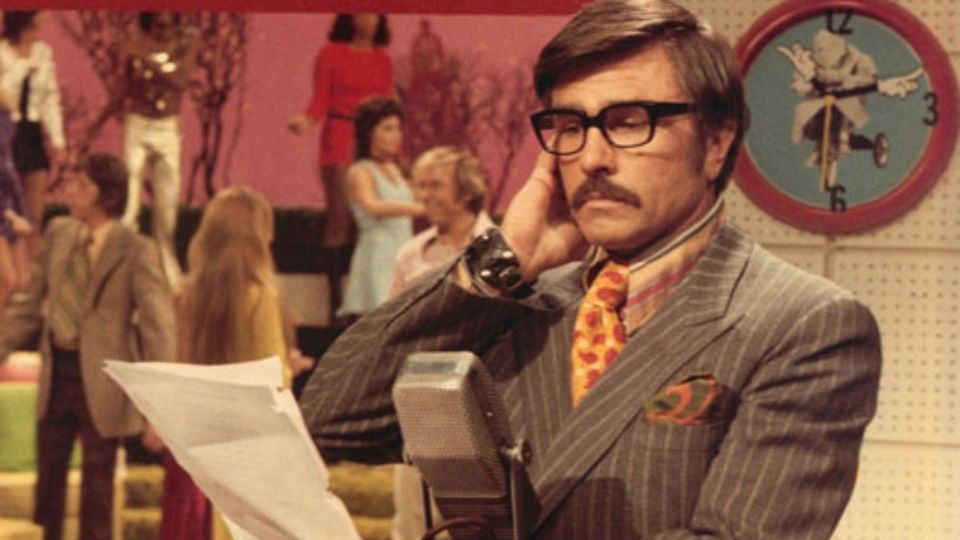
The two scheduled a lunch at Burbank’s famed Smokehouse Restaurant (frequently referenced on HBO’s “The Larry Sanders Show”) and as Owens perfectly recaptures the mood and moment states, “We went to the bathroom to wash up and I put my hand behind my ear and said, ‘My, the acoustics are good in here.’ George said that’s what he wanted me to do on the show – be like announcers of the 1940s and 1950s, who put their hands behind their ears at dance band remotes. They didn’t want to wear earphones on stage, because they thought it looked clumsy or would rip off their toupee.”
Endless catchphrases, including “Sock it to me,” “You bet your bippy,” “Here come da judge” and “The Flying Fickle Finger Of Fate” were introduced on the quirky new television show which – of course – became known as “Rowan & Martin’s Laugh-In.”
Ever since the Monday night show debuted on NBC in January 1968 and made its last first-run telecast in May 1973, Owens’ trademark ear-cupped “From beautiful downtown Burbank, it’s Rowan & Martin’s Laugh-In,” launched every 60-minute episode.
Approximately 40 people appeared as regulars in the show’s five-year run, but Dan Rowan & Dick Martin, Ruth Buzzi and Owens were the only ones to appear on every show. His part and that often-imitated delivery were created as a direct result of his bathroom ad-lib. In addition to having a star on the Hollywood Walk Of Fame, Owens’ ear-print is preserved in cement at NBC Studios/Burbank.
Cult Classic
Practically everyone outside Southern California was unaware that Owens maintained weekday radio responsibilities at KMPC while doing “Laugh-In.”
That show’s enormity sometimes overshadows the reality that Owens has been involved with more than a dozen other television series and made in excess of 1,000 television appearances.
You could probably win a bet with the often-forgotten factoid that Owens preceded Chuck Barris (1976-1977) as host of Barris’ “Gong Show.”
Staying Busy
Elizabeth Montgomery’s 1964 – 1972 ABC sitcom “Bewitched” was the first series Owens ever did as an announcer. “Dick Tufeld [‘Dick Tufeld Speaking’] and I alternated,” he explains. “I was on for Quaker Oats – he was on for Kodak. I also did The ‘Wonderful World Of Disney’ for seven years and was a 1966 regular on ‘The Green Hornet.’”
Simultaneous with doing “Laugh-In” and being a KMPC personality, Owens fronted “Letters To Laugh In,” a daily NBC comedy show. “They may bring back those old shows through syndication,” he reveals. “Stars like Angie Dickinson and Eartha Kittwould read and re-enact jokes that viewers sent us.”
From there, he transitioned to become a regular on CBS’ 1974 summer replacement series “The Hudson Brothers Show” (Bill Hudson was formerly married to “Laugh-In” regular Goldie Hawn) and was also the announcer on “America’s Funniest Videos” and “The Rosie O’Donnell Show,” until the latter relocated to New York. “I do four or five things a day – every day,” Owens divulges. “That’s what makes it so worthwhile.”
Trivial Significance
Although most of his Music Of Your Life show is adlibbed, Owens still devotes considerable preparation to it. “I’ve worked with practically every star I play and know many [tidbits] about all of them,” he notes in his wonderfully warm and friendly tone. “I can tell some inside things about them that many others can’t. They were good chums for many years. I get a lot of email and people request certain songs. I’ve been a fan of trivia – but ‘significa’ might be a better word – because it has significance to some people.”
Provoking Controversy
Some “old school” talents take a dim view of today’s on-air envelope pushing, but this quintessential personality is much more tolerant. “It certainly is personality radio,” comments Owens, who has appeared in approximately 20 movies. “Howard [Stern] did something that really wasn’t being done. When I was at KIMN in 1957, Royce Johnson did a toilet flush on the air, but a competitor sent a tape of [that bit] to the FCC and [Johnson] was fired because of it. KIMN nearly lost its license and Royce had difficulty getting another job. It might not be in good taste, but it’s not vulgar. When Howard first came to Los Angeles, I predicted he’d make it big and he has.”
Longtime Stern agent, Don Buchwald, performed the same role years ago in New York for Owens. “He got me some good spots and has handled Howard’s career very well. It doesn’t matter what kind of format it is, you have to have someone in your corner to expand your audience. I first met Howard when he was at WNBC/New York. He likes to provoke controversy. When he changed his act, he changed his income. It’s like Joe Pyne, who’d carry a gun on his television show and [demonstrate] how he was going to take care of the bad people. I’m not saying what Howard does is good or bad. I just know I’m not capable of doing it.”
Loved By His Peers
In a yearlong poll conducted on Don Barrett’s enormously popular laradio.com, the tireless Barrett asked his many subscribers to name Los Angeles’ all-time best personality, irrespective of format.
Published results indicated Owens had captured the #1 position. “It was a very nice honor,” he says humbly. “It’s not a fan-based thing, but from people in broadcasting. There were great personalities in this city and I’ve been fortunate to know most of them. Robert W. [Morgan] and I were very close friends and [The Real] Don Steeleand I worked together in Omaha. [Longtime KABC-AM/Los Angeles Talk personality] Michael Jackson, Casey Kasem and I were together at KEWB. There may be five-or ten-year [intervals], but you still go back to the same roots.”
Wonderful Ride Continues
Fantasy and imagery in whatever Owens does stems from the fact that he’s been a cartoonist since age 12.
The voice for “Space Ghost,” “Roger Ramjet,” and Ren & Stimpy’s “Powdered Toast Man” is also an accomplished writer.
In September, McGraw-Hill is slated to publish his “How To Make A Million Dollars With Your Voice Or Lose Your Tonsils Trying,” detailing ways to delve into cartoons, radio, television, commercials, films and public speaking. “It’s a handbook, but it’s also silly,” Owens chuckles. “There must be at least 500 anecdotes in there.”
Warmheartedly noting his career in the medium has been “a wonderful ride,” Owens insists, “I still enjoy radio as much as I ever have.”
FEBRUARY 2026 POSTSCRIPT: When Gary Owens died February 12, 2015 from complications due to Type 1 diabetes, he was … 80 years old.
###
