
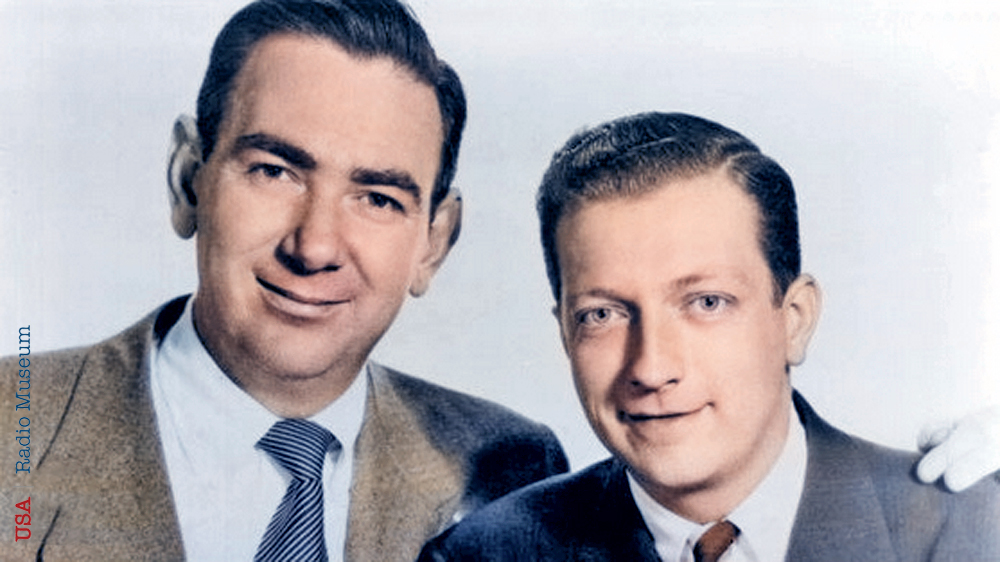
The Bob and Ray Show: NBC’s Masters of Deadpan Satire Introduction: In the golden age of American radio, when voices carried imagination into livin
The Bob and Ray Show: NBC’s Masters of Deadpan Satire
Introduction: In the golden age of American radio, when voices carried imagination into living rooms across the nation, few performers captured the spirit of wit and invention quite like Bob Elliott and Ray Goulding. Together, as Bob and Ray, they transformed the everyday rhythms of broadcasting into a playground of satire, where the absurd was treated with solemnity and the ordinary became extraordinary. Their partnership, born in Boston and perfected on NBC, was more than a comedy act — it was a cultural lens, reflecting the quirks of radio itself with a sly smile and impeccable timing. For the USA Radio Museum, their story is not simply one of laughter, but of legacy: a reminder that radio’s greatest gift has always been its ability to connect, to entertain, and to surprise. — USA RADIO MUSEUM
_____________________
Origins in Boston: WHDH and the Spark of Collaboration
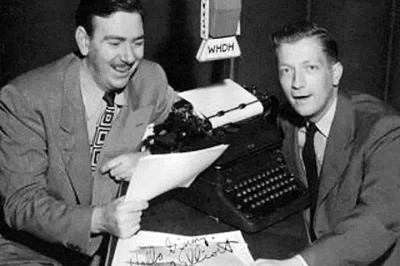
Bob and Ray on WHDH, late 1940s, Boston.
The origins of Bob and Ray’s collaboration can be traced to Boston in the mid‑1940s. Bob Elliott, born in 1923, was working as a disc jockey at WHDH Radio, while Ray Goulding, born in 1922, was employed as a newscaster at the same station. Their paths crossed almost by accident, when rainouts of Boston Red Sox games required improvised programming. Elliott and Goulding were paired together to fill the airtime, and what began as spontaneous banter quickly revealed itself to be something extraordinary. Their chemistry was immediate, their timing impeccable, and their ability to riff on the absurdities of everyday broadcasting irresistible. Soon, WHDH gave them their own program, Matinee with Bob and Ray, where they honed the improvisational style that would become their trademark.
_____________________
WHDH | Bob and Ray Show | December 7, 1949
Audio Digitally Enhanced by USA Radio Museum
_____________________
From Matinee to National Spotlight: The Move to NBC
By 1951, the duo had moved to New York and launched The Bob and Ray Show on NBC Radio. It was here that their talents reached a national audience, and the format they perfected became legendary. Rather than rely on traditional joke setups or punchlines, Bob and Ray specialized in parodying the very medium they inhabited. They lampooned news reports, soap operas, commercials, and interviews, creating a universe of eccentric characters whose lives unfolded in absurd yet strangely familiar ways. Their humor was subtle, often requiring listeners to lean in and catch the sly twist or understated absurdity.
The Art of Deadpan: Crafting a Comic Style
Among their most beloved creations were Mary McGoon, the domestic advisor whose expertise was dubious at best; Wally Ballou, the hapless reporter whose nasal voice and bungled interviews became a running gag; and Barry Campbell, the incompetent showman whose failures were delivered with straight‑faced seriousness. These characters were not merely comic inventions but reflections of the quirks and pretensions of broadcasting itself. Bob and Ray reveled in exposing the artifice of radio, turning its conventions into playgrounds for satire. Their sketches often unfolded slowly, with pauses and hesitations that heightened the absurdity. In an era when most radio comedy relied on rapid‑fire jokes, Bob and Ray’s willingness to let silence linger became part of their genius.
Archival Legacy: 392 Shows Preserved
The USA Radio Museum’s archive preserves an extraordinary record of their work. Within its holdings are 392 original radio broadcasts of The Bob and Ray Show, a treasure trove that captures the duo at the height of their powers. These recordings reveal the breadth of their creativity, from improvised sketches to carefully constructed parodies, and they serve as a living testament to the enduring appeal of their humor. Listening to these shows today, one hears not only the laughter of a bygone era but also the timeless rhythm of satire that still feels fresh.
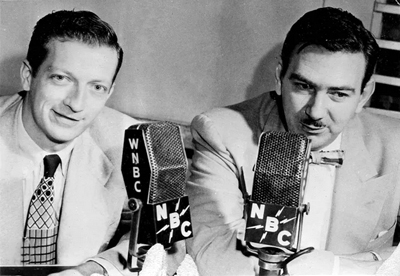
Bob and Ray on the NBC Radio Network.
Bob & Ray Present: CBS Radio Network, 1959–1960
In addition, the Museum holds 116 episodes of Bob & Ray Present the CBS Radio Network, a series that aired from 1959 through 1960. This program represented a later phase of their career, when their satire had become even more refined, and their ability to lampoon the structures of broadcasting reached new heights. The CBS series was notable for its sharper edge, often parodying the very idea of a network itself. It was here that Bob and Ray perfected their ability to dismantle the machinery of broadcasting, exposing its absurdities with wit and precision.
The Art of Deadpan: A Distinctive Comic Tension
What made Bob and Ray so distinctive was their commitment to deadpan delivery. Unlike other comedians who relied on exaggerated voices or overt punchlines, Elliott and Goulding spoke with the seriousness of newsmen, even as they described the most ridiculous scenarios. This contrast between tone and content created a kind of comic tension that was uniquely theirs. Listeners were invited into a world where absurdity was treated as ordinary, and the result was both hilarious and strangely profound. Their humor was not about mocking individuals but about revealing the inherent silliness of institutions, formats, and conventions.
Mutual Broadcasting: Satire Across the Network
By the mid‑1950s, Bob and Ray’s voices were not confined to NBC alone. In 1957, they brought The Bob and Ray Show to the Mutual Broadcasting System, airing weekdays in the late afternoon. These programs carried the same hallmarks of their comedy — improvised sketches, parodies of news formats, and interviews that unraveled into absurdity — but they also demonstrated the duo’s ability to adapt their satire across different networks.
_____________________
Mutual Broadcasting System | Bob and Ray Show | November 30, 1956
Audio Digitally Enhanced by USA Radio Museum
_____________________
Their Mutual broadcasts were widely praised, earning them recognition from the Peabody Awards in 1956, which cited their work as “fresh, original, imaginative, and terribly funny.” At a time when television was beginning to eclipse radio as America’s dominant medium, Bob and Ray kept radio comedy alive with their understated brilliance. Mutual gave them another national platform to showcase their wit, further cementing their reputation as masters of parody and expanding their reach to audiences who might not have tuned in to NBC or CBS.
Influence Across Generations: From Bob Newhart to NPR
Their influence can be traced through countless successors. Bob Newhart’s telephone routines, with their understated absurdity, owe much to Bob and Ray’s style. The Firesign Theatre, with its surreal radio plays, carried forward their spirit of parody. David Letterman, whose own brand of ironic detachment defined late‑night television, often cited Bob and Ray as inspirations. Even modern satirists such as Keith Olbermann have acknowledged their debt, with Olbermann adapting their “Worst Person in the World” concept for his own commentary. Bob Elliott’s later career extended the legacy further, as he appeared alongside his son Chris Elliott in sketches and television appearances, bridging generations of comedy.
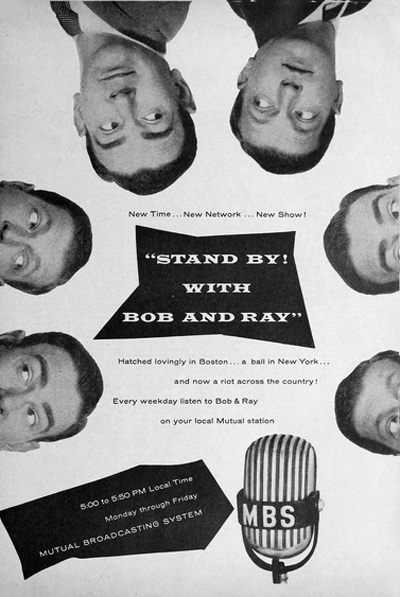
Bob and Ray featured on a Mutual Broadcasting System ad, 1958.
Beyond NBC: CBS, Mutual, and NPR
Beyond NBC, Bob and Ray’s voices graced multiple networks, including CBS, the Mutual Broadcasting System, and later National Public Radio. Their final series, a weekly NPR program that ran from 1982 to 1987, demonstrated that their wit remained timeless. Even in an era when radio was no longer the dominant medium, their humor continued to resonate, proving that the absurdities of broadcasting were universal and eternal. Their NPR work introduced them to new audiences, many of whom had never experienced their earlier broadcasts, ensuring that their influence extended well into the modern age.
National Public Radio: The Final Stage
In the 1980s, Bob and Ray found a new home on National Public Radio, launching a weekly series that ran from 1982 to 1987. These programs carried forward their trademark style — understated delivery, absurd interviews, and parodies of broadcasting itself — but now introduced their wit to audiences who may never have heard their earlier NBC, Mutual, or CBS work.
Characters like Wally Ballou and Mary McGoon reappeared, joined by fresh sketches that lampooned contemporary culture and media. The NPR series proved that their humor was truly timeless: even as radio’s dominance waned in the television age, Bob and Ray’s voices still resonated with intimacy and imagination.
Their final NPR broadcasts, including the last show in January 1987, marked the closing chapter of a career that had spanned four decades. For the USA Radio Museum, these recordings are more than entertainment — they are living documents of how two Boston‑born broadcasters carried satire across every major network, ending with a flourish on public radio.
Recognition and Honors: Hall of Fame Inductions
Recognition of their contributions came in the form of numerous honors. Bob and Ray were inducted into the Radio Hall of Fame and the NAB Broadcasting Hall of Fame, cementing their place among America’s greatest radio pioneers. Yet perhaps their greatest legacy lies not in awards but in the laughter they inspired and the influence they exerted on generations of performers. Their honors serve as formal acknowledgment of what listeners had long known: that Bob and Ray were masters of their craft, innovators who reshaped the landscape of radio comedy.
A Timeless Comedy: Preserving the Spirit of Radio
For the USA Radio Museum, celebrating Bob and Ray means honoring not only two brilliant performers but also the enduring spirit of radio as a medium of imagination, wit, and cultural reflection. Their shows remind us that radio was not merely a vehicle for information or entertainment but a canvas for creativity, a space where the absurd could flourish and the ordinary could be transformed into comedy. The Museum’s preservation of their broadcasts ensures that this legacy remains alive, allowing listeners to experience the joy of Bob and Ray’s world anew.
In listening to their programs today, one is struck by how fresh their humor remains. The deadpan delivery, the absurd scenarios, the sly parodies—all continue to resonate, even in an age of podcasts and streaming media. Bob and Ray remind us that true comedy is timeless, that the quirks of human behavior and the pretensions of institutions are always ripe for satire. Their work stands as a beacon of creativity, a reminder of the power of radio to entertain, to provoke, and to delight.
The Bob and Ray Show was more than comedy; it was a mirror held up to broadcasting itself. By dismantling the conventions of radio and reassembling them with absurdist flair, Bob Elliott and Ray Goulding became icons of American humor. Their voices, characters, and sketches remain preserved in archives and recordings, ensuring that future generations can still laugh at their timeless satire.
_____________________
Columbia Broadcasting System | Bob and Ray Show | June 10, 1960
Audio Digitally Enhanced by USA Radio Museum
_____________________
Obituary: Bob Elliott (1923–2016) & Ray Goulding (1922–1990)
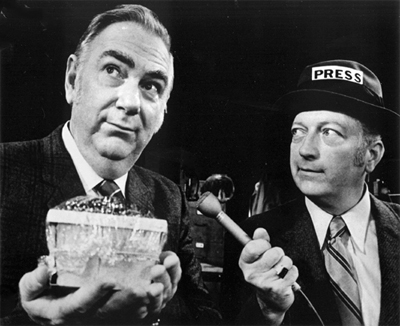
Bob and Ray on PBS, 1984.
Bob Elliott and Ray Goulding, known to generations simply as Bob & Ray, were the duo who turned radio into a stage for satire. Forged in Boston at WHDH in the 1940s, their partnership blossomed into a four‑decade career across NBC, Mutual, CBS, and NPR. With straight‑faced delivery and absurdist invention, they created unforgettable characters like Wally Ballou and Mary McGoon, lampooning the very conventions of broadcasting with wit and precision.
Ray Goulding, born in Lowell, Massachusetts in 1922, passed away on March 24, 1990 at age 68 in Manhasset, New York. Bob Elliott, born in 1923 in Boston, carried their legacy forward until his passing on February 2, 2016 at age 92 in Cundy’s Harbor, Maine.
Together, they left behind more than laughter — they left a blueprint for modern satire. Their voices, preserved in hundreds of broadcasts, remain a cornerstone of American radio history. For the USA Radio Museum, their story is not only about comedy but about connection: two broadcasters who proved that the absurd, delivered with sincerity, becomes timeless.
Conclusion
The voices of Bob and Ray still echo, not only in the preserved recordings of their shows but in the DNA of American comedy. Their deadpan delivery, their parade of eccentric characters, and their fearless lampooning of broadcasting conventions remain as fresh today as when they first aired. To honor them is to honor radio itself — a medium that thrives on imagination, intimacy, and the shared joy of storytelling. As the USA Radio Museum safeguards 392 (NBC, Mutual, PBS) radio broadcasts and 116 CBS episodes of their work, it ensures that future generations will continue to discover the brilliance of two men who made the absurd sublime. Bob Elliott and Ray Goulding were more than entertainers; they were architects of laughter, builders of a comic tradition that endures. Their legacy reminds us that radio, at its best, is not only heard but felt — a living memory, a timeless connection, and a source of joy that never fades.
______________________________
Contact: jimf.usaradiomuseum@gmail.com
______________________________
A USARM Viewing Tip: On your PC? Mouse/click over each image for expanded views. On your mobile or tablet device? Finger-tap all the above images inside the post and stretch image across your device’s screen for LARGEST digitized view. Then click your brower’s back arrow to return to the featured post.
© 2025 USA Radio Museum. All rights reserved.
