
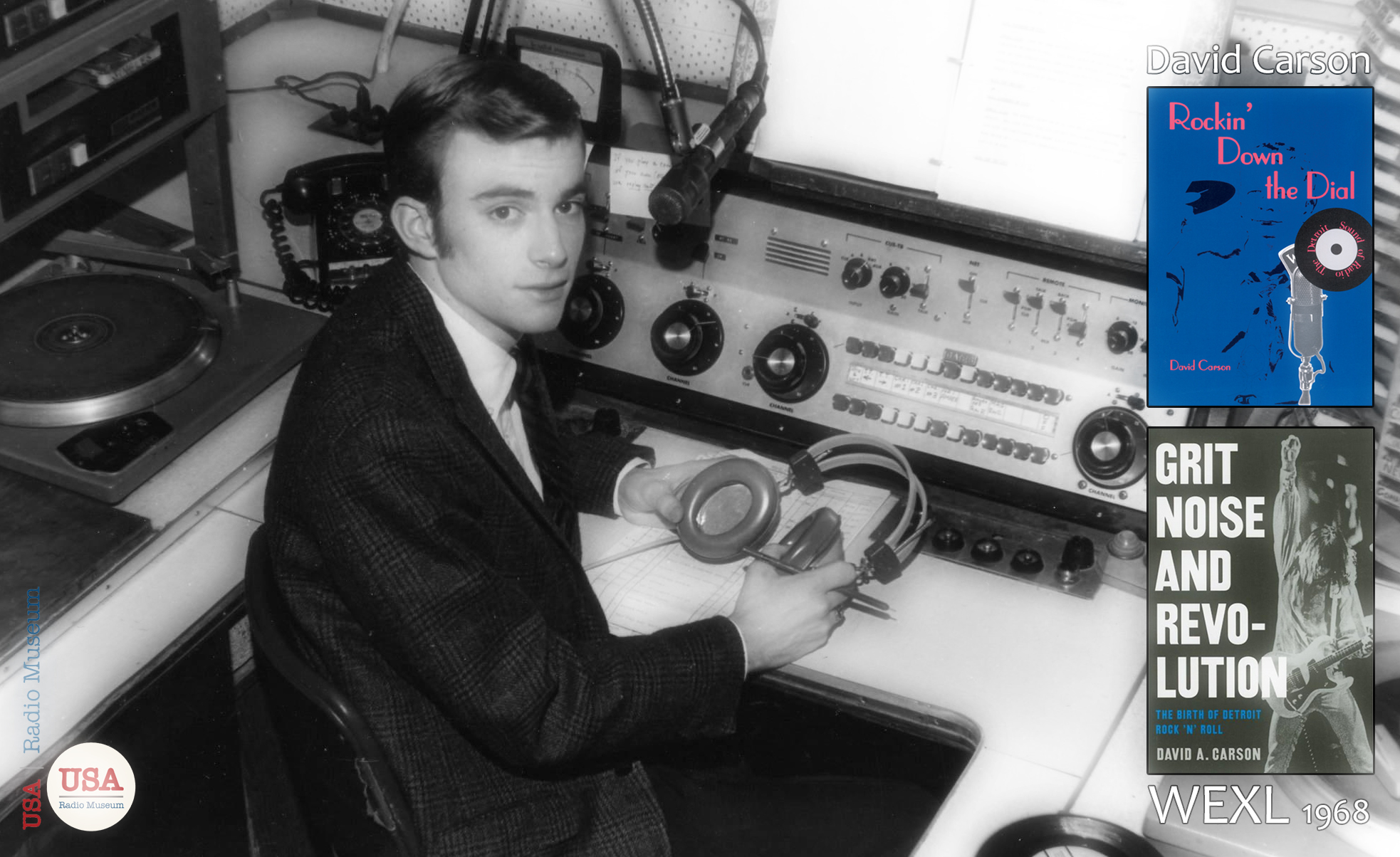
Introduction: A Time Capsule of 1963 — Preserved by David Carson Detroit has always been a city of sound—industrial rhythms pounding from its facto
Introduction: A Time Capsule of 1963 — Preserved by David Carson
 Detroit has always been a city of sound—industrial rhythms pounding from its factories, soulful melodies flowing from Motown, and the crackling voices of radio personalities who became as familiar as family. To understand Detroit’s cultural power, one must listen not only to the music but also to the airwaves that carried it. Few historians have captured this dual legacy with the clarity and devotion of David A. Carson, whose work bridges the story of radio and rock ’n’ roll into a single narrative of transformation.
Carson’s two landmark books, Rockin’ Down the Dial: The Detroit Sound of Radio and Grit, Noise and Revolution: The Birth of Detroit Rock ’n’ Roll, stand as companion volumes that chronicle the city’s rise as both a broadcasting powerhouse and a rock capital. His scholarship is matched by his personal archives, including a rare scoped recording of WXYZ’s Lee Alan introducing Chuck Berry at the Walled Lake Casino Pavilion on November 29, 1963—a night that encapsulated the energy of Detroit radio at the cusp of cultural change.
This article explores Carson’s journey as a historian, the enduring impact of his books, and the living memory he continues to share. It is a story of voices and guitars, jingles and amplifiers, of a city that gave America both its soundtrack and its storytellers. — USA RADIO MUSEUM
_____________________
David A. Carson: Chronicler of Detroit’s Sound
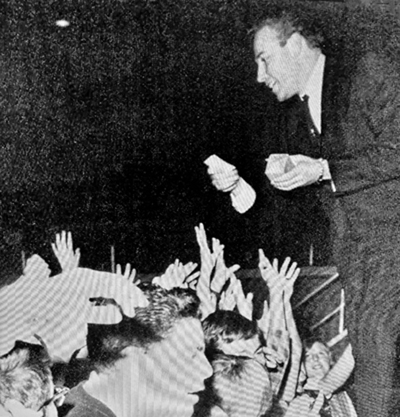
Lee Alan, on stage, at the Walled Lake Casino Pavilion in Novi, MI., 1963. (Credit: David Carson)
Detroit has always been more than a city of industry. It is a city of voices, rhythms, and revolutions, where radio and rock ’n’ roll converged to shape American culture. Few have captured that story with the depth and devotion of David A. Carson, a historian and author whose work bridges the airwaves and the stage. Through his two acclaimed books—Rockin’ Down the Dial: The Detroit Sound of Radio and Grit, Noise and Revolution: The Birth of Detroit Rock ’n’ Roll—Carson has preserved the pulse of Detroit’s sound. And through his personal archives, including a rare scoped recording of WXYZ’s Lee Alan introducing Chuck Berry at the Walled Lake Casino in November 1963, he continues to remind us that history is not just written—it is heard.
The Making of a Historian
Carson grew up on Detroit’s east side, immersed in the voices that poured from transistor radios and car dashboards. He was not only a listener but a participant, becoming a deejay himself and later a chronicler of the city’s musical and broadcasting heritage. His passion was not simply nostalgia; it was a recognition that Detroit’s sound was foundational to American identity. By the late 1990s, Carson had begun to shape that passion into scholarship, determined to document the stories of the personalities, stations, and musicians who defined an era.
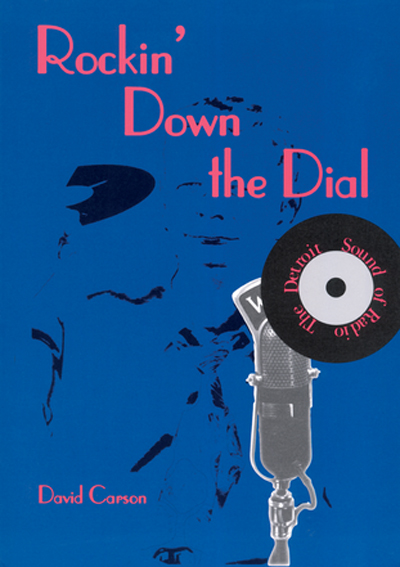 Rockin’ Down the Dial
Published in 2000, Rockin’ Down the Dial was Carson’s first major contribution to Detroit’s cultural record. The book traces the evolution of Detroit radio from the pioneering days of Jack the Bellboy in the 1940s to the powerhouse CKLW “Big 8” era of the 1960s and 70s. It is a story of jingles and contests, of echo chambers and Top 40 formats, of underground FM stations that broke new ground in 1968. Carson’s narrative is alive with the voices and chock full of recollections of deejays who became household names, and with the energy of a medium that was as much about personality as it was about music. Detroit radio was not simply a conduit; it was a community, and Carson’s book preserves its texture.
Grit, Noise and Revolution
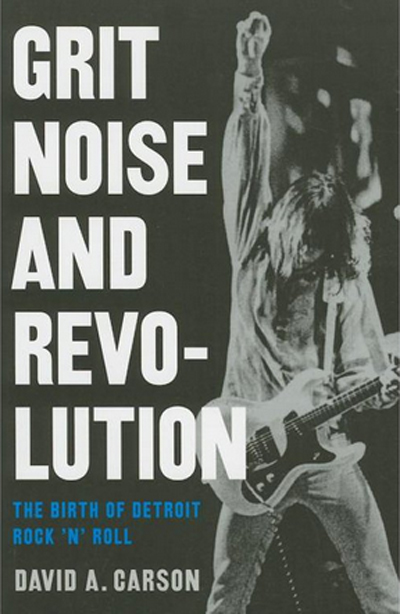
Six years later, Carson published Grit, Noise and Revolution, a sweeping account of Detroit’s rock scene. The book focuses on the years 1965 to 1972, when Detroit’s sound crystallized into something raw, rebellious, and unmistakably its own. Carson traces the roots of this sound in blues, R&B, and Motown, and then follows its explosion through bands like MC5, Iggy Pop and the Stooges, Mitch Ryder and the Detroit Wheels, SRC, Bob Seger, Ted Nugent and the Amboy Dukes, and Grand Funk Railroad. He situates the music within the political and social upheaval of the time, showing how Detroit’s rock was inseparable from the city’s struggles and spirit. Critics praised the book for its detail and its passion; musician Marshall Crenshaw called it “a great blow‑by‑blow account of an exciting and still‑legendary scene.”
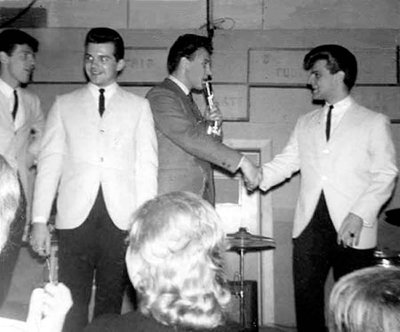
Lee Alan introducing The Reflections at the Walled Lake Casino, 1963. (Credit: David Carson)
Together, Carson’s two books form a dual chronicle: one of the voices that ruled the dial, and one of the sounds that shook the stage. They are companion volumes, telling the story of Detroit’s cultural power from two perspectives that ultimately converge.
A Night at Walled Lake Casino
Carson’s commitment to preservation extends beyond the printed page. Today residing in Nolensville, Tennessee, he continues to share rare recordings and memories that bring Detroit’s past to life. Among the most evocative is a scoped recording of Lee Alan’s “On the Horn” show, broadcast live over WXYZ 1270 from the stage of the Walled Lake Casino Pavilion on Friday, November 29, 1963.
According to David, the tape begins with the conclusion of a 7‑UP commercial, sliding into Alan’s full opening theme. It was precisely 7:15 p.m. The atmosphere crackles with anticipation: Chuck Berry, already a legend, is slated to perform. Fellow Wixie DJ Dave Prince, the self‑proclaimed “Ugly Little Prince,” joins Alan on stage for rapid‑fire repartee, while Paul Winter lends his voice to a station contest promotion. Commercials for cars, movies, and even pimple cream punctuate the broadcast, along with bright PAMS jingles that instantly transport the listener to another era.
 Alan himself is at full throttle, his voice commanding, his energy palpable. He works with only a microphone, communicating with his producer through headphones in a noisy, chaotic environment. Records spin from a booth beside the stage, while Alan thrashes through his copy book to find the right commercial or tag. It is a portrait of a deejay at work, improvising, adapting, and performing in real time.
The historical context deepens the recording’s resonance. The broadcast took place 7 days after President Kennedy’s assassination in Dallas, a nation still in mourning. It was 30 days after WKNR launched, reshaping Detroit’s radio landscape. And it was 27 days before the Beatles’ “I Want to Hold Your Hand” would be released in the United States on December 26. Unbeknownst to many at the time, a new musical experience will spread universally around the globe by the four “mopped-topped” lads from Liverpool, England, ear-marking a new sound what would be defined as “Beatlemania” by early-1964. In Carson’s words, it was “a moment in time, the end of an era.”
Preserving the Sound
For the USA Radio Museum, Carson’s contribution is invaluable. His books provide the narrative framework, while his recordings offer the living texture. Together, they remind us that history is not abstract; it is embodied in voices, in songs, in commercials and jingles, in the improvisations of a deejay working at full throttle. Carson’s work ensures that Detroit’s sound is not forgotten, but preserved for future generations.
Legacy and Continuity
Carson’s dual focus—radio and rock—mirrors the Museum’s mission to honor both the medium and the music. His books can be positioned side by side in a feature that shows how Detroit’s cultural power flowed from the airwaves to the stage. The Walled Lake Casino recording can serve as a centerpiece, a tangible artifact that connects the narrative to a specific moment.
Visitors can read about the rise of CKLW and the explosion of MC5, and then listen to Lee Alan introducing Chuck Berry, feeling the energy of 1963 as if they were there.
_____________________
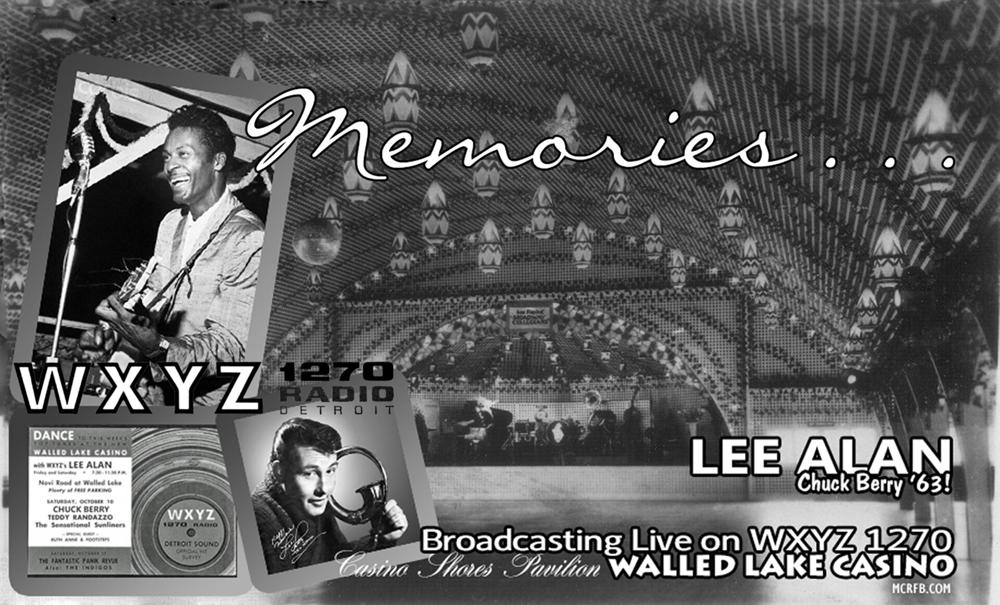
WXYZ Radio 1270 (Detroit) | Lee Alan Broadcasting from Walled Lake Casino | Friday, November 29, 1963
Audio Digitally Enhanced by USA Radio Museum
_____________________
The Bulletin Within the Broadcast
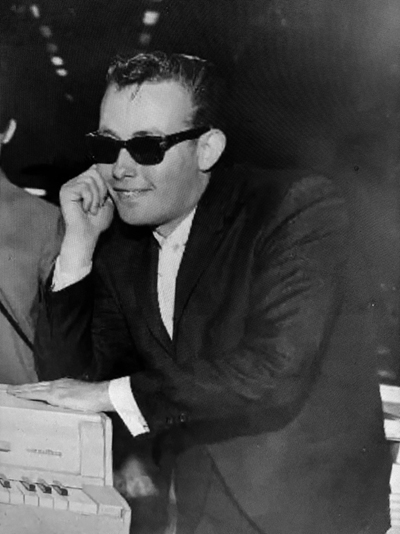
Lee Alan, affectionately remembered by Detroiters as “The Horn” on WXYZ Radio 1270, photographed at the Walled Lake Casino in 1963. (Credit: David Carson)
While Lee Alan’s “On the Horn” show from WXYZ was filled with commercials, jingles, and repartee from fellow Wixie DJs, the tape also captures a sudden interruption: an ABC Radio news flash. The announcement was brief but momentous—President Lyndon Johnson had appointed a special commission to investigate the assassination of President Kennedy.
This bulletin situates the recording firmly on November 29, 1963, exactly one week after the tragedy in Dallas. It reminds us that radio was not only entertainment but also the nation’s lifeline to breaking news. In the midst of Alan’s high‑energy show, listeners were confronted with the sobering reality of history unfolding.
The juxtaposition is striking: Chuck Berry’s rock ’n’ roll energy on one side, and the gravity of a presidential commission on the other. Together, they capture the dual nature of radio in 1963—a medium that could pivot instantly from joy to solemnity, from music to history.
Conclusion
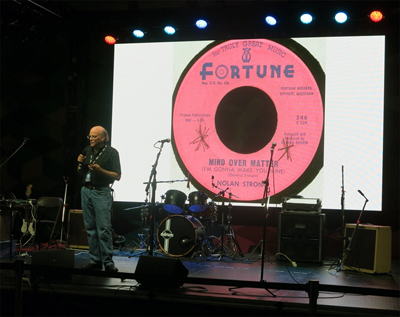
David Carson, speaking about his book, ‘Grit, Noise and Revolution’ back in 2018. (Credit: David Carson, Facebook)
David Carson’s contribution to Detroit’s cultural memory is not only found in his books but also in the recordings he has preserved and shared. The scoped WXYZ tape he entrusted to the USA Radio Museum is a time capsule from a Friday night on WXYZ, 62 years ago, capturing both the vitality of Detroit radio and the gravity of a tragic event.
At its heart is an ABC Radio bulletin announcing President Lyndon Johnson’s appointment of a commission to investigate the assassination of President John F. Kennedy. This solemn interruption reminds us how radio served as the nation’s immediate lifeline to breaking news, carrying the weight of history into living rooms and car dashboards.
And yet, that same evening, WXYZ’s Lee Alan was broadcasting live from the Walled Lake Casino Pavilion, introducing the legendary Chuck Berry to an anticipated Detroit audience in Novi, Michigan. Just one week after the tragedy in Dallas, Alan’s broadcasting persona, the commercials, jingles, and repartee with fellow DJs brought joy and excitement to listeners, despite the nation was still mired in collective grief over the death of a President, and burial, just four days earlier.
Again, this Carson recording (above) embodies the dual nature of radio in 1963: a medium that could pivot from somber solemnity to celebration, from national tragedy to cultural vitality. It is not simply a broadcast audio well preserved—it is a living witness to history, a reminder that radio was both a mirror of the times and a stage for the voices and music that defined them. Bridged together in moments in time.
For the USA Radio Museum, Carson’s artifact is invaluable. His books provide the narrative framework, while this recording offers the texture—the jingles, the commercials, the sudden news flash, the aura of a live concert. Together, they preserve the voices and sounds that defined Detroit, ensuring that future generations can hear the city’s story as it was lived.
David Carson is more than a historian; he is a steward of memory. His work reminds us that Detroit’s sound was never confined to one medium—it lived on the dial, on the stage, and in the hearts of listeners. Thanks to his scholarship and his archives, it continues to live today, resonating anew through the USA Radio Museum’s online presentation—marking this one 1963 WXYZ radio milestone, 62 years on.
______________________________
Contact: jimf.usaradiomuseum@gmail.com
______________________________
A USARM Viewing Tip: On your PC? Mouse/click over each image for expanded views. On your mobile or tablet device? Finger-tap all the above images inside the post and stretch image across your device’s screen for LARGEST digitized view. Then click your brower’s back arrow to return to the featured post.
© 2025 USA Radio Museum. All rights reserved.
