
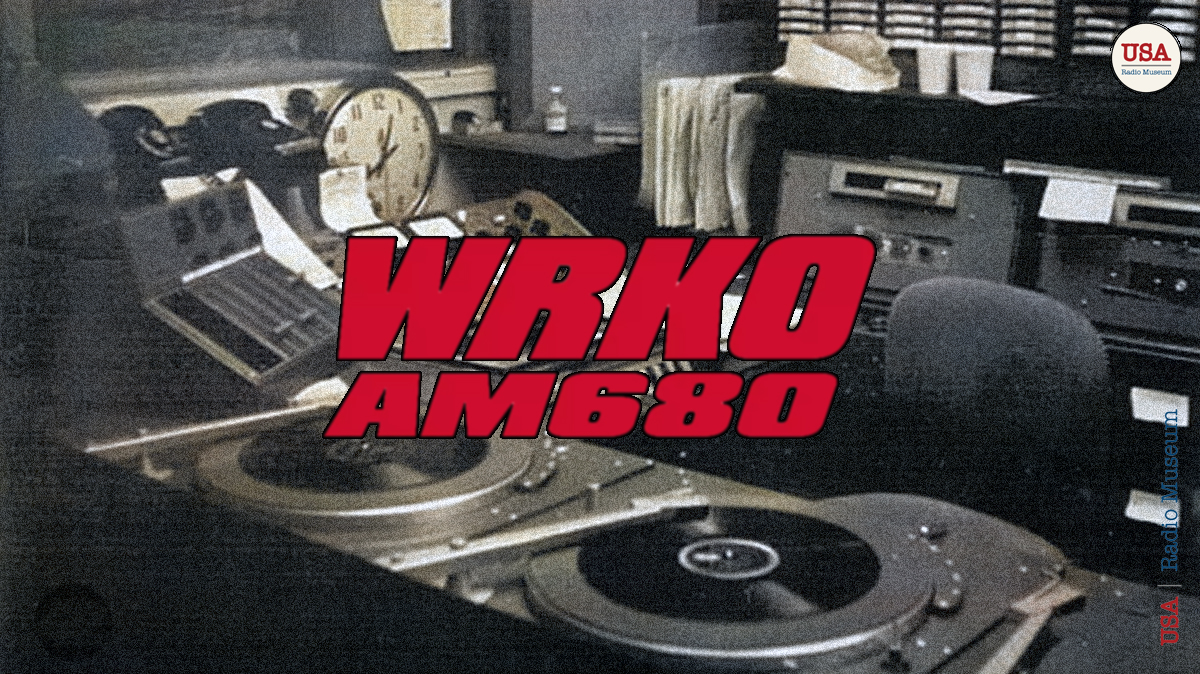
Introduction: When Boston’s Airwaves Caught Fire in 1967 On March 13, 1967, Boston woke up to a shockwave. At 5:30 a.m., the long‑established WNAC
Introduction: When Boston’s Airwaves Caught Fire in 1967
On March 13, 1967, Boston woke up to a shockwave. At 5:30 a.m., the long‑established WNAC 680 vanished, replaced by a new identity that would redefine New England radio: WRKO — The Big 68. What emerged that morning wasn’t just a format flip. It was a cultural ignition. Backed by RKO General and powered by the Drake‑Chenault “Boss Radio” philosophy, WRKO delivered a sound that was fast, modern, disciplined, and unmistakably alive. For a generation of listeners, WRKO became the soundtrack of adolescence and the pulse of a changing city. — USA RADIO MUSEUM
_____________________
RKO General in the 1960s: A Coast‑to‑Coast Broadcasting Empire
 Before WRKO’s launch, RKO General was already one of the most powerful broadcasting companies in North America. The 1960s were its golden age, with major radio and television holdings stretching from Los Angeles to New York, Boston to Detroit, and even across the Canadian border. KHJ Los Angeles had become the national showcase for the Drake‑Chenault format in 1965, while WOR New York anchored the East Coast with prestige and reach. CKLW in Windsor/Detroit, licensed in Canada but serving millions of Americans (1962-1971), was emerging as a cross‑border powerhouse. WNAC‑TV and WNAC Radio gave RKO a strong Boston presence, but the AM signal was ripe for reinvention.
The Road to Revolution: The 1966 KHJ Study That Sparked WRKO
The spark that led to WRKO’s creation began in 1966, when General Manager Perry S. Ury sent Program Director Bob Henabery to Los Angeles to study KHJ firsthand. Henabery returned with a detailed internal report praising KHJ’s pacing, production, and musical precision — a sound Boston had never heard. His analysis argued that the city’s radio landscape had a gap: WBZ offered a broad mix of music and news, while WMEX delivered a more frenetic Top 40. There was room for a station that combined modern polish with tight programming discipline.
That memo became the catalyst. Nine months later, WRKO was born.
The Birth of a Powerhouse: The Big 68 Arrives
WRKO’s launch was meticulously engineered. The Drake‑Chenault system emphasized structure, pacing, and clarity. But within that structure, WRKO’s personalities became stars. Chuck Knapp brought smooth confidence. Dale Dorman — “Uncle Dale” — became one of Boston’s most beloved voices. J.J. Wright mastered timing and presence. Tommy Williams added youthful energy. Joel Cash and Harry Nelson anchored the station with authority. These weren’t just DJs — they were companions, narrators, and cultural touchstones for New England listeners.
The Sound of WRKO: Precision, Personality, and the Johnny Mann Singers
 A defining element of WRKO’s sound came from the Johnny Mann Singers, whose jingles became the sonic signature of RKO General’s stations. Bill Drake and Gene Chenault understood that a station’s identity had to be instantly recognizable, and the Johnny Mann Singers delivered shimmering vocal logos that stitched the entire RKO network together. On WRKO, these jingles didn’t just introduce songs — they announced a new era of radio, punctuating the format with energy and modernity.
WRKO’s playlist embraced the full spectrum of late‑1960s and early‑1970s popular music: Motown, the British Invasion, psychedelic rock, bubblegum pop, singer‑songwriters, and early disco. Every song felt bigger on WRKO. The compression, the pacing, the jingles — everything worked together to create a sense of urgency and excitement. When WRKO played a hit, it felt like a hit.
_____________________
WRKO 680 (Boston) | Johnny Mann Singers | Drake/Chenault Productions, Los Angeles (1967)
Audio Digitally Remastered by USA Radio Museum
_____________________
WRKO and the Boston Soundtrack of the Late 1960s
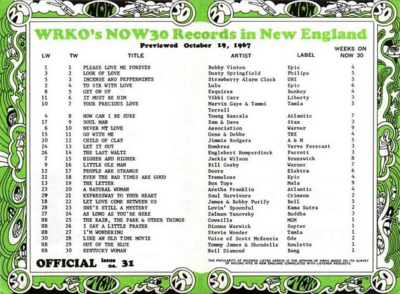 The late 1960s were a turbulent time in America, and Boston was no exception. WRKO became a cultural barometer, reflecting the energy and anxieties of a generation. Within two years, it had become the dominant Top 40 station in New England. Its promotions were massive, its concerts packed, and its news department delivered crisp, authoritative updates during one of the most volatile periods in American history.
The 1970s: Reinvention and the FM Challenge
As the 1970s unfolded, FM radio began its ascent. Stereo sound, album‑oriented rock, and shifting listener habits reshaped the competitive landscape. WRKO adapted by broadening its playlist, adding more personality, and deepening its local engagement. New voices joined the station — Harry Nelson, Paul Perry, Jeff Rollins, Charlie Van Dyke, Jerry Butler, and Tommy Ellis — carrying WRKO through a decade of reinvention. Even as FM grew stronger, WRKO remained a Boston institution.
The 1980s: How RKO’s Downfall Shaped WRKO’s Future
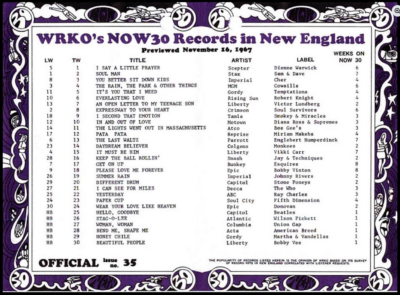 By the early 1980s, WRKO remained a Boston institution, but its parent company, RKO General, was entering the most turbulent period in its history. Decades of investigations into bribery, fraudulent billing, political favors, and withheld documents had finally caught up with the company. The FCC began openly questioning whether RKO General was fit to hold broadcast licenses at all — an unprecedented challenge for a major American broadcaster.
For WRKO, the impact was gradual but unmistakable. Money that once fueled programming innovation and technical upgrades was diverted into legal battles. FM radio was exploding, younger listeners were migrating to stereo album‑oriented rock, and new competitors were emerging. WRKO still had heritage and talent, but it no longer had a parent company capable of bold investment or long‑term strategy.
As RKO General’s legal troubles deepened, its stations lived under a cloud of uncertainty. License renewals were contested, hearings dragged on for years, and rumors of forced divestitures spread through the industry. WRKO’s staff worked hard to maintain the station’s identity, but the instability affected planning, marketing, and the ability to retain or recruit top talent.
Throughout the decade, RKO General began losing key properties as the FCC stripped licenses or forced sales. WNAC‑TV Boston, WOR‑TV New York, KHJ‑TV Los Angeles, WOR Radio, and other holdings were sold or taken away. The once‑mighty RKO network slowly disintegrated. WRKO, once part of a unified broadcasting family, found itself increasingly isolated.
By 1985, WRKO and sister station WROR were sold to Atlantic Ventures, ending WRKO’s era as part of the RKO General empire — the empire that had created it, shaped it, and defined its golden age.
_____________________
WRKO 680 (Boston) | WRKO Radio Collage | 1967-1975
Audio Digitally Remastered by USA Radio Museum
_____________________
Legacy: The Big 68 Lives On
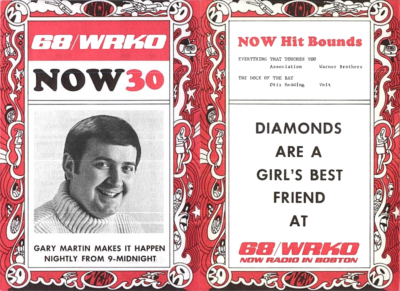 WRKO’s 1967–1977 Top 40 era remains one of the most luminous chapters in Boston’s broadcast history — a decade when a single AM signal could unite a region, shape its soundtrack, and define its cultural heartbeat. The voices that filled its airwaves, the shimmering Johnny Mann jingles, the relentless pacing, the promotions that electrified New England — all of it lives on in the memories of those who grew up with The Big 68 glowing from their dashboard or bedside radio.
For listeners, WRKO was never just a station. It was a companion, a confidant, a pulse in the background of their lives. It was the sound of after‑school rides, summer nights, first loves, heartbreaks, and the thrill of hearing a brand‑new hit for the very first time. It was the place where Boston felt young, loud, modern, and connected to the world beyond its skyline.
Even as formats changed, as FM rose, and as the RKO General empire faded into history, WRKO’s golden era continued to echo — in airchecks lovingly preserved, in the memories of the jocks who lived it, and in the hearts of the millions who tuned in. The Big 68 became more than a frequency. It became a shared cultural memory, a chapter of New England life written in harmony, compression, and pure radio magic.
Today, WRKO’s legacy endures not only in nostalgia, but in the very architecture of American Top 40 radio. Its precision, its pacing, its production values, its sense of showmanship — these became the blueprint for stations across the country. WRKO was a revolution disguised as a radio station, and its impact still ripples across the medium it helped transform.
The Big 68 lives on — in the stories we tell, the archives we preserve, and the generations who still remember what it felt like when WRKO made Boston feel alive.
_____________________
Sources & Credits
Research for this tribute drew upon a wide range of publicly available historical materials, including FCC records, CRTC rulings, RKO General corporate histories, contemporary newspaper reporting, archival airchecks, industry trade publications, and documented accounts of the Drake‑Chenault programming era. Additional context was informed by historical summaries of CKLW, WRKO, KHJ, WOR, WNAC, and other RKO‑owned stations, as well as retrospective analyses by radio historians, former broadcasters, and media scholars.
_____________________
Contact: jimf.usaradiomuseum@gmail.com
_____________________
A USARM Viewing Tip: On your PC? Mouse/double-click over the images for expanded views. On your mobile or tablet device? Finger-tap all the above images inside the post and stretch image across your device’s screen for LARGEST digitized view. Then click your browser’s back arrow to return to the featured post.
© 2026 USA Radio Museum. All rights reserved.

But WRKO A.K.A. The Big 68’s legacy is alive and well courtesy of WXKS A.K.A. Kiss 1O8 FM!
Thanks, Vaughn! And thank you for all the great comments you’ve shared — we see them, we appreciate them, and they never go unnoticed. You’re right that Kiss 108 carried a lot of that high‑energy spirit into the FM era. WRKO lit the fuse, and stations like WXKS helped keep Boston radio vibrant for the next generation. Thanks again for being part of the conversation — your enthusiasm always adds to the story. — Jim Feliciano, USARM
My pleasure.