
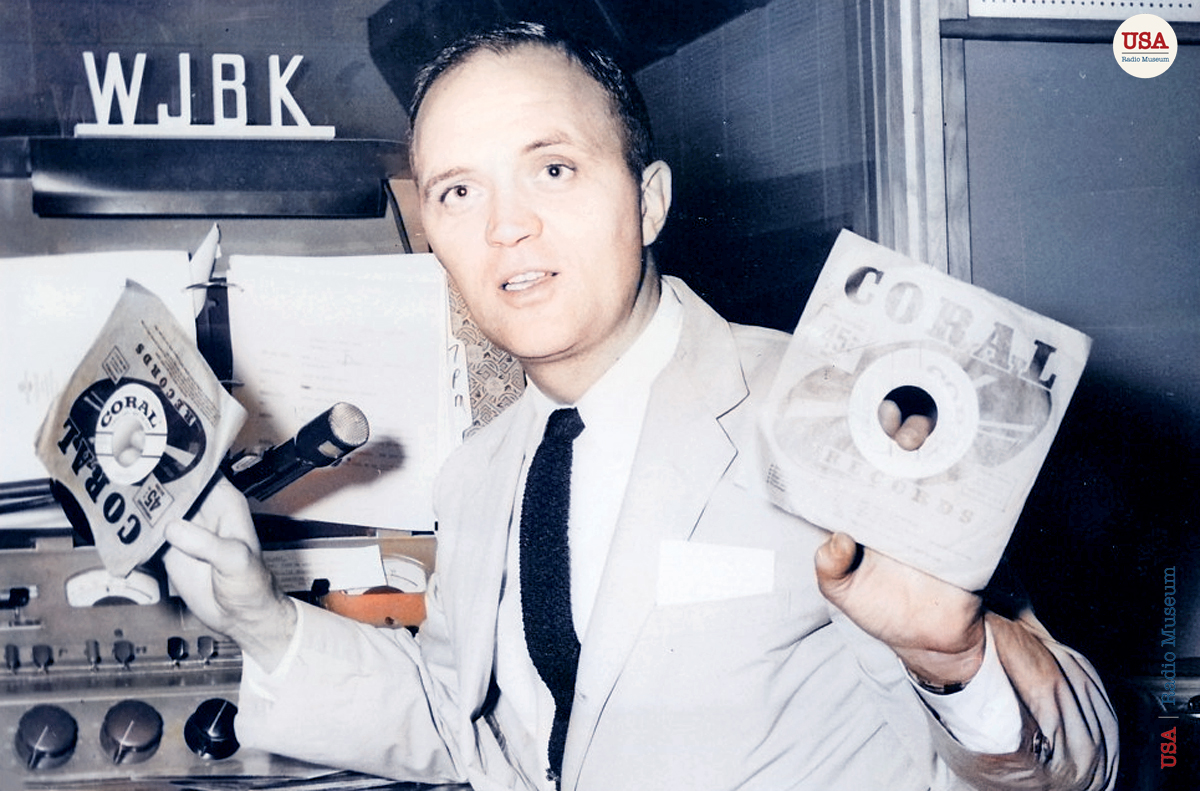
Introduction: Curtain Time in the Motor City—The Legacy of WJBK Radio 15 Before Detroit became a battleground of Top 40 giants — before WKNR’s revo
Introduction: Curtain Time in the Motor City—The Legacy of WJBK Radio 15
 Before Detroit became a battleground of Top 40 giants — before WKNR’s revolution, before CKLW’s Big 8 thunder, before WXYZ’s ABC polish — there was WJBK Radio 1500. For nearly three decades, WJBK shaped the sound of the Motor City, evolving from a polished full‑service station into one of Detroit’s earliest and most influential contemporary hit outlets.
From the birth of the Jack the Bellboy legend in the 1940s to the fierce Top 40 wars of the early 1960s, WJBK was a station defined by personality, precision, and a deep connection to its listeners. Its story is one of innovation, reinvention, and ultimately, transformation — a journey that mirrors the evolution of American radio itself.
This is the definitive chronicle of WJBK’s rise, reign, and final days as a Top 40 station, culminating in its transition to Beautiful Music in August 1964. — USA RADIO MUSEUM
_____________________
CHAPTER I
THE EARLY YEARS: ED McKENZIE AND THE BIRTH OF “JACK THE BELLBOY” (1937–1952)
 Long before WJBK became a hit‑music force, its identity was shaped by one man: Ed McKenzie. Joining the station in 1937, McKenzie became indispensable during World War II, taking on roles as engineer, announcer, and eventually chief announcer. In 1945, he stepped behind the turntables — and Detroit radio changed forever.
Inspired by Lionel Hampton’s recording “Jack the Bellboy,” McKenzie adopted the name for his new disc‑jockey persona. The Bellboy quickly became one of the most recognizable voices in the city, blending warmth, rhythm, and personality in a way that set WJBK apart.
By 1952, McKenzie’s star had risen so high that WXYZ lured him away.
The Detroit Free Press reported on January 17, 1952:
• McKenzie would begin at WXYZ on February 4
• A special studio was being built for him
• His show was slated for national syndication
But WJBK made a bold move: The station retained the legal rights to the “Jack the Bellboy” name. This decision would shape the next 12 years of WJBK history.
CHAPTER II
THE FORMULA RADIO ERA AND THE BIG FOUR (1956–1958)
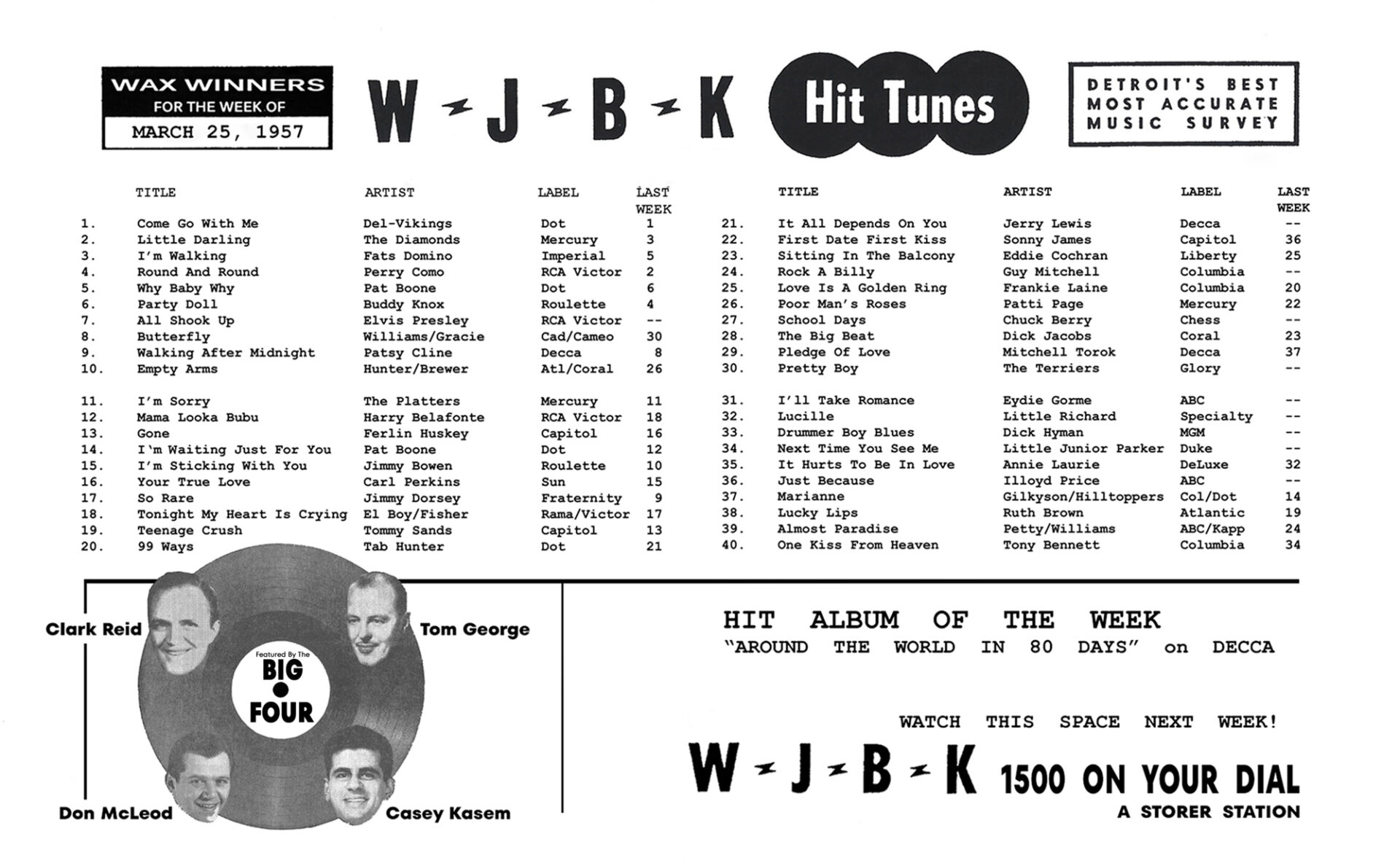
WJBK March 25, 1957. (Credit: Motor City Radio Flashbacks)
By the mid‑1950s, WJBK had entered a new phase of its evolution under the ownership of Storer Broadcasting, which acquired the station in 1954. Storer was one of the most influential broadcast groups of the era — disciplined, image‑driven, and deeply committed to creating a consistent, polished sound across all of its properties. Their stations in Miami, Atlanta, Toledo, and Detroit all shared a recognizable sonic fingerprint
Storer Broadcasting and the Rise of Formula Radio
Under Storer, WJBK adopted what became known as Formula Radio, a structured programming philosophy built on:
• Tight rotation of hit records
• Clean, uniform production values
• Strong station branding and jingles
• Disciplined on‑air presentation
• A consistent sound across all dayparts
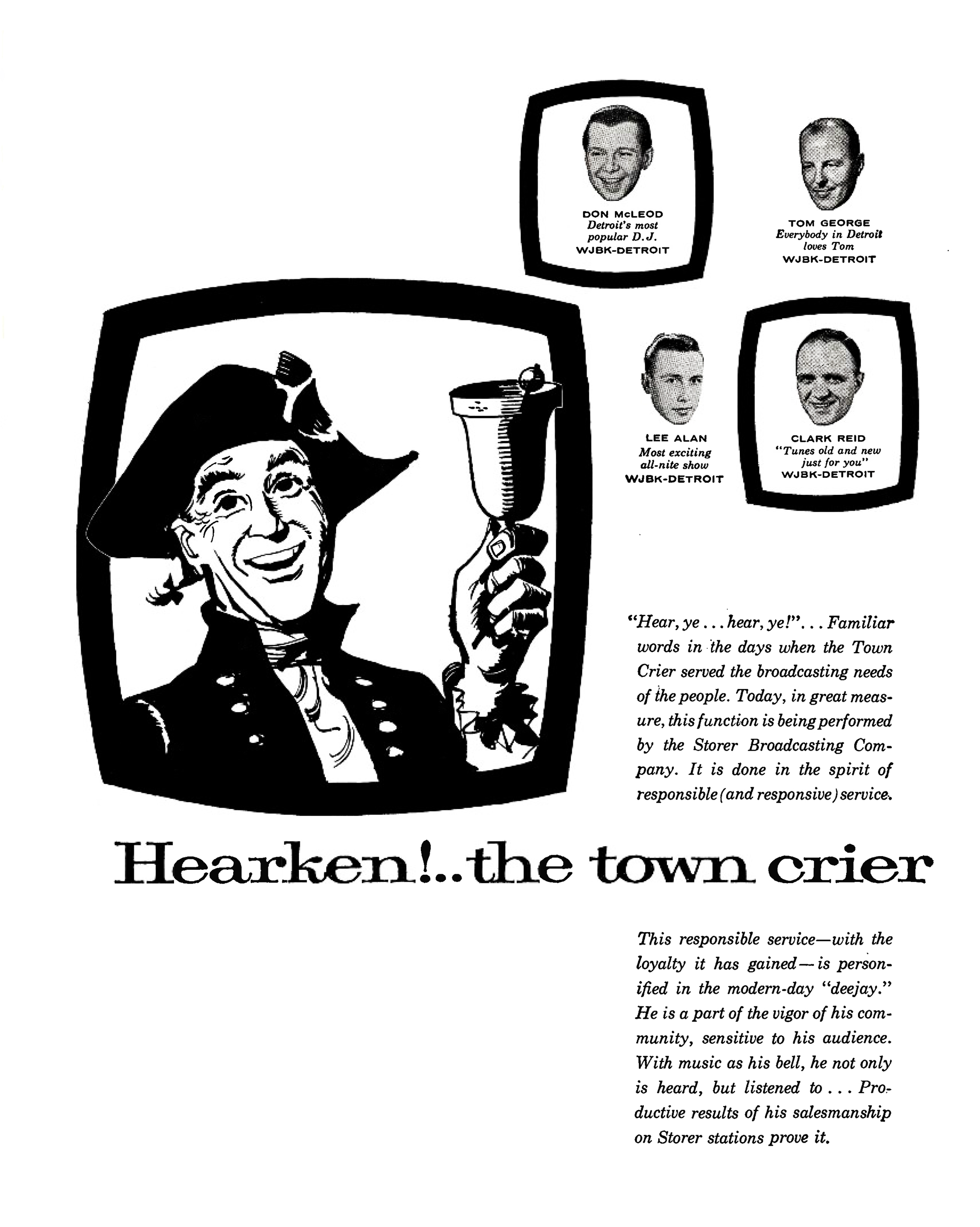
BROADCASTING June 22, 1959
Storer believed that radio should feel professional, predictable, and personality‑driven, but never chaotic. Their approach emphasized pacing, polish, and a sense of order — a contrast to the looser, more free‑form styles still common on many stations in the early 1950s.
For WJBK, this meant:
• A bright, upbeat morning show anchored by Clark Reid, who joined the station in 1956 from WJR
• A midday and afternoon lineup built on reliability and smooth transitions
• A nighttime personality — the Bellboy — who carried the station’s youth appeal
• Surveys, jingles, and promotional materials that reflected Storer’s corporate design language
Storer’s influence gave WJBK a clean, modern, tightly engineered sound that set it apart from competitors like WXYZ and WKMH. It also laid the groundwork for WJBK’s later transition into Top 40 — and ultimately, its struggle to adapt when the more aggressive WKNR arrived in 1963.
The Big Four Take Shape
By 1957, WJBK had assembled what became known as The Big Four:
• Clark Reid – Mornings
• Tom George – Midday
• Don McLeod – Afternoons
• Casey Kasem – Evenings
Kasem’s warm, narrative style made him a standout, but his tenure was brief. In November 1957, he left WJBK for WBNY in Buffalo. To fill the gap, WJBK hired Dan Baxter for the all‑night shift. The stage was set for the next major transformation — the return of Tom Clay and the revival of the Bellboy.
CHAPTER III
THE RETURN OF TOM CLAY AND THE REVIVAL OF THE BELLBOY (1958–1959)
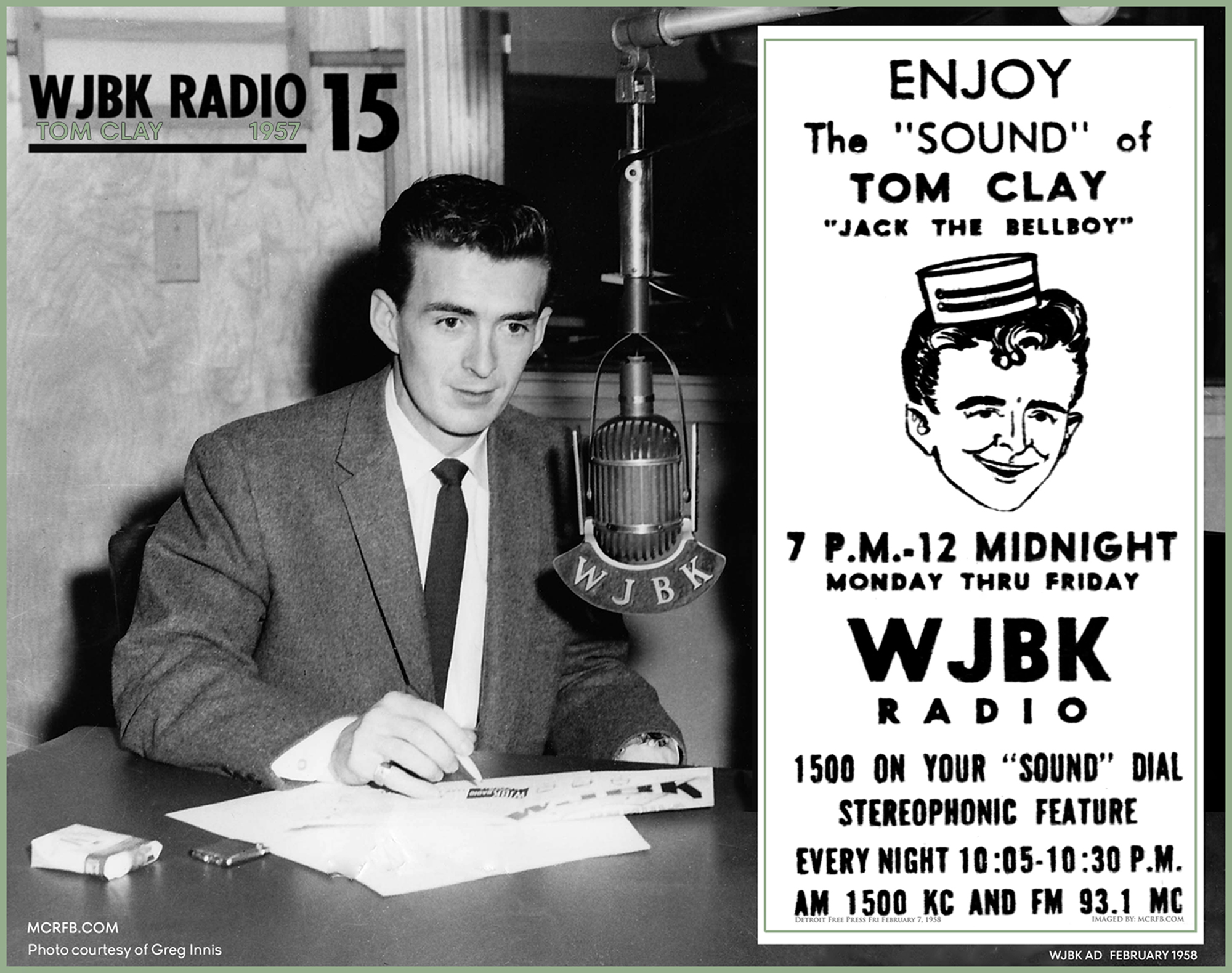 In early 1958, Tom Clay arrived in Detroit and stepped into the same evening hours Casey Kasem had held. WJBK revived the Jack the Bellboy moniker — dormant since 1952 — and Clay became its new voice.
Clay’s dramatic, theatrical style electrified the station. His show opened with the sweeping orchestral theme “Curtain Time” (1952) by Tony Acquaviva and the New York Symphony Orchestra — a sonic signature listeners never forgot. His presence brought a renewed sense of personality and flair to WJBK’s nighttime programming, and for a brief moment, the Bellboy identity felt more alive than ever.
The Payola Scandal Hits WJBK
But the momentum of WJBK’s late‑1950s resurgence came to an abrupt halt in November 1959, when the national Payola scandal swept across American radio. WJBK was not spared. Two of its most prominent personalities — Don McLeod and Tom Clay — were abruptly dismissed after being accused of accepting “pay for play” considerations.
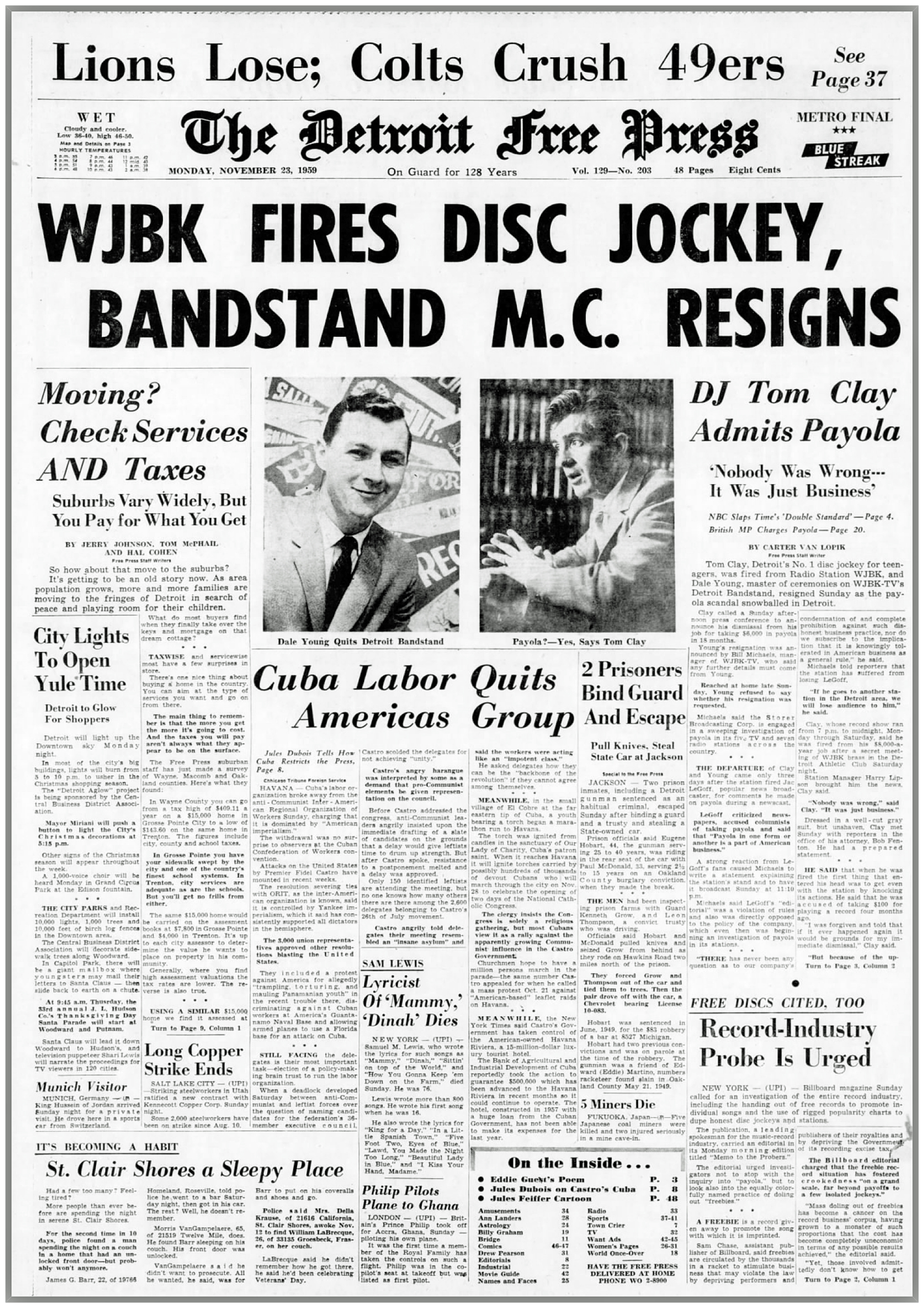
The Detroit Free Press, November 23, 1959
The scandal, which engulfed stations nationwide, created a climate of suspicion and public scrutiny. Although the investigations would later reveal inconsistencies and uneven enforcement across the industry, the impact on WJBK was immediate and severe:
• The station lost two major voices overnight
• Its evening programming was thrown into turmoil
• The newly revived Jack the Bellboy identity was silenced once again
• WJBK’s carefully built Formula Radio stability was shaken at a critical moment
Clay’s departure was particularly disruptive. His theatrical Bellboy persona had re‑energized the station’s nighttime hours, and his firing left a noticeable void. McLeod’s dismissal further destabilized the lineup, forcing WJBK to rebuild quickly as the 1960s approached.
Yet despite the scandal, Clay’s influence endured.
He had re‑established the Bellboy as a central part of WJBK’s brand — a legacy that would carry forward into the next decade.
_____________________
WJBK 15 | Tom Clay | March 1958
Audio Digitally Remastered by USA Radio Museum
_____________________
CHAPTER IV
THE FORMULA 45 ERA AND THE 1958 SURVEY LINEUP
By April 1958, WJBK’s programming identity was fully crystallized in its Formula 45 Music Guide — a weekly survey listing the station’s top 45 singles. The April 21, 1958 survey featured:
Air Personalities
• Tom George
• Clark Reid
• Don McLeod
• “Jack the Bellboy” (Tom Clay)
• Dan Baxter (overnights)
News Department
• Barney Lee
• Peter Stoner
• Norm Lenhardt
These surveys — now preserved in the USA Radio Museum archive — remain some of the most iconic artifacts of WJBK’s golden era.
CHAPTER V
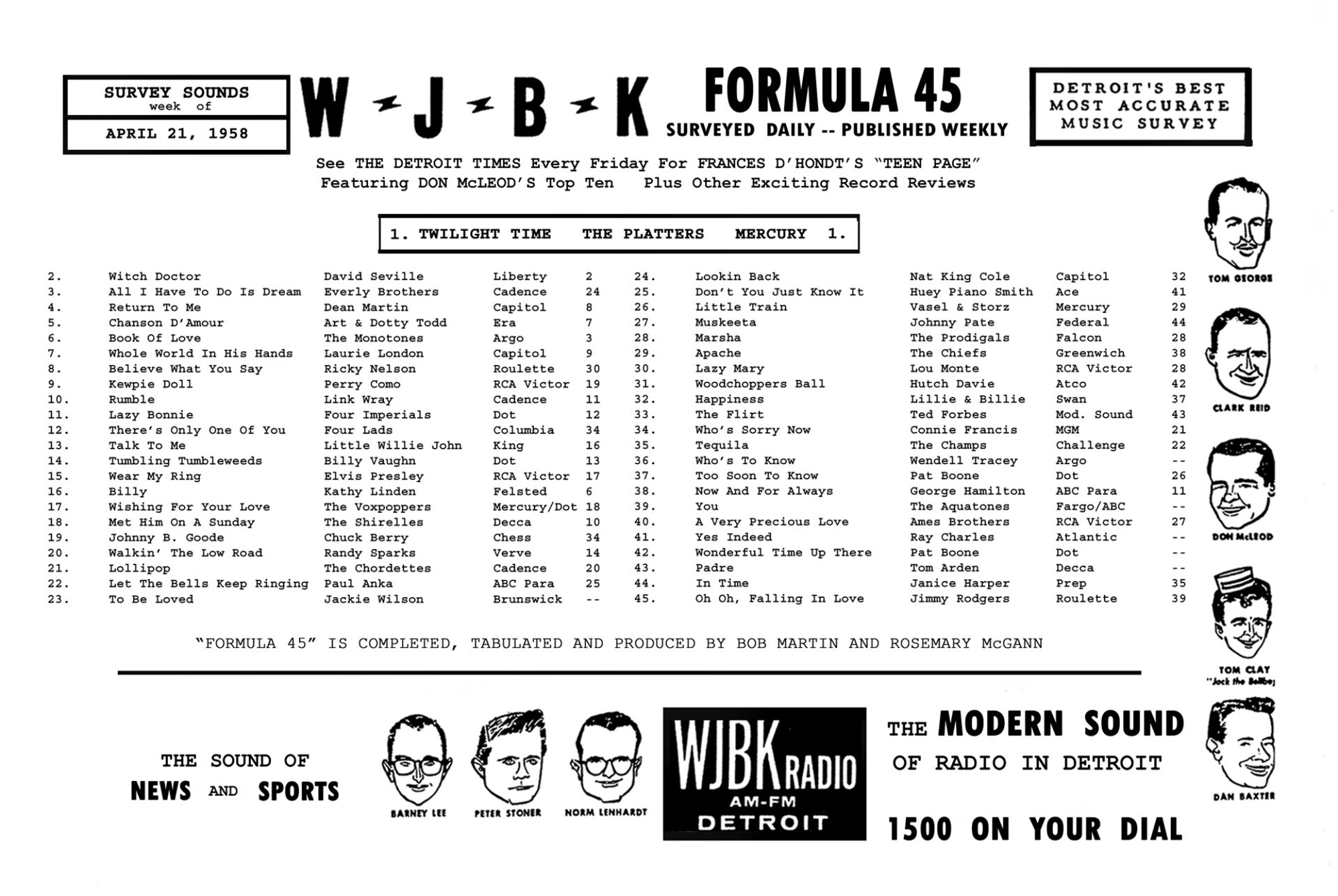
WJBK April 21, 1958. (Credit: Motor City Radio Flashbacks)
THE EARLY 1960s: WJBK ENTERS THE TOP 40 BATTLEFIELD (1962–1963)
As the 1960s opened, Detroit radio was entering one of its most competitive eras. Teenagers were becoming the dominant listening audience, and stations were sharpening their formats, tightening their playlists, and elevating their personalities to capture the growing youth market. Before WKNR’s arrival and before CKLW’s Big 8 transformation, the Detroit dial was essentially a two‑station race — a fierce contest between WJBK and WXYZ. WXYZ has some of the legendary names and voices at the time: Fred Wolf, Paul Winter, Joel Sebastian, Lee Alan, Don Zee, and Dave Prince.
WXYZ Takes the Daytime Lead
 By early 1962, WXYZ had become a formidable force. According to Pulse ratings from January and February of that year, WXYZ held a commanding lead during the daytime hours. Their ABC ownership, polished production, and strong midday lineup helped them secure:
• 19 and 16 shares in key daytime periods
• A dominant Saturday performance, posting 19, 18, and 19 shares across the broadcast day
These numbers reflected a station operating at peak strength — confident, consistent, and deeply connected to Detroit listeners.
WJBK Holds the Night
 Yet the Pulse data also revealed something equally important:
WJBK remained a powerhouse after dark.
Between 6 p.m. and midnight, WJBK captured a 23 share, outperforming WXYZ and demonstrating the enduring appeal of its evening personalities and programming structure. This nighttime dominance was a testament to the station’s strong lineup and the loyalty of its teen audience.
A Market on the Brink of Change
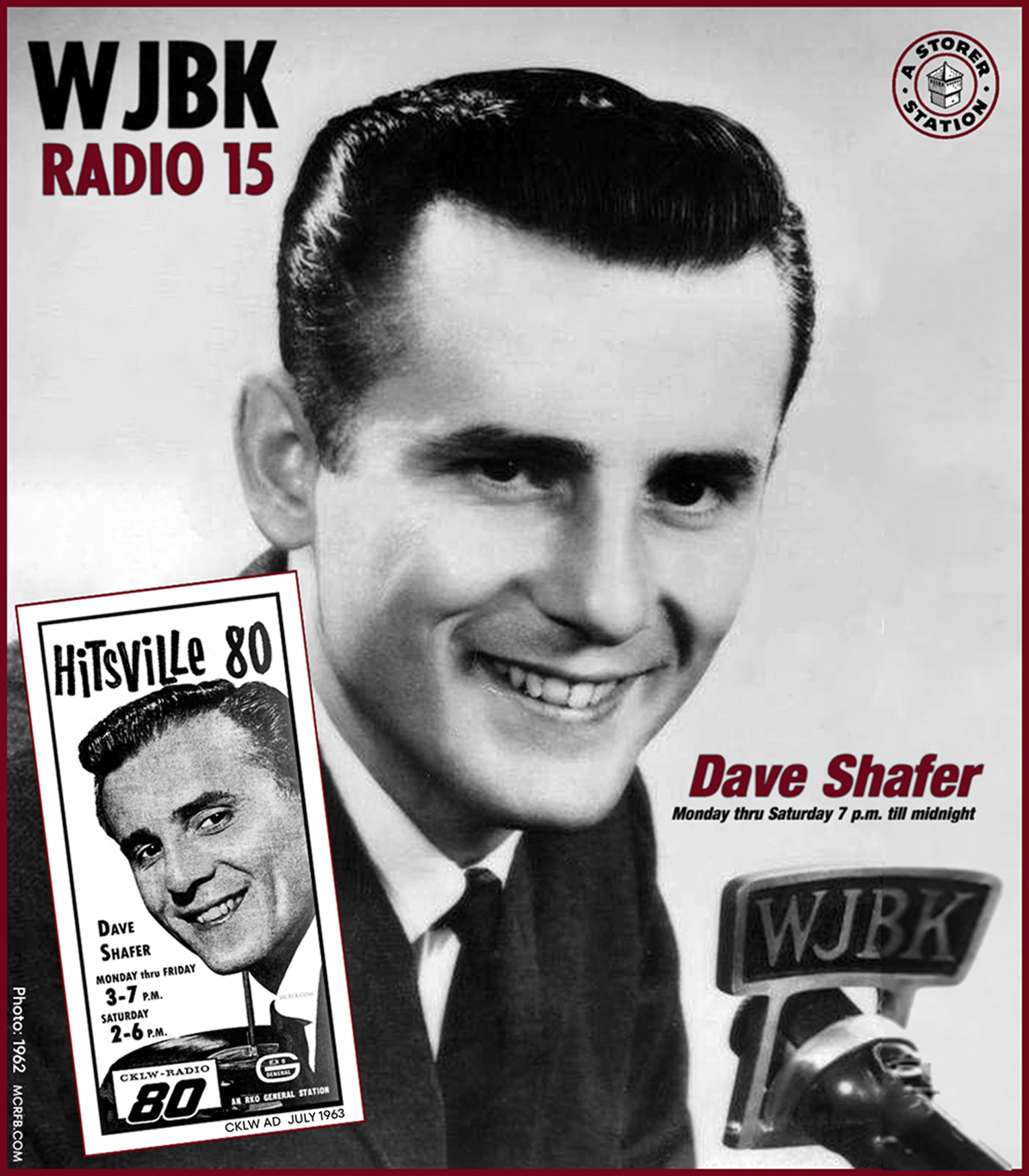 These early‑1962 Pulse figures capture a Detroit radio landscape that was stable — but poised for upheaval. WXYZ commanded the daytime hours. WJBK held the night. CKLW was modernizing but not yet dominant. WKMH was a year away from its Keener transformation.
This was the calm before the storm. Within a year, WKNR would arrive and rewrite the rules. Within two years, WJBK would be fighting for survival in a four‑station Top 40 war. Within three years, the station would exit the format entirely.
But in early 1962, the battle was clear:
WJBK vs. WXYZ — two giants fighting for Detroit’s ears.
CHAPTER VI
1963: TERRY KNIGHT ARRIVES — AND THE BELLBOY CHANGES HANDS AGAIN
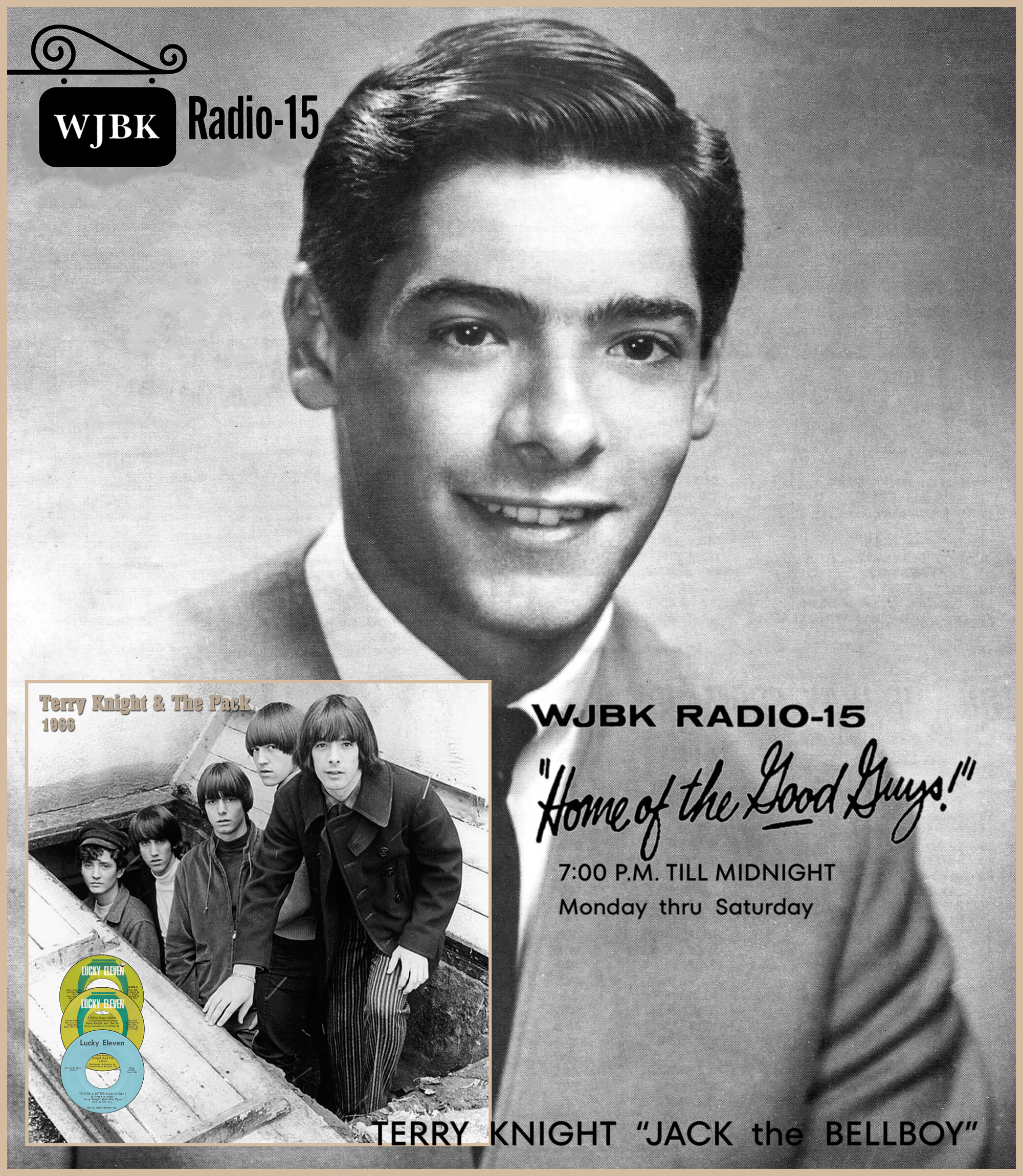 In June 1963, Dave Shafer left for CKLW. WJBK hired Terry Knight, a rising young DJ from WTAC and Alma College, to replace him. Knight became the fourth Bellboy, opening his 7 p.m. show with the brassy, high‑energy “Wild Twist” (1962) by the Roller Coasters. His tenure was brief but memorable. Knight would soon leave radio to front Terry Knight & The Pack, the Flint band that eventually evolved into Grand Funk Railroad. He later managed the Rolling Stones and Grand Funk — one of the most unusual career arcs in Detroit radio history.
Meanwhile, in September 1963, Tom Clay returned to Detroit — but to CKLW, not WJBK. The stage was set for the biggest shakeup yet.
_____________________
WJBK 15 | Terry Knight | June 24, 1963
Audio Digitally Remastered by USA Radio Museum
_____________________
CHAPTER VII
OCTOBER 31, 1963: WKNR ARRIVES — AND THE GAME CHANGES
On Halloween night, WKMH 1310 flipped formats and rebranded as:
WKNR — Keener 13
With its tight Top 30 + 1 playlist, bold imaging, and relentless promotion, WKNR exploded onto the scene. Within weeks, it became Detroit’s hottest station.
Suddenly, Detroit had four stations fighting for the same audience:
• WJBK
• WXYZ
• CKLW
• WKNR
WJBK’s broader playlist and older Formula Radio structure began to feel dated.
The station was losing the teen battle — fast.
CHAPTER VIII
THE FINAL TOP 40 LINEUPS (1963–1964)
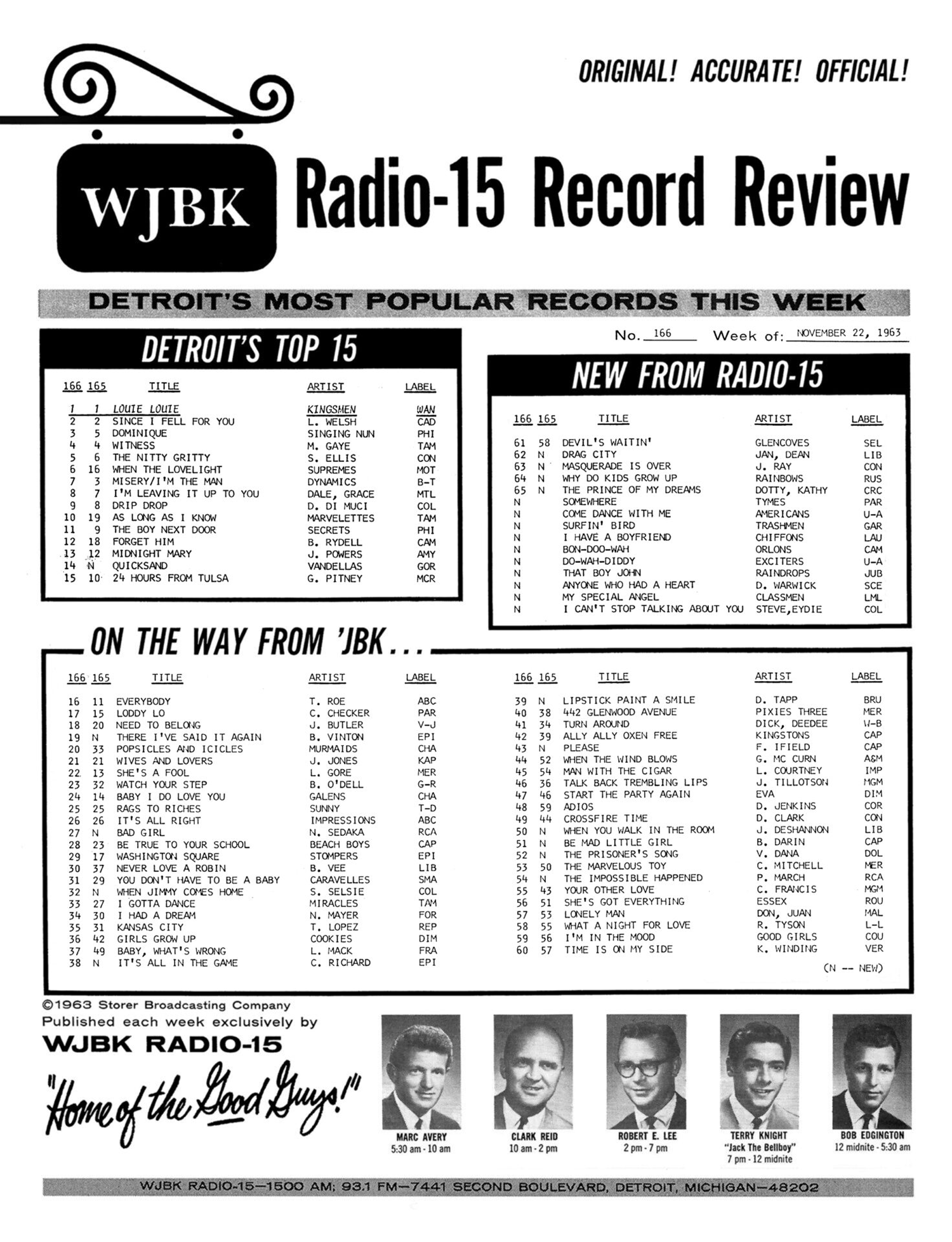
WJBK November 22, 1963. (Credit: Motor City Radio Flashbacks)
The 1963 Lineup:
• Marc Avery (mornings)
• Clark Reid
• Robert E. Lee
• Terry Knight (Jack the Bellboy)
• Bob Edgington
• Dave Milan (Sundays)
The 1964 Lineup — The Final Top 40 Team
• Marc Avery
• Clark Reid
• Robert E. Lee
• Robin Walker (the final Jack the Bellboy)
• Bob Edgington
• Bobby Layne (Sundays)
During these years, WJBK’s Record Review Survey expanded to 60+ records, reflecting a broader, more inclusive playlist — a contrast to WKNR’s tight rotation, numbered half the WJBK playlist. But the writing was on the wall.
CHAPTER IX
AUGUST 1964: WJBK DROPS TOP 40 — “JUST BEAUTIFUL MUSIC” BEGINS
On July 14, 1964, WJBK released its final Record Review Survey.
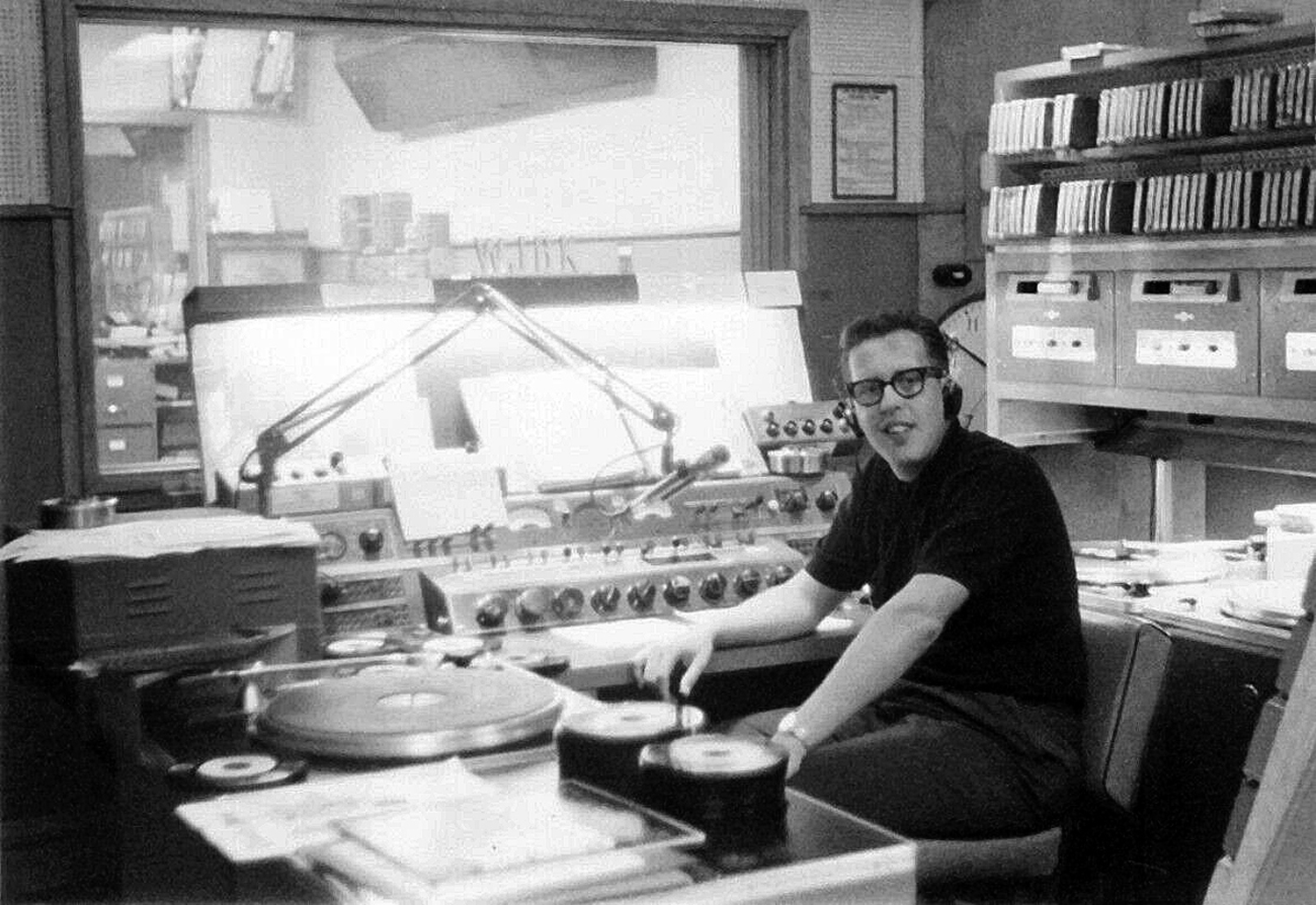
WJBK Dave Milan (Sunday Host) 1963. (Credit: Motor City Radio Flashbacks)
There were no songs listed — only a message:
“A Notable Change . . .
Thank you for following the WJBK Radio 15 Record Review for the past year. This weekly playlist now ceases publication to make way for a noticeable change in WJBK programming which results from a continuing study of audience preferences in the greater Detroit area.
Keep your dial on WJBK Radio 15 for the sound of ‘Just Beautiful Music.’ Tune in to a special sneak preview of ‘The Sound of Music and Total Information News’ starting at 2:00 p.m. on Sunday, August 16th.”
With those words, WJBK formally closed the book on its Detroit teenage audience and prepared to enter the adult‑oriented world of Beautiful Music. On that date, WJBK officially ended its Top 40 era and transitioned to:
• Beautiful Music
• Album‑based programming
• Total Information News
The Bellboy retired.
The surveys stopped.
The teen wars ended.
And WJBK entered a new chapter.
_____________________
SIDEBAR I: The Post‑1964 Beautiful Music Era

The Detroit Free Press, December. 2, 1964
When WJBK left Top 40 in August 1964, the station reinvented itself with a calm, elegant Beautiful Music format built around soft orchestras, instrumental covers, and minimal DJ talk. This wasn’t a retreat — it was a strategic shift toward Detroit’s growing adult audience.
Storer Broadcasting’s polished production values remained, giving WJBK a warm, consistent, upscale sound that appealed to office workers, homemakers, and older listeners who preferred melody over momentum. For a time, WJBK became a sonic refuge in a rapidly changing musical landscape.
SIDEBAR II: The Soft‑Rock Amendment (1966–1969)
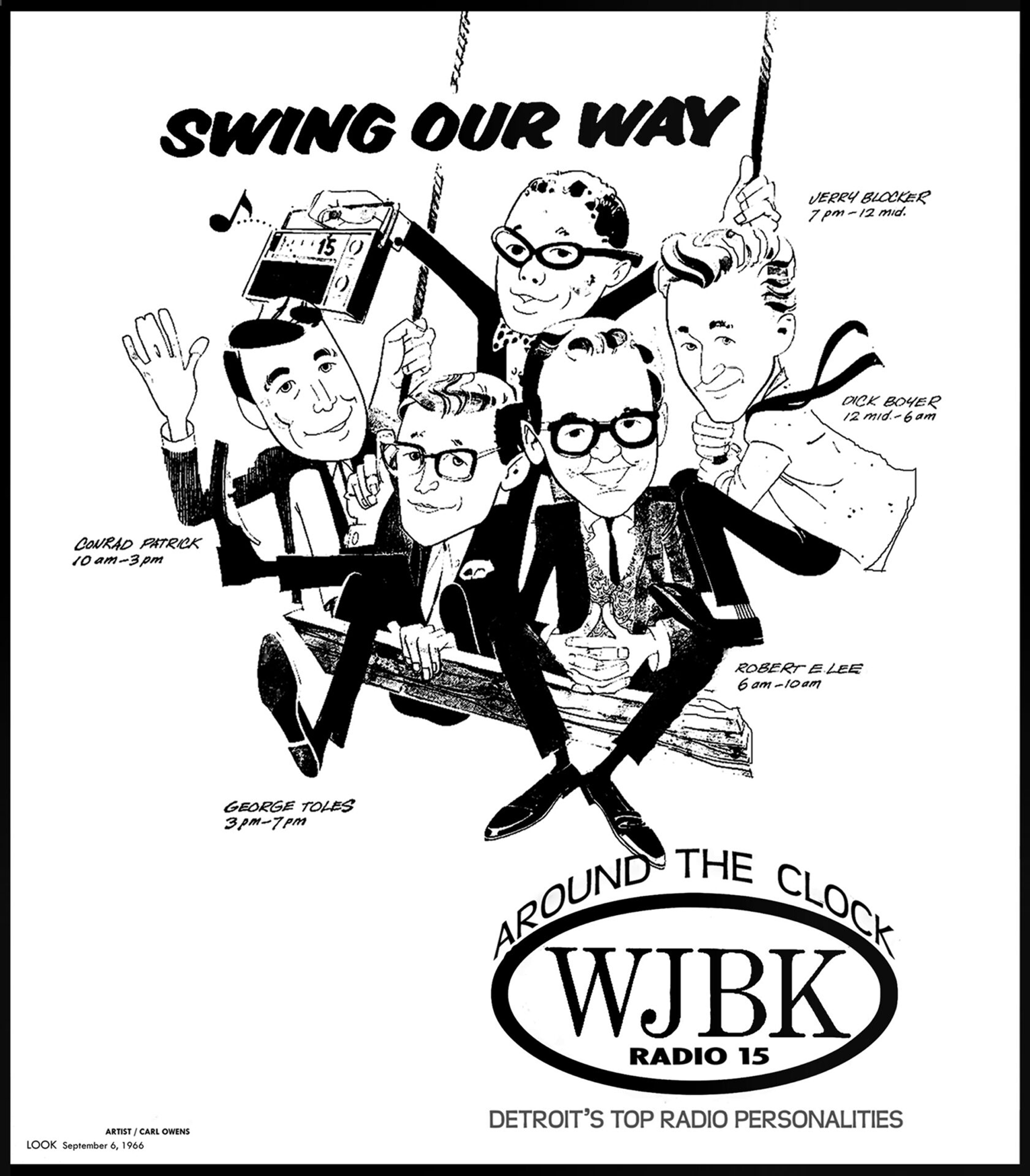 By 1966, WJBK recognized that pure orchestral Beautiful Music no longer reflected the world around it. The station responded with a subtle shift — adding soft pop vocals, MOR hits, and gentle contemporary songs by artists like The Lettermen, Petula Clark, Sergio Mendes, and early Neil Diamond. Warm personalities were back on the air. Conrad Patrick, Robert E. Lee, Marc Avery, and Jerry Brocker.
This Soft‑Rock Amendment kept WJBK relevant without abandoning its adult identity. It was a bridge format: modern enough to stay connected, calm enough to remain familiar. The hybrid sound carried WJBK through the late ’60s, right up to its brief 1969 return to Top 40 before the final flip to WDEE.
_____________________
EPILOGUE
THE LEGACY OF WJBK RADIO 1500
WJBK’s Forgotten Comeback: The Short‑Lived 1969 Top 40 Revival
Most Detroit listeners remember WJBK’s Top 40 era ending in 1964 . . . but fewer know that the station made one last, bold attempt to rejoin the hit‑radio battlefield.
In March 1969, WJBK briefly returned to a modernized Top 40 format, hoping to recapture the energy of its earlier years. Program Director Mike Scott, fresh from KGB San Diego, brought in a West Coast–influenced sound: personality‑driven, fast‑paced, and contemporary. The lineup included standout talents such as:
• Lee Baby Simms – Morning Drive
• K.O. Bailey – Afternoons
• Tom Shannon, Hank O’Neil, Tom Dean, and Jim Hampton (Curator, Co-publisher, USA Radio Museum)
_____________________
WJBK 15 | Jimmy Hampton | August 29-30, 1969
Audio Digitally Remastered by USA Radio Museum
_____________________
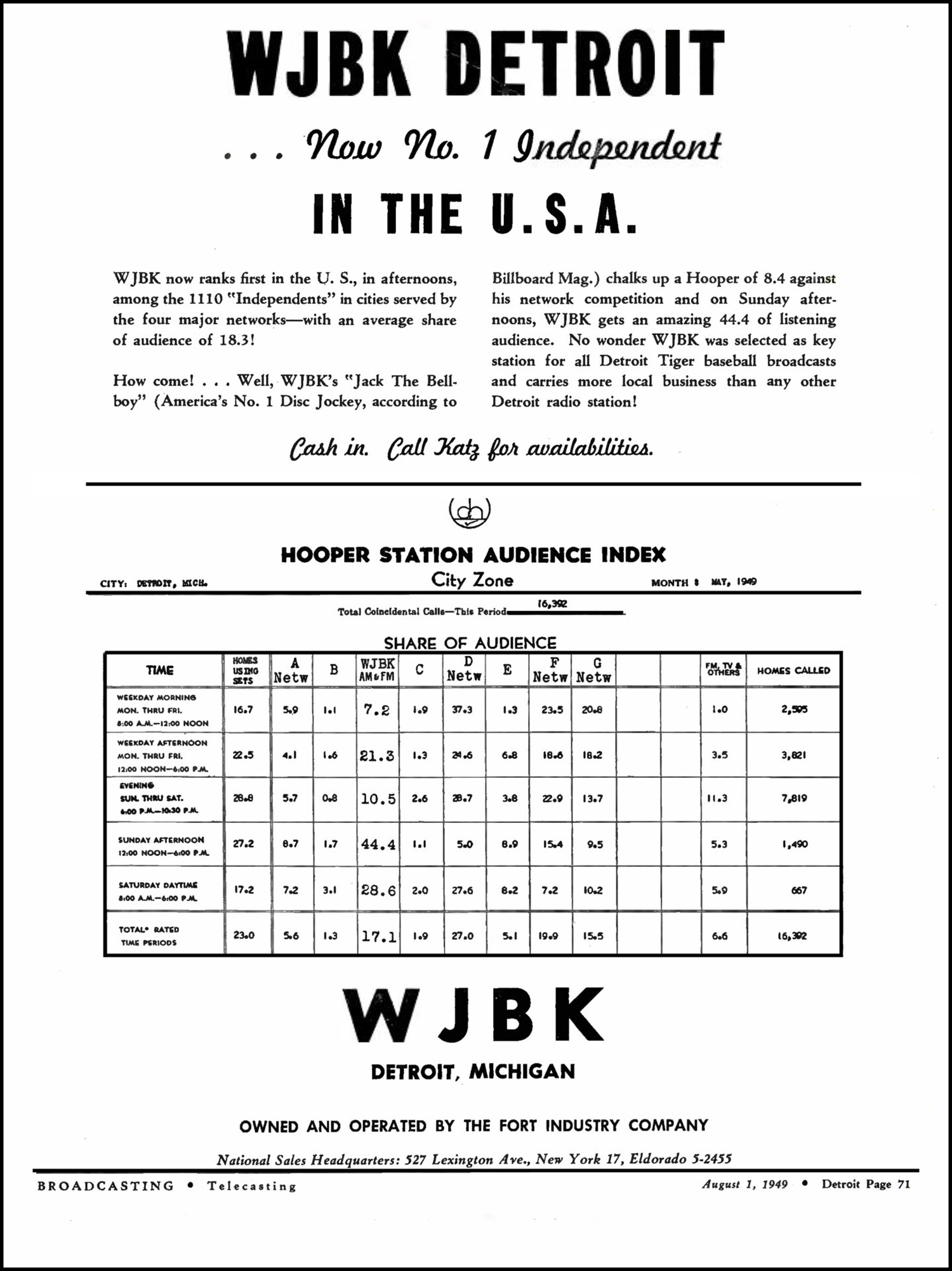
BROADCASTING August 1, 1949 (Credit: Motor City Radio Flashbacks)
The station sounded fresh, lively, and competitive — but the comeback was short‑lived. After only six months, WJBK was sold. The new owners dropped both the WJBK call letters and the Top 40 format, flipping the station to modern country under a new identity: WDEE — “The Big D.”
This marked the final chapter in WJBK’s long and storied journey through Detroit’s contemporary music landscape.
From Ed McKenzie in 1937 to Robin Walker in 1964, WJBK shaped the sound of Detroit for nearly three decades. It launched careers, defined eras, and left behind some of the most iconic surveys, jingles, and personalities in Motor City radio history.
Its Top 40 years — though overshadowed by the later dominance of WKNR and CKLW — remain a vital chapter in the story of Detroit broadcasting.
Today, thanks to the USA Radio Museum, the legacy of WJBK lives on through:
• Restored airchecks
• Preserved surveys
• Archival photographs
• DJ profiles
• And the memories of the listeners who grew up with Radio 15
WJBK may have left the Top 40 battlefield in 1964, but its influence — and its sound — continue to echo across Detroit’s radio history.
_____________________
WJBK 15 | Robert E. Lee | July 7, 1963
Audio Digitally Remastered by USA Radio Museum
_____________________
Curator’s Note: A WJBK Reflection
I remember. As a 6‑year‑old child in 1959, I grew up listening to WJBK Radio 1500 in Detroit, hearing it every morning from the kitchen‑table radio my mother kept set on the dial — and I stayed with it right up through the final days of its Top 40 era in 1964. Those voices, those jingles, those surveys, and those Bellboy themes became part of the soundtrack of my childhood. I remember the excitement of tuning in at night, the thrill of hearing the latest hits, and the personalities who felt like familiar friends coming through the speaker.
 What I didn’t know then — sitting at that kitchen table, feet barely touching the floor — was that these moments would become the foundation of a lifelong passion. WJBK wasn’t just a station; it was an early teacher, a companion, and a window into a world of sound, storytelling, and imagination. It shaped the way I listened, the way I remembered, and ultimately, the way I chose to preserve the history of the medium that shaped me.
That is why the USA Radio Museum exists.
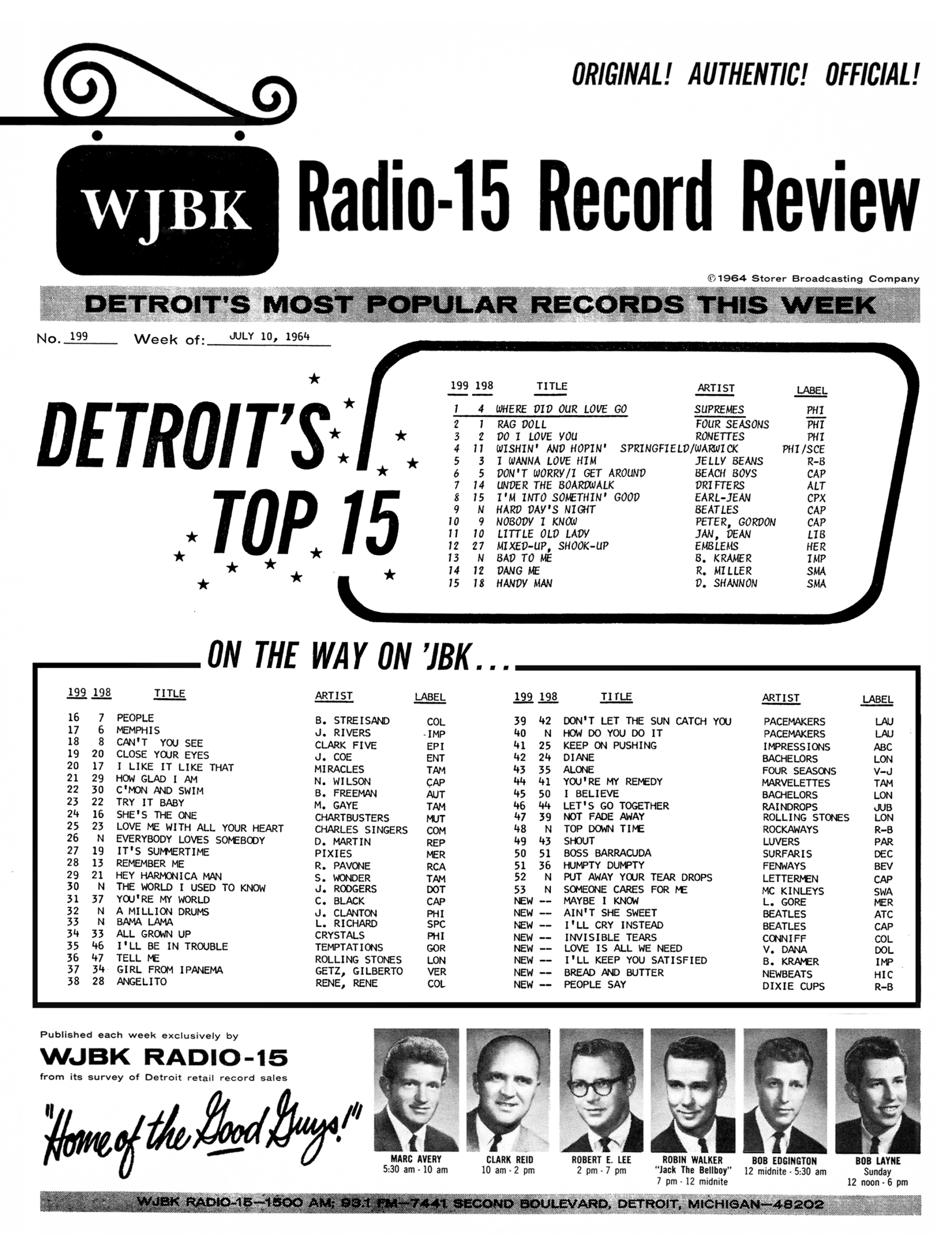
WJBK July 10, 1964 (Credit: Motor City Radio Flashbacks)
To honor the stations that shaped our lives.
To preserve the voices that guided us.
To keep alive the soundtracks of our cities, our families, and our memories.
Every survey we archive, every aircheck we restore, every tribute we write is part of that mission — a way of ensuring that stations like WJBK are never lost to time. For those of us who heard it in real time, Radio 15 will always hold a special place in our hearts. And for those discovering it now, we hope this history helps them understand why it mattered.
WJBK was one of the stations that made me fall in love with radio.
This tribute is my way of giving something back — a way of honoring those wonderful memories of WJBK, from a time when radio in the Motor City felt truly magical.
— Jim Feliciano, Co-publisher, USA Radio Museum
______________________________
Sources & Credits
A USA Radio Museum Archival Compilation
Primary Archival Materials
• USA Radio Museum (formerly Motor City Radio Flashbacks)
• WJBK Radio 1500 Record Review Surveys (1957–1964)
• WJBK Formula 45 Music Guides (1958)
• WJBK DJ Lineup Sheets and Internal Memos (1950s–1960s)
• Audio archives including Tom Clay, Dave Shafer, Terry Knight, and Clark Reid
• WJBK July 14, 1964 Final Record Review Survey (face‑sheet edition)
Newspaper & Periodical Sources
• The Detroit Free Press, January 17, 1952
• Billboard Magazine, August 1, 1964
Broadcast Industry Context
• Storer Broadcasting corporate history
• Detroit radio market analyses (1950s–1960s)
• Documented career timelines of WJBK personalities
Music & Theme Verification
• “Curtain Time” (1952) – Tony Acquaviva & The New York Symphony Orchestra (Tom Clay’s opening theme)
• “The Honeydripper” (1960) – The Kirby Stone Four (Dave Shafer’s show theme)
• “Wild Twist” (1962) – The Roller Coasters (Terry Knight’s show theme)
• “I Want to Be Happy” (1961) – The Four Freshmen Clark Reid’s morning theme
______________________________
Contact: jimf.usaradiomuseum@gmail.com
______________________________
A USARM Viewing Tip: On your PC? Mouse/click over each image for expanded views. On your mobile or tablet device? Finger-tap all the above images inside the post and stretch image across your device’s screen for LARGEST digitized view. Then click your browser’s back arrow to return to the featured post.
© 2026 USA Radio Museum. All rights reserved.
