
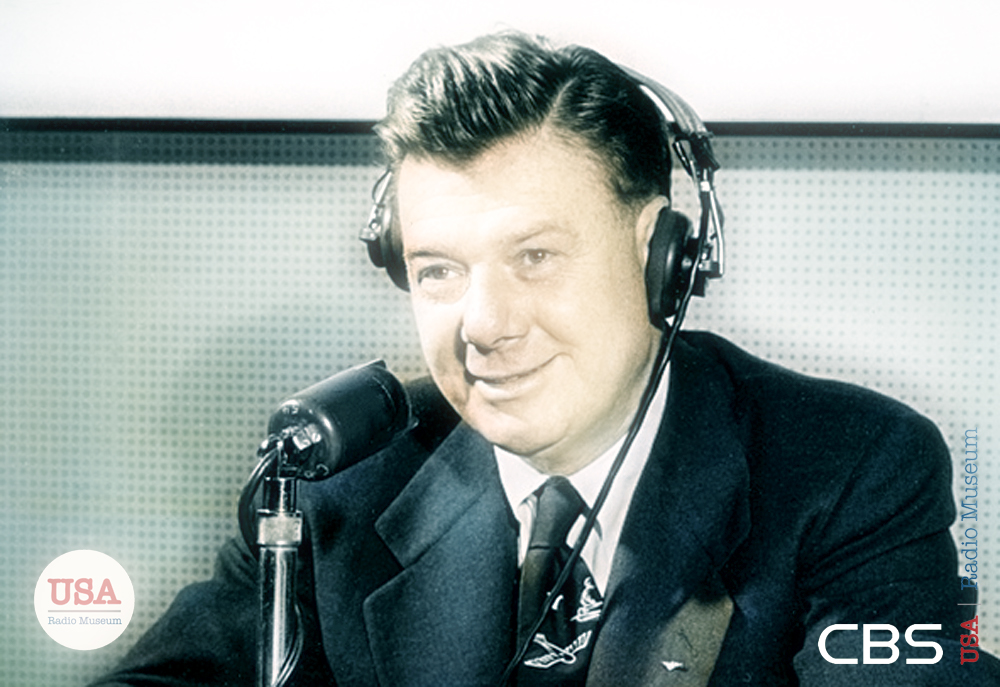
Introduction: A Four‑Decade Legacy That Shaped American Radio There are rare figures in broadcasting whose influence stretches not just across year
Introduction: A Four‑Decade Legacy That Shaped American Radio
 There are rare figures in broadcasting whose influence stretches not just across years, but across eras. Arthur Godfrey was one of them. Long before he became a national household name, before CBS built morning programming around his easygoing charm, Godfrey was already shaping the sound of American radio. The earliest surviving recording in the USA Radio Museum’s archive — a remarkable 53‑minute broadcast from September 21, 1939, originating from WSJV in Washington, D.C. — captures a young Godfrey at the dawn of a career that would span more than four decades, from 1939 to 1972. It is the first chapter in a story of evolution, innovation, and enduring connection.
By the time Arthur Godfrey Time premiered nationally on the CBS Radio Network in 1945, he had already spent years refining the conversational intimacy that would become his signature. What followed was not merely a successful program, but a cultural shift. Godfrey’s warm, unhurried style broke from the polished announcer tradition of early radio and introduced a new kind of authenticity — one that made listeners feel as though he were speaking directly to them. It was a transformation so profound that it redefined the relationship between broadcaster and audience.
For nearly thirty years on CBS, and more than forty years on the air overall, Arthur Godfrey Time became a morning ritual for millions. His voice guided America through wartetime recovery, postwar optimism, the rise of television, and the cultural upheavals of the 1960s. The USA Radio Museum’s collection of eighty‑nine surviving recordings, spanning from 1939 to 1972, preserves this extraordinary journey. These broadcasts are not simply archival treasures — they are living echoes of a man who helped shape the very language of radio.
This tribute honors that full arc: the early Washington years, the national CBS era, and the final broadcasts that closed one of the longest and most influential careers in American radio history. It is a celebration of a voice that became a companion to a nation, and a reminder of the enduring power of sincerity in a medium built on connection. — USA RADIO MUSEUM
_____________________
The Birth of a New Kind of Morning
When Arthur Godfrey Time premiered on the CBS Radio Network in May 1945, the country was emerging from the shadows of World War II. Americans were hungry for normalcy, warmth, and a sense of connection. Morning radio at the time tended to be brisk, scripted, and formal — a carryover from the announcer‑driven style of the 1930s. Godfrey, who had already made a name for himself on CBS with Arthur Godfrey’s Talent Scouts, brought something radically different.
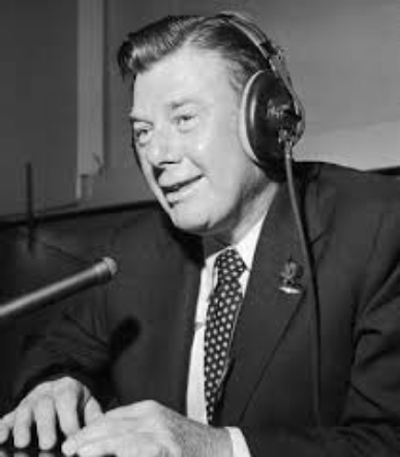 He spoke plainly. He spoke slowly. He spoke as if he were talking to one person, not millions.
This conversational intimacy was not an affectation; it was the essence of Godfrey’s appeal. He had discovered early in his career that the microphone rewarded authenticity. Instead of projecting, he leaned in. Instead of declaiming, he confided. Instead of performing, he conversed. The result was a style that felt revolutionary in its simplicity.
Listeners responded immediately. Within months, Arthur Godfrey Time became one of the most popular morning shows in the country. CBS recognized that it had something rare — a host who could command attention without raising his voice, who could make a scripted line sound spontaneous, and who could turn a commercial into a friendly recommendation. Advertisers adored him. Audiences trusted him. And the network gave him room to grow.
The Format: Music, Mischief, and Morning Ease
At its core, Arthur Godfrey Time was a variety program, but it never felt like one. The show blended music, light comedy, casual conversation, and occasional commentary, but the transitions were so seamless that the format seemed almost secondary. What mattered was the mood — relaxed, unhurried, and unmistakably Godfrey.
He surrounded himself with musicians and performers who shared his sensibility. The show featured the Mariners, the vocal group he championed; the talented Jeanette Davis; the orchestra led by Archie Bleyer; and a rotating cast of singers, instrumentalists, and guests. Music was central, but it was never presented with the formality of a concert. Instead, it drifted in and out of the program like a natural extension of the conversation.
Godfrey’s humor was gentle, often self‑deprecating, and rooted in observation rather than punchlines. He teased his cast affectionately, riffed on the news of the day, and occasionally wandered into personal anecdotes that felt like stories shared across a kitchen table. His spontaneity was legendary. Scripts were treated as suggestions. If a moment felt right, he followed it. If it didn’t, he ignored it.
This looseness was part of the show’s charm. It made listeners feel as though they were eavesdropping on a group of friends rather than listening to a polished broadcast. In an era when radio was still dominated by announcers with stentorian voices and rigid delivery, Godfrey’s style was a revelation.
_____________________
Arthur Godfrey | Columbia Broadcasting System | September 21, 1939
Audio Digitally Enhanced by USA Radio Museum
_____________________
The Television Years and the Height of Influence
By the early 1950s, Godfrey had become one of the most powerful figures in American broadcasting. CBS expanded his presence to television, and for a time Arthur Godfrey Time aired simultaneously on radio and TV. The cross‑platform success was unprecedented. Godfrey’s easygoing manner translated naturally to the screen, and his popularity soared.
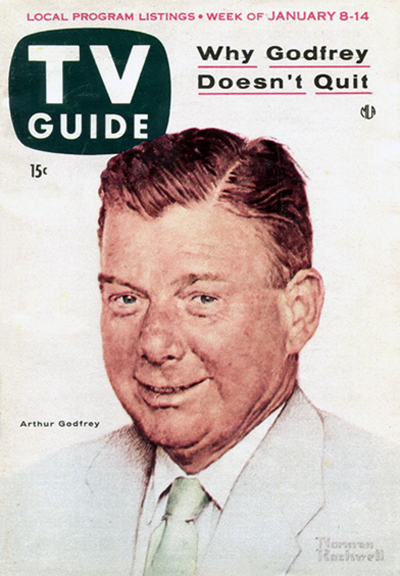
TV GUIDE: January 8, 1955
TIME magazine famously described him as the man millions relied on “no less than hot coffee to start their day.” It was not hyperbole. At the height of his influence, Godfrey commanded an audience that spanned generations, regions, and social classes. His endorsement could make or break a product. His approval carried weight. His disapproval could be devastating.
Yet even as television reshaped the media landscape, the radio version of Arthur Godfrey Time retained its unique charm. The intimacy of radio suited Godfrey’s style in a way television never fully replicated. On radio, he could pause, reflect, and let silence do the work. He could speak directly into the listener’s imagination. He could be, in the truest sense, a companion.
A Voice of Trust in a Changing America
The 1950s and 1960s were decades of profound transformation in American life. Television became dominant. Youth culture emerged. Music evolved. Politics grew turbulent. Through it all, Arthur Godfrey Time remained a constant — a reassuring presence in a world that seemed to be accelerating.
Godfrey’s appeal during these years was rooted in trust. He was not a shock jock, a provocateur, or a performer chasing trends. He was steady, familiar, and grounded. His commentary, when he offered it, was measured and thoughtful. He avoided controversy, preferring instead to focus on the small pleasures and everyday experiences that united his listeners.
This steadiness made him a fixture in homes across the country. For many Americans, Godfrey was not just a broadcaster; he was a friend. His voice was woven into the fabric of their mornings — a voice that greeted them as they prepared breakfast, read the newspaper, or headed to work.
The Decline of Network Variety Radio
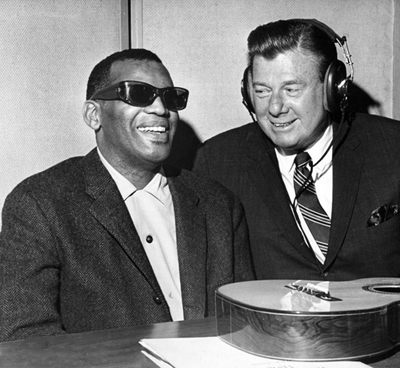
Arthur Godfrey interviews Ray Charles, 1967.
By the late 1960s, the era of network variety radio was drawing to a close. Music formats, talk radio, and local programming were reshaping the medium. The grand, personality‑driven shows that had dominated the 1940s and 1950s were fading. Yet Arthur Godfrey Time persisted, even as its audience aged and its cultural footprint narrowed.
Godfrey himself had slowed down. His health was declining, and his once‑prolific television presence had diminished. But he remained committed to his radio audience. The show continued on WCBS in New York, even after the network version had ended, and Godfrey’s voice — older now, but still warm — continued to greet listeners each morning.
One of the most poignant surviving recordings in the USA Radio Museum archive is from April 30, 1971. In it, Godfrey hosts the show with the same gentle ease that had defined his career, even as the world around him had changed dramatically. It is one of the last known broadcasts of Arthur Godfrey Time, and it stands as a testament to the endurance of a format — and a personality — that had once captivated the nation.
The Legacy of Arthur Godfrey Time
To understand the legacy of Arthur Godfrey Time, one must understand what it replaced. Before Godfrey, radio hosts were performers. They projected. They entertained. They maintained a certain distance from their audience. Godfrey collapsed that distance. He spoke as a friend, not a performer. He made the microphone an instrument of intimacy.
This shift had profound implications. Modern morning radio — from personality‑driven shows to conversational talk formats — owes a direct debt to Godfrey. His influence can be heard in the relaxed banter of contemporary hosts, in the blending of music and conversation, and in the emphasis on authenticity over performance.
But the legacy is not merely stylistic. It is emotional. Godfrey understood that radio was a companion medium. It kept people company. It filled quiet spaces. It offered comfort. Arthur Godfrey Time embodied that understanding. It was a show that made listeners feel seen, heard, and included.
For the USA Radio Museum, the eighty‑nine surviving recordings of Godfrey’s broadcasts are more than archival artifacts. They are living memories — echoes of a time when radio shaped the rhythm of daily life. They capture not only the sound of a show but the spirit of an era.
The Final Countdown: Arthur Godfrey’s Last Month on the Air (April 1972)
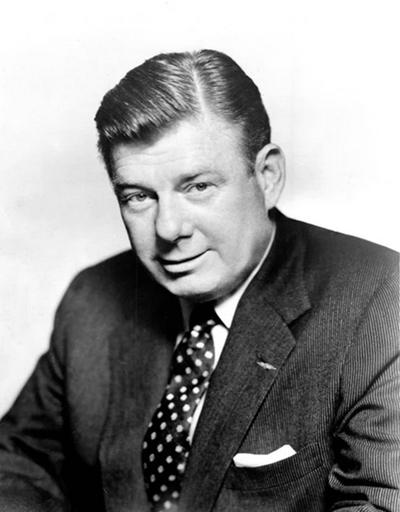 Among the most poignant treasures in the USA Radio Museum archive are the broadcasts from April 1972, the final month of Arthur Godfrey Time. These recordings reveal a host who understood that his long journey in radio was nearing its end — and who chose to mark that moment with a gesture both nostalgic and deeply personal.
Beginning on April 3, 1972, Godfrey launched a remarkable series of retrospective programs, each one dedicated to “remembering” a different year of his broadcasting life. The first of these, Remembering 1972, set the tone: reflective, warm, and tinged with the gentle humor that had defined his style for decades. Day by day, year by year, he walked listeners backward through time, revisiting the music, memories, and moments that had shaped both his career and the country.
This month‑long retrospective culminated in the final surviving broadcast in the USARM archive:
72‑04‑27 — Arthur Godfrey Time: Remembering 1948
This recording is especially significant. It represents the last known show preserved in the museum’s collection — a symbolic return to the postwar era when Godfrey’s national influence was rising and Arthur Godfrey Time was becoming a morning institution. In revisiting 1948, Godfrey was not merely recalling a year; he was revisiting the moment when his voice became part of the American household.
The structure of these April 1972 programs is unlike anything else in his archive. They are, in essence, Godfrey’s own curated farewell — a countdown through the years that mattered most to him, offered to the listeners who had traveled those years by his side. It is rare in broadcasting history for a host to narrate his own legacy in real time, rarer still for those broadcasts to survive.
The USA Radio Museum’s preservation of these shows — from April 3 through April 27, 1972 — captures the final arc of a four‑decade career. They stand as a testament to Godfrey’s enduring connection with his audience and to his instinctive understanding of radio as a medium of memory, companionship, and shared experience.
_____________________
Arthur Godfrey Time | ‘Remembering 1948’ | CBS Radio Network | April 27, 1972
Audio Digitally Enhanced by USA Radio Museum
_____________________
A Chronicle Preserved
The preservation of these recordings, spanning from 1939 to 1972, is a remarkable achievement. They allow historians, researchers, and enthusiasts to trace the evolution of Godfrey’s style, the shifting tone of the show, and the broader changes in American broadcasting. They reveal the subtle ways in which Godfrey adapted to new cultural landscapes while remaining true to his core identity.
Listening to these recordings today is a deeply evocative experience. One hears the warmth of Godfrey’s voice, the laughter of his cast, the easy interplay between music and conversation. One hears a nation waking up — not just to the news of the day, but to the comfort of familiarity.
In an age of digital media, where content is abundant but connection can feel elusive, the intimacy of Arthur Godfrey Time feels almost radical. It reminds us that the power of radio lies not in spectacle but in presence. It is the power of a voice, a moment, a shared experience.
Broadcasting Career Summary
Arthur Godfrey — A Four‑Decade Force in American Radio & Television
Arthur Godfrey’s broadcasting career stands as one of the longest, most influential, and most culturally transformative in American media history. Beginning in the 1930s on local radio — including early work on WFBR Baltimore and WSJV Washington — Godfrey developed a conversational, intimate style that broke sharply from the formal announcer tradition of the era. By the time he joined the CBS Radio Network in the mid‑1940s, he had already perfected the warm, one‑on‑one tone that would make him a national phenomenon.
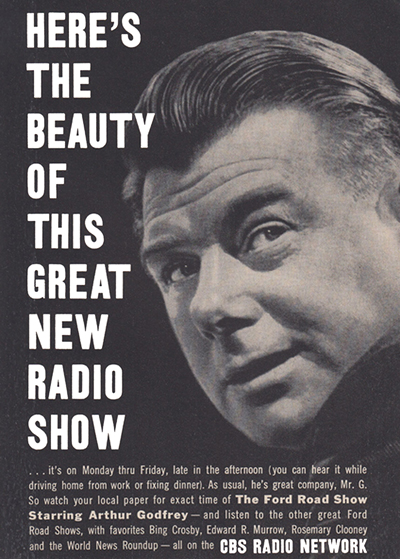 His flagship program, Arthur Godfrey Time, launched nationally in 1945 and ran until 1972, becoming the country’s most beloved morning ritual. At his peak in the early to mid‑1950s, Godfrey was heard or seen up to six days a week, hosting as many as nine separate CBS broadcasts, including Arthur Godfrey’s Talent Scouts and Arthur Godfrey and His Friends. His influence extended across radio and television simultaneously — a rare feat in the early days of TV.
Godfrey’s relaxed, unrehearsed style revolutionized broadcasting. He treated commercials as friendly recommendations, spoke directly to listeners, and cultivated an atmosphere of ease and authenticity. His approach became the blueprint for modern personality‑driven radio and morning broadcasting.
By the late 1960s, as network variety radio declined, Godfrey remained one of the last great voices of the golden era. His final month of broadcasts in April 1972 — preserved in the USA Radio Museum archive — forms a poignant retrospective of his entire career, culminating in Remembering 1948, the last known surviving recording.
His legacy endures in every broadcaster who values sincerity, warmth, and the power of a human voice to connect.
Biographical Profile
Arthur Morton Godfrey (1903–1983)
Arthur Morton Godfrey was born on August 31, 1903, in Manhattan, New York. Raised in modest circumstances, he developed an early fascination with radio technology and communication. His service in the U.S. Navy and Coast Guard during the 1920s provided formal radio training and shaped his understanding of the medium’s potential for connection and companionship.
Godfrey’s broadcasting career began in the early 1930s on WFBR in Baltimore, where he quickly distinguished himself with a relaxed, conversational delivery that contrasted sharply with the booming announcer voices of the era. By the late 1930s, he was a rising presence on Washington, D.C. radio — including the 1939 WSJV broadcast preserved in the USA Radio Museum archive.
His national breakthrough came with CBS in the 1940s. Over the next two decades, Godfrey became one of the most recognizable voices in America, hosting multiple top‑rated radio and television programs. His ukulele playing, gentle humor, and unhurried pacing made him a household name.
Godfrey was also a passionate aviation advocate, a skilled pilot, and a public figure whose influence extended beyond entertainment. His endorsement power was legendary; his authenticity, unmatched.
He continued broadcasting into the early 1970s, concluding his career with a reflective series of programs in April 1972. Arthur Godfrey died on March 16, 1983, in New York City at age 79.
_____________________
Arthur Godfrey Time | ‘Remembering 1958’ | CBS Radio Network | April 17, 1972
Audio Digitally Enhanced by USA Radio Museum
_____________________
Obituary‑Style Tribute
Arthur Godfrey, Beloved Broadcaster Who Redefined American Radio, Dies at 79
Arthur Godfrey, arguably one of the most influential and beloved figures in American broadcasting, died on March 16, 1983, in New York City at the age of 79. For more than four decades, Godfrey’s warm, conversational voice was a daily presence in American homes, guiding listeners through mornings, introducing new talent, and reshaping the very nature of radio and television performance.
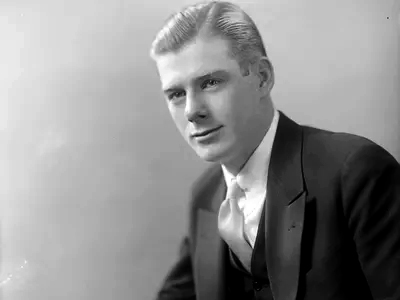
Arthur Godfrey, 1930s.
Born in Manhattan in 1903, Godfrey rose from modest beginnings to become a national institution. His early radio work in Baltimore and Washington revealed a natural gift for intimacy — a style that made listeners feel as though he were speaking directly to them. When he joined the CBS Radio Network in the 1940s, that gift blossomed into a phenomenon.
Arthur Godfrey Time, his long‑running morning program, became a staple of American life from 1945 to 1972. At the height of his fame in the 1950s, Godfrey was heard or seen on CBS as many as nine times a week, hosting Arthur Godfrey’s Talent Scouts, Arthur Godfrey and His Friends, and other top‑rated programs. His influence was so profound that TIME magazine once wrote that millions relied on him “no less than hot coffee to start their day.”
Godfrey’s broadcasting philosophy was simple: be yourself. His gentle humor, unhurried pacing, and sincere delivery made him one of the most trusted voices in America. He championed musicians, nurtured new talent, and treated commercials as personal recommendations rather than scripted interruptions. His approach became the foundation of modern personality‑driven broadcasting.
His contributions were recognized with numerous honors, including induction into the Radio Hall of Fame, induction into the NAB Broadcasting Hall of Fame in 1977, a 1972 Peabody Award for personal achievement, and three stars on the Hollywood Walk of Fame — for Radio, Television, and Recording — all awarded in 1960.
Godfrey’s final broadcasts in April 1972, preserved in the USA Radio Museum archive, form a moving retrospective of his life in radio — a month‑long farewell in which he revisited the years that shaped him and the listeners who had traveled those years with him.
Arthur Godfrey leaves behind a legacy that continues to echo through the airwaves. His voice, his warmth, and his pioneering spirit helped define an era — and continue to inspire broadcasters who understand that the heart of radio is not performance, but connection.
_____________________
Arthur Godfrey Time | ‘Remembering 1968’ | CBS Radio Network | April 07, 1972
Audio Digitally Enhanced by USA Radio Museum
_____________________
Conclusion: The Enduring Echo of a Morning Companion
Arthur Godfrey Time was more than a radio show. It was a cultural institution, a daily ritual, and a pioneering force in American broadcasting. It introduced a new kind of authenticity, reshaped the relationship between host and listener, and set the template for modern morning radio. Its influence endures not only in the formats it inspired but in the memories of those who welcomed Godfrey into their homes each day.
For the USA Radio Museum, revisiting this chronicle is an act of preservation and celebration. It honors a show that helped define an era, a host who became a national companion, and a medium that continues to evolve while carrying echoes of its past. The eighty‑nine recordings preserved in the museum’s archive stand as a testament to the enduring power of radio — and to the man who understood that power better than anyone.
Arthur Godfrey once said that the secret to broadcasting was simple: “Just be yourself.” In a world of noise, he offered clarity. In a world of performance, he offered sincerity. And in a world that was changing faster than ever, he offered something timeless — a voice that felt like home.
______________________________
Sources & Credits:
The New York Times – Obituary: Arthur Godfrey, 79, Radio and TV Host
Provides biographical details, career milestones, and context surrounding his passing in 1983.
The Washington Post – Arthur Godfrey: A Broadcasting Original
Offers insight into Godfrey’s early Washington, D.C. years and his rise from local to national prominence.
Smithsonian Magazine – The Man Who Made Radio Personal
Explores Godfrey’s conversational style and its impact on the evolution of American broadcasting.
Broadcasting Magazine Archives (1940s–1970s)
Document contemporary coverage of Arthur Godfrey Time, CBS programming decisions, and Godfrey’s influence during the Golden Age of Radio.
Peabody Awards – Recipient Profile (1972)
Confirms Godfrey’s Peabody Award for personal achievement and contributions to broadcasting.
National Association of Broadcasters – Broadcasting Hall of Fame Inductees (1977)
Recognizes Godfrey’s induction and summarizes his industry‑wide impact.
Hollywood Walk of Fame – Star Records (1960)
Verifies Godfrey’s three stars (Radio, Television, Recording) and his cross‑media influence.
Library of Congress – Recorded Sound Research Center
Provides historical context on network radio, variety programming, and the preservation of mid‑century broadcasts.
USA Radio Museum Archives (1939–1972)
Includes 89 surviving recordings of Arthur Godfrey Time, featuring the earliest known WSJV broadcast from September 21, 1939, and the final April 1972 “Remembering…” retrospective series.
______________________________
Contact: jimf.usaradiomuseum@gmail.com
______________________________
A USARM Viewing Tip: On your PC? Mouse/click over each image for expanded views. On your mobile or tablet device? Finger-tap all the above images inside the post and stretch image across your device’s screen for LARGEST digitized view. Then click your brower’s back arrow to return to the featured post.
© 2025 USA Radio Museum. All rights reserved.
