
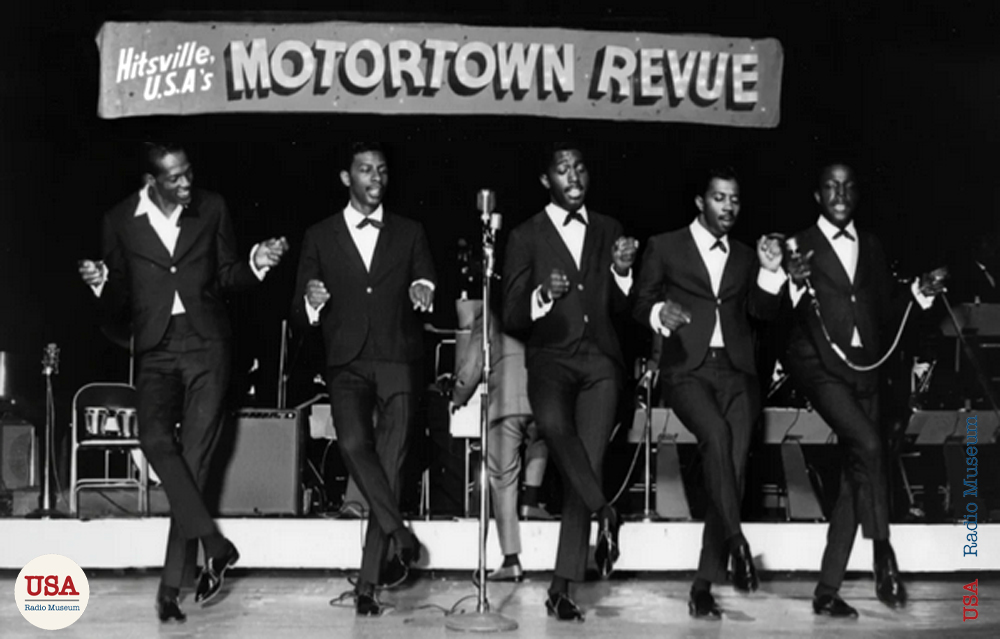
Overture: Detroit Wintry Nights Under the Fox Theater Lights Every December, as the cold settled over Detroit and Woodward Avenue shimmered wit
Overture: Detroit Wintry Nights Under the Fox Theater Lights
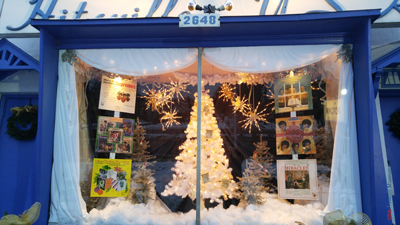
Motown Museum: Hitsville U.S.A., photo taken by the author, 8:06 a.m. Christmas morning, December 25, 2016.
Every December, as the cold settled over Detroit and Woodward Avenue shimmered with holiday lights, something magical happened at the Fox Theatre. Families bundled in coats, teenagers clutching transistor radios, and Motown fans of every age lined up beneath the glowing marquee. They weren’t just attending a concert — they were stepping into a ritual, a celebration, a homecoming.
The Motor Town Revue wasn’t merely a show. It was Motown’s annual gift to the city that raised it. For one week — sometimes ten days — the Fox Theatre became the center of the Motown universe. The stars came home. The hits came alive. And Detroit, in all its grit and glory, gathered to witness the sound that was reshaping American culture.
From 1963 through 1969, the Motor Town Revue at the Fox Theatre became a cherished holiday tradition — a blend of spectacle, community, and pure musical joy. What follows is the story of those unforgettable years, told through the artists, the songs, the ads, and the memories preserved in the Detroit Free Press archives.
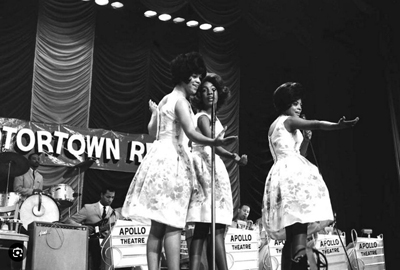
The Supremes performing at the Apollo Theater’s Motortown Revue in New York’s Harlem district, 1963.
The Motor Town Revue has always held a special place in Detroit’s heart — and in mine. As a lifelong student of radio, music, and the cultural forces that shape us, I’ve always believed that these stories deserve to be preserved with care, accuracy, and emotion. The Revue wasn’t just a concert series; it was a moment in time when Detroit’s creativity and community converged on one stage.
By bringing back these yearly-ads, these memories, and these performances back into the light, we honor not only the artists who made Motown a global force, but the audiences who filled the Fox Theatre year after year. This feature is dedicated to them — to the families, the fans, the dreamers, and the city that made Motown possible.
In behalf of Jim Hampton, and I, thank you for taking this journey with us.— Jim Feliciano (co-curator), USA RADIO MUSEUM
_____________________
I. Before the Beginning: The Regal Theater Motortown Revue Performance (1962)
The Night “Fingertips” Became a Legend in Chicago
According to Classic Motown, the first Motortown Revue, launched in late 1962, was a fully Motown‑produced package tour — conceived, staffed, and operated entirely in‑house by Berry Gordy and his team. As Gordy later recalled, “We had in‑house everything . . . artists, producers, musicians, chaperones and road managers.” Originally billed as the “Motor Town Special,” the tour played more than 30 shows across the eastern United States from late October through mid‑December 1962, introducing Motown’s young roster to audiences far beyond Detroit.
On to Chicago.
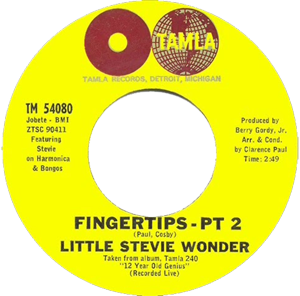 Long before “Fingertips (Part 2)” topped the charts, it was simply a moment — a spontaneous, electrifying moment — inside the Regal Theater in Chicago during the Motortown Revue of 1962. Stevie Wonder was only twelve years old, a boy with boundless energy and a harmonica that seemed almost too powerful for his small hands. The crowd was already buzzing from his performance when Stevie unexpectedly returned to the stage for an encore. The band, caught mid‑transition to the next act, scrambled to rejoin him.
What happened next became one of the most famous live moments in Motown history. As Stevie launched into another burst of harmonica improvisation, a frantic voice from the band can be heard on the recording shouting, “What key? What key?” twice — a raw, unfiltered slice of live performance chaos. Instead of derailing the moment, it added to the electricity. The audience roared.
Stevie fed off the energy. The band locked in. And a legend was born.
That recording — imperfect, spontaneous, alive — became the foundation of the Tamla single released in the summer of 1963. It was Motown’s first live No. 1 hit and the record that transformed Little Stevie Wonder into a national sensation. The Regal Theater didn’t just host a concert that night. It captured lightning.
In that moment, a child became a star. A live recording became a phenomenon. And Motown discovered that its future could be shaped not only in the studio, but on the stage — in front of real audiences, in real time, with real magic.
Stevie Wonder didn’t just perform that night.
He changed Motown forever.
II. 1963 — The Beginning: November 10–16, 1963
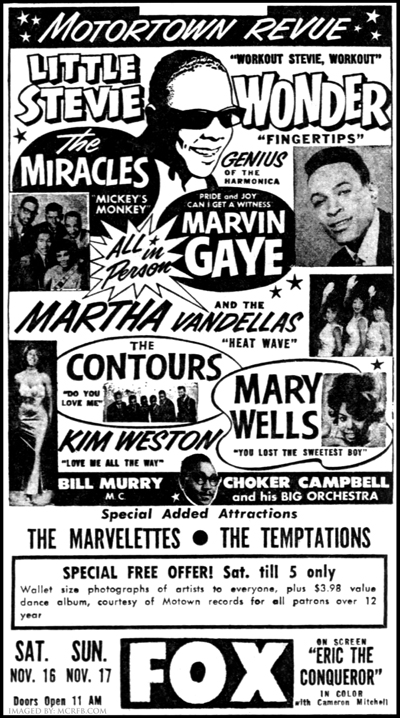
Detroit Free Press, November 10, 1963
The first Motor Town Revue at the Fox Theatre arrived with the energy of a movement on the rise. Motown was still young, but its artists were already reshaping the sound of American radio. The Detroit Free Press ad for the 1963 Revue reads like a snapshot of Motown’s early brilliance.
Stevie Wonder — still a very young teenager — was featured with “Workout Stevie, Workout” and “Fingertips,” the song that had made him a national sensation. The Miracles brought “Mickey’s Monkey,” charting nationally a Top 10. Marvin Gaye performed “Pride And Joy,” and Martha & The Vandellas lit up the stage with their 1963 anthem “Heat Wave.” The Contours delivered “Do You Love Me,” off the Gordy label (naturally, it was named after its founder) which became the group’s first national rise in 1962, while Mary Wells took to the stage and sang her latest Motown single, “You Lost The Sweetest Boy,” and Kim Weston offered “Love Me All The Way” on Tamla.
Also billed were The Marvelettes, The Temptations, M.C. Bill Murray, and Choker Campbell & His Orchestra — the musical backbone of Motown’s live sound in the early-1960s.
Motown sweetened the excitement with a “Special Free Offer”: wallet‑size artist photos for all attendees and a $3.98 dance album for patrons over 12. It was clever marketing, yes — but more than that, it was a gesture of gratitude. Detroit had embraced Motown, and Motown embraced Detroit right back.
The tradition had begun.
III. 1964–65 — December 25, 1964 to January 1, 1965
By the following year, the Motor Town Revue had grown into a full holiday spectacle. The 1964–65 lineup was a showcase of Motown’s rising stars and its growing confidence.
Marvin Gaye appeared once again at the Fox with “Pride and Joy” and “How Sweet It Is.” Smokey Robinson & The Miracles performed “Can You Do The Jerk” and “Mickey’s Monkey.” The Supremes — now in the middle of their breakthrough — sang “Come See About Me” and “Baby Love.” Both singles gained the number one spot on the Billboard Hot 100 that year. Stevie Wonder returned with “Fingertips,” still electrifying audiences by popular demand.
The Marvelettes brought “Too Many Fish in the Sea,” while The Temptations performed “The Way You Do the Things You Do” and “Girl (Why You Wanna Make Me Blue).” The bill also included The Headliners, Willie Tyler & Lester, Tommy Good & The Tabs, and Choker Campbell’s band featuring Earl Van Dyke, who promoted his Soul Records single “Soul Stompin’.”
Comic M.C. Bill Murry kept the show moving with humor and warmth.
This Revue felt polished, confident, and unmistakably Motown — a holiday tradition now firmly rooted in Detroit’s cultural calendar.
IV. 1965–66 — December 25 to New Year’s Eve, 1965
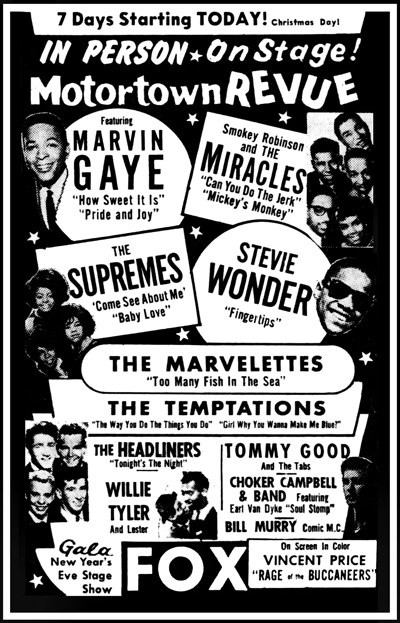
Detroit Free Press, December 25, 1964
The 1965 Revue captured Motown at a moment of explosive growth. Marvin Gaye returned with “Ain’t That Peculiar” and “How Sweet It Is,” The Temptations performed “My Girl,” and Martha & The Vandellas delivered “Dancing in the Street” and “Love Makes Me Do Foolish Things.”
Jr. Walker & The All Stars brought raw energy with “Cleo’s Mood” and “Shotgun.” Harvey Fuqua’s Tri-Phi and Harvey labels (Detroit based) were taken over by Motown Records in 1963, and Junior Walker and the All-Stars began recording for the subsidiary label Soul in 1964. Stevie Wonder performed “Fingertips” and “Uptight,” while Chris Clark introduced “Do Right Baby, Do Right,” and Tammi Terrell sang her first Motown hit, “I Can’t Believe You Love Me.”
Choker Campbell & His Orchestra headlined the New Year’s Eve gala with “Soul Stompin’” and “Can’t Help Myself,” giving the Fox Theater a jubilant send‑off into 1966.
This Revue felt like a celebration of Motown’s expanding universe — a label surging with new ambition and national momentum. And by now, Detroit claimed Motown with unmistakable pride. These weren’t just performers on a stage; they were the city’s own sons and daughters, carrying Detroit’s sound, swagger, and soul across the country.
V. 1966 — December 25 to New Year’s Eve, 1966
By 1966, Motown was at full power, and the Motor Town Revue reflected that strength. The Temptations headlined with “I’m Losing You,” “Ain’t Too Proud to Beg,” and “Beauty’s Only Skin Deep.” Stevie Wonder performed “A Place in the Sun,” “Fingertips,” and “Blowin’ in the Wind,” while Martha Reeves & The Vandellas delivered “I’m Ready for Love,” “Dancing in the Street,” and “Nowhere to Run.”
Gladys Knight & The Pips appeared with “Every Beat of My Heart,” Jimmy Ruffin with “What Becomes of the Brokenhearted” and “I’ve Passed This Way Before,” and The Underdogs — a newly signed white Detroit band — performed their local hit “Love’s Gone Bad.”
J.J. Barnes (a Ric-Tic Records artist/product bought out by Gordy earlier in the year), Tammi Terrell, and the Earl Van Dyke Band rounded out a lineup that blended Motown’s established stars with its rising voices.
This Revue felt like a city‑wide celebration — Detroit’s pride reflected back at itself through the music it had given the world.
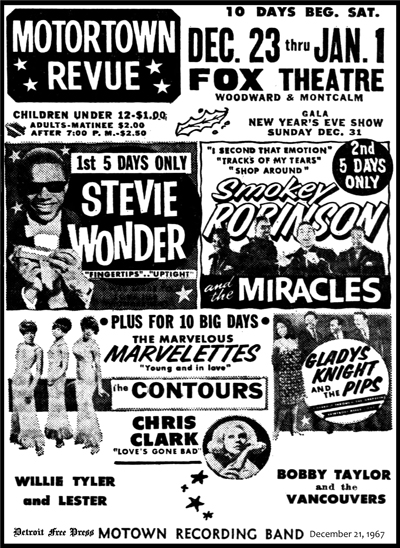
VI. 1967–68 — December 23 through New Year’s Day, 1968
The 1967 Revue stretched across ten days, with Stevie Wonder and Smokey Robinson & The Miracles headlining the first five days only. Stevie brought “Fingertips” and “Uptight,” while Smokey and The Miracles performed “I Second That Emotion,” “Tracks of My Tears,” and “Shop Around.”
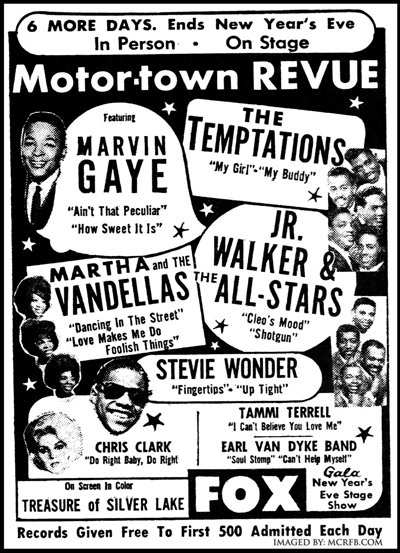
Detroit Free Press, December 26, 1965
For the full ten‑day run, the bill featured The Marvelettes (“Young and In Love”), The Contours, Chris Clark (“Love’s Gone Bad”), Gladys Knight & The Pips, Willie Tyler & Lester, and Motown’s newest signing, Bobby Taylor & The Vancouvers — a groundbreaking interracial Canadian band whose guitarist, Tommy Chong, would later become half of Cheech & Chong.
Ticket prices remained accessible: $1 for children under 12, $2 for adult matinees, and $2.50 after 7 p.m.
This Revue captured Motown at a crossroads — honoring its early stars while embracing new directions and new audiences into a new year.
VII. 1968–69 — December 26 through New Year’s Day, 1969
The final known Motor Town Revue at the Fox Theatre closed the decade with power and poignancy. The Temptations headlined with “Cloud 9,” “(I Know) I’m Losing You,” and “I Could Never Love Another,” signaling their new psychedelic‑soul direction. Gladys Knight & The Pips performed “I Wish It Would Rain,” “It Should Have Been Me,” and their remake of Stevie Wonder’s “You Met Your Match.” Stevie himself appeared with “For Once in My Life” and “Uptight.”
Bobby Taylor & The Vancouvers returned with “Does Your Mama Know About Me,” joined by Motown newcomer (and Edwin Starr talent discovery) Blinky (“I Wouldn’t Change The Man He Is”), The Originals (“Goodnight Irene”), Willie Tyler & Lester, and Bohannon’s Band — the live embodiment of the Motown Sound.
Ticket prices matched the previous year, keeping the tradition accessible to Detroit families until the very end.
In historical hindsight, this Revue felt like a farewell — not announced, not formalized, but felt. A chapter closing as Motown prepared to write its next one in the last year of the decade.
VIII. Beyond Detroit: The Motortown Revue on the Road
Brooklyn Fox Theatre (1963) & Apollo Theater (1963)
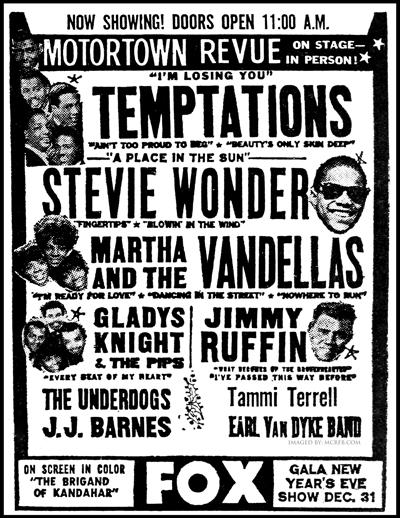
Detroit Free Press, December 27, 1966
While Detroit’s Fox Theatre became the spiritual home of the Motor Town Revue, Motown’s touring machine also carried the show to major East Coast stages — most notably the Brooklyn Fox Theatre and Harlem’s Apollo Theater in 1963.
At the Brooklyn Fox (sadly, this historic venue succumbed to a wrecking ball in 1970 for a parking lot), the Revue introduced New York audiences to the rising Motown roster. These shows were part of Motown’s early push into major urban markets, bringing the Detroit sound to teenagers who had only heard the hits on radio.
But it was the Apollo Theater performance — also in 1963 — that became legendary. Recorded live and later released by Motown Records, the Apollo show captured the raw electricity of the Revue at a pivotal moment. The Apollo audience, famous for its honesty and intensity, embraced Motown’s young stars with thunderous enthusiasm.
These East Coast performances expanded the Revue’s reach, sharpened the artists’ stagecraft, and demonstrated that Motown’s magic resonated far beyond Detroit.
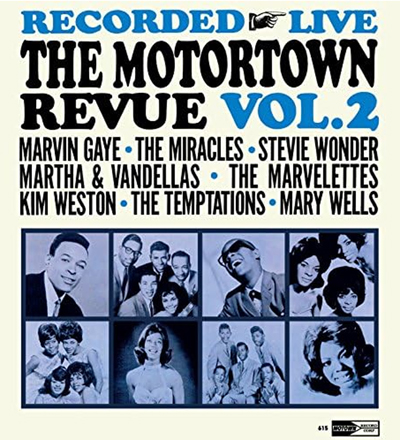 IX. Recorded Live at the Apollo: The Motortown Revue’s First Great Live Album (1963)
In late 1963, Motown brought the Motor Town Revue to Harlem’s Apollo Theater — a venue known for launching careers and testing the mettle of even the most seasoned performers. What happened on that stage was so electric, so undeniable, that Motown made the bold decision to record the show and release it as a live album.
The result was Recorded Live at the Apollo: The Motortown Revue, Vol. 1, a landmark LP that captured the label’s young roster at a moment of explosive growth.
The album features unforgettable performances by:
• The Contours
• The Supremes
• Marvin Gaye
• The Marvelettes
• Stevie Wonder
• Mary Wells
• Smokey Robinson & The Miracles
Detroit Free Press, December 21, 1967
What makes the album extraordinary is its authenticity. You hear the crowd — loud, responsive, ecstatic. You hear the artists feeding off that energy. You hear Motown’s stagecraft in its early form: tight arrangements, crisp choreography, and the unmistakable pulse of the Motown Sound.
For many listeners, this LP was their first taste of Motown live. It revealed the label not just as a hit‑making machine, but as a powerhouse of performance — a company whose artists could command the toughest stage in America and leave it roaring.
Today, the Apollo album stands as a priceless artifact of Motown’s early touring years and a testament to the power of the Motor Town Revue.
X. The Revue as a Launchpad for Stars
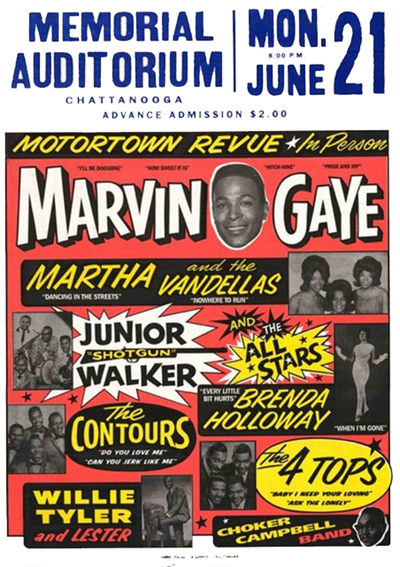
Motortown Revue, Chattanooga, Tennessee, 1965.
Long before Motown artists became household names, the Motor Town Revue served as their proving ground — a stage where raw talent met Detroit audiences who were honest, discerning, and fiercely loyal. The Revue wasn’t just a showcase; it was a laboratory. It was where Motown tested new acts, refined choreography, perfected harmonies, and shaped performers into world‑class entertainers.
Stevie Wonder’s early appearances are a perfect example. Still a teenager, he stepped onto the Fox Theatre stage with the same exuberance that electrified “Fingertips.” Detroit audiences watched him grow in real time — from prodigy to artist, from novelty to visionary.
The Supremes, too, found their footing here. Before they became the most successful girl group in history, they were a struggling trio searching for their breakthrough. The Revue gave them visibility, confidence, and a direct connection to the fans who would soon propel “Baby Love” and “Come See About Me” to the top of the charts.
The Temptations’ rise followed a similar arc. Their early Revue performances revealed a group whose harmonies, choreography, and charisma were sharpening with every show. Detroit audiences witnessed their evolution from promising newcomers to Motown’s crown jewels.
Behind the scenes, Motown’s legendary choreographers — Cholly Atkins, Maurice King, and others — used the Revue to refine the signature stagecraft that would define Motown’s live performances for decades. Precision steps. Elegant hand gestures. Seamless transitions. The Revue was where it all came together.
For the USA Radio Museum, this section of the story is essential. The Revue wasn’t just entertainment — it was the birthplace of the Motown stage tradition, a living classroom where the sound and story of radio and live performance were shaped before the world ever heard them.
_____________________
SIDEBAR | The Fox Theatre: A Character in the Story
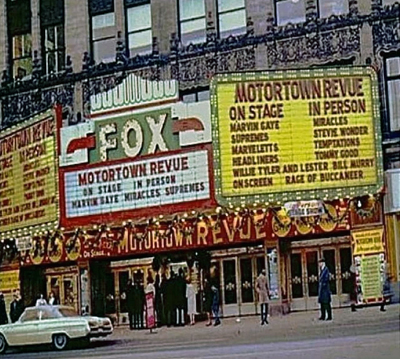
The Motortown Revue, Fox Theater in Detroit, December 1964.
The Fox Theatre was more than a venue — it was a cathedral of sound, a palace of dreams, and a cultural anchor for Detroit. Its gilded ceilings, sweeping balconies, and glowing marquee created an atmosphere of grandeur that elevated every performance. For Motown artists, performing at the Fox wasn’t just another gig; it was a homecoming, a rite of passage, a moment of belonging.
The acoustics of the Fox were legendary. The building seemed to breathe with the music — amplifying Stevie Wonder’s harmonica, carrying Martha Reeves’ voice to the rafters, and giving The Temptations’ harmonies a warmth that felt almost spiritual. The Fox didn’t just host the Revue; it shaped its sound.
In Detroit’s entertainment history, the Fox stood as a beacon — a place where the city gathered to celebrate, escape, and dream. When Motown transformed it into a holiday tradition, the connection deepened. Families returned year after year. Children grew up with the Revue as part of their December memories. The Fox became a symbol of Detroit pride, resilience, and joy.
Even today, Detroiters speak of the Fox with reverence. It is a place where memories live — where Motown’s magic once filled the air, where the Motor Town Revue became a ritual, and where the city’s cultural heartbeat echoed through every performance.
_____________________
XI. Berry Gordy’s Vision: The Revue as Motown’s First Great Marketing Masterstroke

The Motortown Revue headed for the Tamla-Motown U.K. Tour in 1965.
Berry Gordy didn’t just support the Motor Town Revue — he understood its potential from the moment he saw it. In 1963, as Motown’s roster of young artists began to blossom, Gordy recognized that the Revue could be far more than a concert series. It could be a marketing engine, a talent‑development platform, and a brand‑building spectacle that introduced audiences to the Motown Sound in its purest form: live, energetic, and unforgettable.
The Revue allowed Gordy to showcase multiple artists in one night, giving fans a sampler of Motown’s growing talent. Even if someone came to see Mary Wells or The Miracles, they left talking about Stevie Wonder, Martha & The Vandellas, or The Temptations. Every performance became a cross‑promotion. Every applause break was a commercial. Every ticket sold was an investment in Motown’s future.
The Revue also served as Gordy’s live laboratory. He watched how audiences reacted to new songs, new choreography, new arrangements. If a number brought the house down at the Fox Theatre, Gordy knew it had the potential to be a hit. If a routine needed tightening, the Revue revealed it instantly. In this way, the Motor Town Revue helped shape Motown’s stagecraft long before the world saw it on television.
Gordy’s genius wasn’t just in making records — it was in understanding how to build a movement. The Motor Town Revue was one of his earliest and boldest steps toward that vision.
XII. Crossing the Atlantic: The Motortown Revue Goes International (1965)
By 1965, Motown had conquered the American radio landscape — and Berry Gordy set his sights on the world. That year, he made a bold move: he took the Motor Town Revue across the Atlantic, introducing the Motown Sound to audiences in England, France, and eventually the Tamla/Motown brand leap-frogged across the European Continent.
The lineup was extraordinary:
• The Supremes
• The Temptations
• Smokey Robinson & The Miracles
• Martha & The Vandellas
• Stevie Wonder
• The Earl Van Dyke Band
For many British fans, this was their first time seeing Motown artists live — and the reaction was explosive. England embraced the Motown Sound with a passion that surprised even Gordy. British audiences were captivated by the harmonies, the choreography, the energy, and the sheer polish of Motown’s performers.
The tour ignited a cultural spark.
British musicians studied Motown’s arrangements.
Radio stations expanded their playlists.
Fans lined up for autographs and imported singles.
 From England, the excitement spread to France, where Motown artists performed to enthusiastic crowds who had only heard the music on European radio. By the end of 1965, the Motor Town Revue had become an international phenomenon — a cultural ambassador for Detroit and a symbol of American musical innovation.
This European tour laid the groundwork for Motown’s global dominance. It proved that the Motown Sound transcended borders, languages, and cultures. And it marked the moment when Detroit’s music became the world’s finest sound heard on the radio in the ’60s pop era.
Why The Motortown Revue Still Matters
These two developments — Gordy’s early marketing genius and the Revue’s international expansion — reveal the full scope of the Motor Town Revue’s impact.
It wasn’t just a Detroit holiday tradition.
It was a strategic engine, a global ambassador, and a cultural bridge.
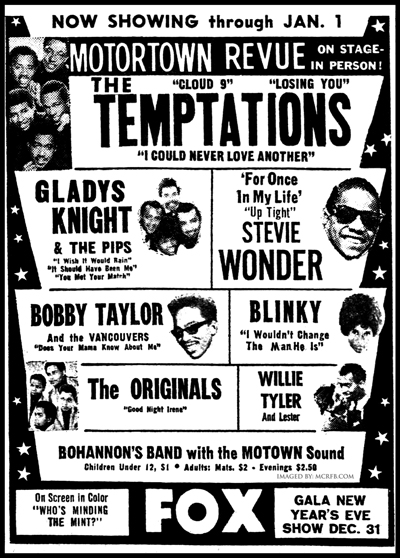
Detroit Free Press, December 29, 1968
Today, the Motor Town Revue stands as a symbol of Detroit’s golden musical era — a time when the city’s creativity, energy, and spirit shaped the sound of a generation.
Its influence can be felt in later Motown tours, in the choreography and stagecraft that became industry standards, and in the memories of those who attended the shows. For many Detroiters, the Revue wasn’t just entertainment — it was a shared experience, a holiday ritual, a moment of pride.
The ads preserved in the Detroit Free Press archives capture this legacy in ink and imagery. They are time capsules, each one a snapshot of a city in motion, a label on the rise, and a community gathering to celebrate the music it helped create. Their typography, their phrasing, their exuberant exclamation points — all of it reflects the optimism and excitement of a Detroit that believed in its artists and saw its own story reflected on the Fox Theatre marquee and stage.
These ads remind us that the Motor Town Revue was more than a concert series. It was a cultural ritual that brought families downtown during the holidays. It was a showcase that launched careers and shaped legends. It was a bridge between radio and live performance, between the studio and the stage, between Detroit and the world.
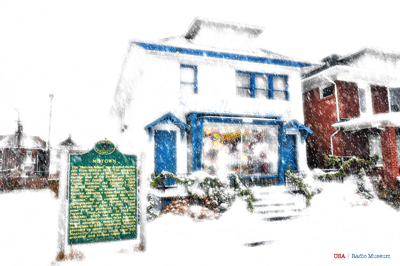
The Motown Museum basking in Detroit wintry glow, 2013. (Credit: Motor City Radio Flashbacks)
And today, its legacy lives on through the work of the USA Radio Museum. By preserving these ads, documenting the lineups, and telling the stories behind the shows, the museum ensures that the Motor Town Revue remains accessible to new generations — not as a distant memory, but as a living, breathing chapter of American music history of the 1960s.
The Revue endures because it represents the best of what Detroit has always been: creative, resilient, joyful, and united by the power of music, affectionately remembered always as The Motown Sound, The Sound of Young America.
By preserving this piece of Motown history, the USA Radio Museum honors not only the artists who performed, but the visionaries who understood how powerful radio, live performance, and community could be when united with purpose — the very spirit that rose from Detroit’s neighborhoods and dance halls, lit the Fox Theatre in brilliance, and ultimately carried the Motown Sound from the heart of the Motor City to every corner of the world.
______________________________
Contact: jimf.usaradiomuseum@gmail.com
______________________________
Post updated 10:23 a.m. EST., December 24, 2025
A USARM Viewing Tip: On your PC? Mouse/click over each image for expanded views. On your mobile or tablet device? Finger-tap all the above images inside the post and stretch image across your device’s screen for LARGEST digitized view. Then click your brower’s back arrow to return to the featured post.
© 2025 USA Radio Museum. All rights reserved.

It would be cool if The Jackson 5ive ended the MoTown’s MotorTown ReVue right before the record company moves to L.A.