
Exhibit Overview Across the 1960s, July 9 surfaces as a quietly consequential date — not for a single headline‑making event, but for four moments
Exhibit Overview
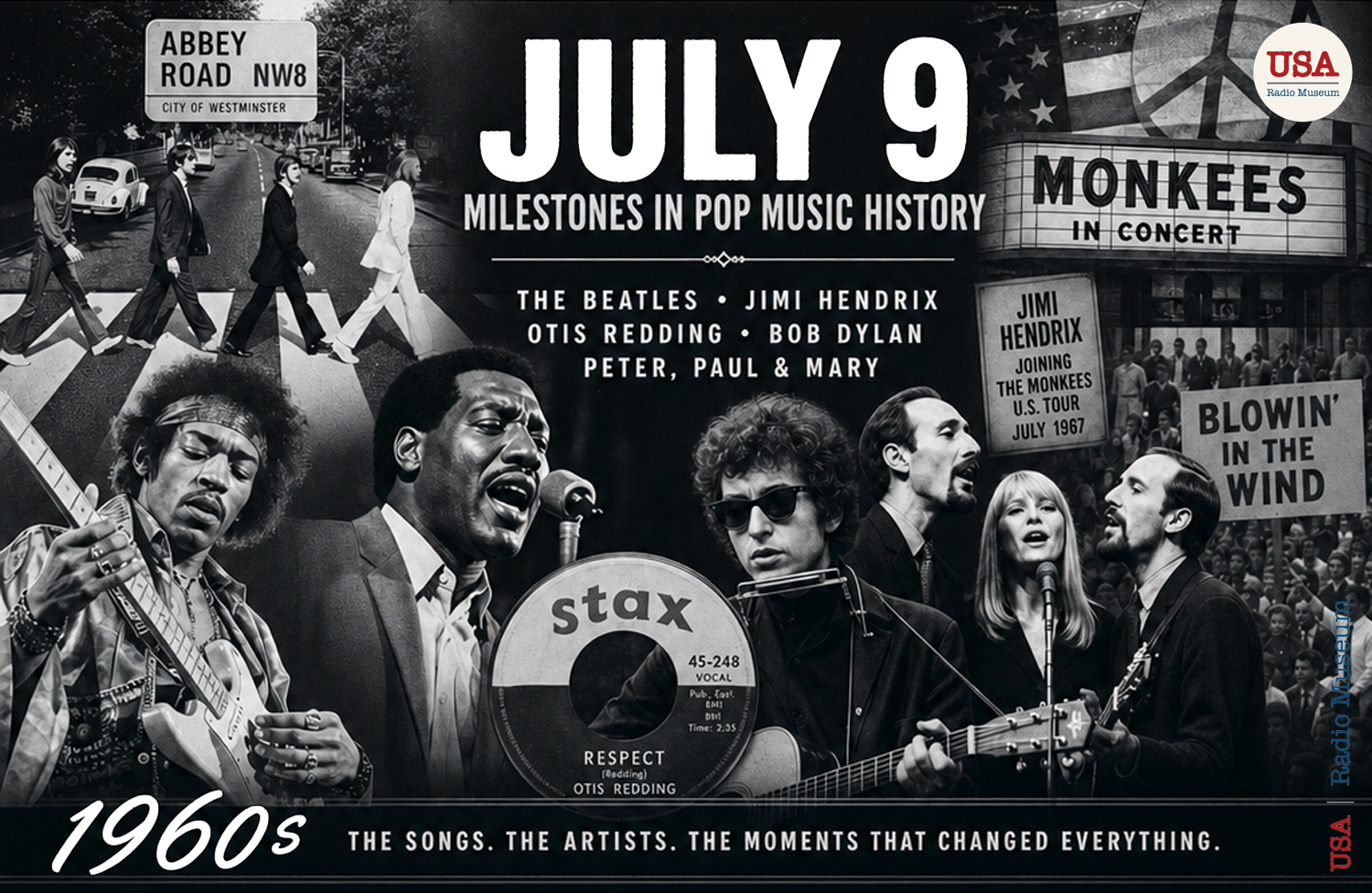
 Across the 1960s, July 9 surfaces as a quietly consequential date — not for a single headline‑making event, but for four moments in which artists at the center of the decade’s cultural transformation were shaping work that would echo across generations. The Beatles were navigating personal upheaval inside the sanctum of Abbey Road. Jimi Hendrix was colliding with America’s teen‑idol machinery. Otis Redding was distilling Southern soul into its most concentrated form. And Bob Dylan was giving voice to a rising moral consciousness — aided by the trio who carried his words into the American mainstream.
Together, these moments form a living portrait of the 1960s: restless, inventive, and increasingly aware of its own power. —USA Radio Museum
I. 1969 — The Beatles at Abbey Road
Creativity Under Strain and the Last Glow of a Legendary Collaboration
By July 1969, The Beatles were deep into the sessions for Abbey Road, the final studio album they would complete together. The day’s work centered on Paul McCartney’s “Maxwell’s Silver Hammer,” a darkly comic music‑hall pastiche whose polished theatricality contrasted sharply with the band’s internal tensions.
John Lennon had only just returned from a serious car crash in Scotland. He and Yoko Ono had been injured — Yoko more severely — prompting an unprecedented accommodation: a hospital bed installed directly in Studio Two. The sight was unforgettable. The world’s most famous rock band worked around a bed in the middle of the studio, a symbol of how intertwined Lennon and Ono had become and how unconventional the Beatles’ creative environment had grown.
McCartney, ever meticulous, pushed for a crisp, elaborate arrangement, complete with the distinctive “anvil” percussion that gives the track its macabre charm. George Harrison and Ringo Starr contributed professionally, though neither was particularly fond of the song. Lennon, still recovering, participated minimally.
This July 9 session captures the Beatles in their late‑era paradox: still capable of extraordinary craftsmanship, still determined to finish what would become their final collective statement, yet unmistakably drifting apart. The recording of “Maxwell’s Silver Hammer” is less about the song itself and more about the fragile ecosystem of creativity that defined the band’s last months together.
II. 1967 — The Jimi Hendrix Experience
A Collision Between Psychedelic Innovation and Pop Idolatry
On July 9, 1967, The Jimi Hendrix Experience appeared at the Convention Hall in Miami as part of The Monkees’ U.S. tour — one of the most improbable pairings in 1960s concert history. The Monkees were at the height of their teen‑idol fame, adored by young audiences who followed them from television to the stage. Hendrix, meanwhile, had just detonated onto the international scene with a revolutionary guitar style, a psychedelic aesthetic, and a stage presence that radiated danger, sexuality, and improvisational brilliance.
The mismatch became apparent almost immediately. Teenybopper audiences, many barely into adolescence, were bewildered by Hendrix’s volume, intensity, and raw virtuosity. Some screamed for The Monkees throughout his set; others simply stared, unsure how to process what they were witnessing.
Behind the scenes, tour promoter Dick Clark and Hendrix’s manager Chas Chandler recognized the problem. Rather than publicly acknowledge the incompatibility, they concocted a tongue‑in‑cheek explanation: the Daughters of the American Revolution had allegedly complained about Hendrix’s act. The story provided a graceful exit, and the Experience left the tour after only six shows.
The Miami performance on July 9 stands as a cultural collision — the psychedelic vanguard meeting mainstream pop entertainment head‑on. Hendrix would soon find his true audience: older, more adventurous listeners who understood the radical shift he represented. But this brief Monkees tour remains a fascinating footnote, illustrating how quickly the musical landscape was changing and how ill‑prepared the pop establishment was for Hendrix’s arrival.
III. 1965 — Otis Redding at Stax
The Lightning‑Strike Creation of a Soul Landmark
On July 9, 1965, Otis Redding began the recording sessions for Otis Blue: Otis Redding Sings Soul, one of the defining albums of 1960s American music. Recorded almost entirely within a 24‑hour period at Stax Studios in Memphis, the album is a masterclass in emotional intensity, interpretive genius, and the collaborative magic of the Stax house band.
Redding approached the sessions with urgency and clarity. The album consisted largely of covers — songs by Sam Cooke, Solomon Burke, and other R&B greats — but Redding transformed each one, infusing them with his signature blend of grit, vulnerability, and explosive vocal power. Booker T. Jones, Steve Cropper, Donald “Duck” Dunn, and drummer Al Jackson Jr. responded with tight, intuitive playing that elevated every track.
During a break in the session, Jackson and Redding had a conversation that would lead to one of Otis’s most iconic compositions. Jackson remarked on Redding’s relentless touring schedule and the simple desire for dignity when returning home. Redding absorbed the sentiment and wrote “Respect” — not yet the feminist anthem Aretha Franklin would later make famous, but a plea from a weary man seeking acknowledgment and care.
The July 9 session marks the beginning of an album that would cement Redding’s place as one of soul music’s towering figures. Otis Blue remains a landmark: raw, immediate, and deeply human, capturing the essence of Southern soul at its peak.
IV. 1962 — Bob Dylan at Columbia
A Song That Would Travel the World — And the Voices Who Carried It
On July 9, 1962, Bob Dylan entered Columbia Recording Studios in New York for an afternoon session that would yield “Blowin’ in the Wind,” a song that would become one of the most enduring moral anthems of the 20th century. At the time, Dylan was still a rising figure in the folk scene — respected, intriguing, but not yet the cultural force he would soon become.
Dylan had first performed the song publicly at Gerde’s Folk City earlier that spring, in a two‑verse version. Shortly afterward, he added the middle verse, completing the triptych of rhetorical questions that gave the song its haunting universality. The July 9 recording captured the song’s stark beauty: Dylan’s plainspoken voice, his steady guitar, and the quiet conviction that made the lyrics feel both intimate and monumental.
Yet the song’s journey — its transformation from a Greenwich Village meditation into a national hymn — owes a profound debt to Peter, Paul & Mary. In 1963, at the height of the Dylan Pop‑Folk era, the trio recorded “Blowin’ in the Wind” with a clarity, warmth, and harmonic lift that made the song accessible to millions who had never stepped inside a folk club. Their version became a cultural accelerant: a Top 10 hit, a staple of civil rights gatherings, and a bridge between Dylan’s poetic urgency and the broader American public.
Where Dylan’s recording felt like a solitary voice posing questions to the world, Peter, Paul & Mary’s interpretation sounded communal — a chorus of conscience. Their harmonies softened none of the song’s moral weight; instead, they amplified it, giving the lyric a sense of shared responsibility. In doing so, they helped carry Dylan’s message into churches, campuses, union halls, and living rooms, transforming “Blowin’ in the Wind” from a folk song into a generational statement.
The July 9 studio session marks the birth of the song. Peter, Paul & Mary’s recording marks its awakening. Together, they illustrate how the folk revival — and the artists within it — worked in tandem to shape the soundtrack of America’s social transformation.
Closing Reflection
Four Moments, One Decade in Motion
July 9 in pop music history is not defined by a single event but by a constellation of moments that reveal the decade’s creative breadth. The Beatles were navigating personal upheaval while crafting their final masterpiece. Hendrix was confronting the limits of mainstream pop audiences. Otis Redding was distilling soul music into its purest form. Bob Dylan — aided by the voices who carried his words farther than he could alone — was giving shape to a generation’s conscience.
Each story is distinct, yet together they form a portrait of the 1960s as a time of artistic daring, cultural transformation, and restless innovation — a decade when music didn’t just reflect the world but helped reshape it.
_____________________
Sources & Credits
USA Radio Museum — July 9 Milestones in Pop Music History
• This Day in Music — “On This Day in Music: July 9” Historical chart notes, artist milestones, and daily music‑history references for The Beatles, Hendrix, Otis Redding, and Dylan. https://www.thisdayinmusic.com/on-this-day-in-music-july-9/ (thisdayinmusic.com in Bing)
• The Beatles Recording Sessions — Abbey Road Studios Documentation Session logs, production notes, and late‑era Beatles studio accounts. https://www.abbeyroad.com/
• Mark Lewisohn — The Complete Beatles Chronicle Authoritative chronology of Beatles recording sessions and studio activity. https://www.bing.com/search?q=Mark+Lewisohn+Complete+Beatles+Chronicle (bing.com in Bing)
• Dick Clark Productions Archives Tour documentation and promotional materials related to The Monkees’ 1967 U.S. tour. https://dickclark.com/
• Hendrix: Setting the Record Straight — John McDermott & Eddie Kramer Historical context on Hendrix’s U.S. tours, management decisions, and performance history. https://www.bing.com/search?q=Hendrix+Setting+the+Record+Straight+McDermott+Kramer (bing.com in Bing)
• Stax Records Archives Otis Redding session notes, Booker T. & the M.G.’s accounts, and Stax production history. https://staxrecords.com/
• Otis! The Definitive Otis Redding — Scott Freeman Comprehensive biography detailing the creation of Otis Blue and Redding’s studio process. https://www.bing.com/search?q=Otis%21+Scott+Freeman+book (bing.com in Bing)
• Columbia Recording Studios — Bob Dylan Session Documentation Recording logs for Dylan’s July 9, 1962 session for “Blowin’ in the Wind.” https://www.bing.com/search?q=Columbia+Recording+Studios+Bob+Dylan+1962 (bing.com in Bing)
• Gerde’s Folk City Archives Performance history and early Dylan setlists from the Greenwich Village folk scene. https://www.bing.com/search?q=Gerde%27s+Folk+City+archives (bing.com in Bing)
• Peter, Paul & Mary Official Discography — Warner Bros. Records Release notes and historical context for their 1963 recording of “Blowin’ in the Wind.” https://www.peterpaulandmary.com/
• Library of Congress — Civil Rights Movement Cultural Materials Documentation of “Blowin’ in the Wind” as a movement anthem. https://www.loc.gov/
• Smithsonian National Museum of American History Collections on the Folk Revival, 1960s popular music, and cultural history. https://americanhistory.si.edu/ (americanhistory.si.edu in Bing)
• Getty Images / Michael Ochs Archives Era photography for The Beatles, Hendrix, Otis Redding, Dylan, and Peter, Paul & Mary. https://www.gettyimages.com/
• USA Radio Museum Internal Research Notes Broadcast history, artist radio appearances, and curatorial analysis.
_____________________
Contact: jimf.usaradiomuseum@gmail.com
_____________________
A USARM Viewing Tip: On your PC? Mouse/double-click over the images for expanded views. On your mobile or tablet device? Finger-tap all the above images inside the post and stretch image across your device’s screen for LARGEST digitized view. Then click your browser’s back arrow to return to the featured post.
© 2026 USA Radio Museum. All Rights Reserved.
