
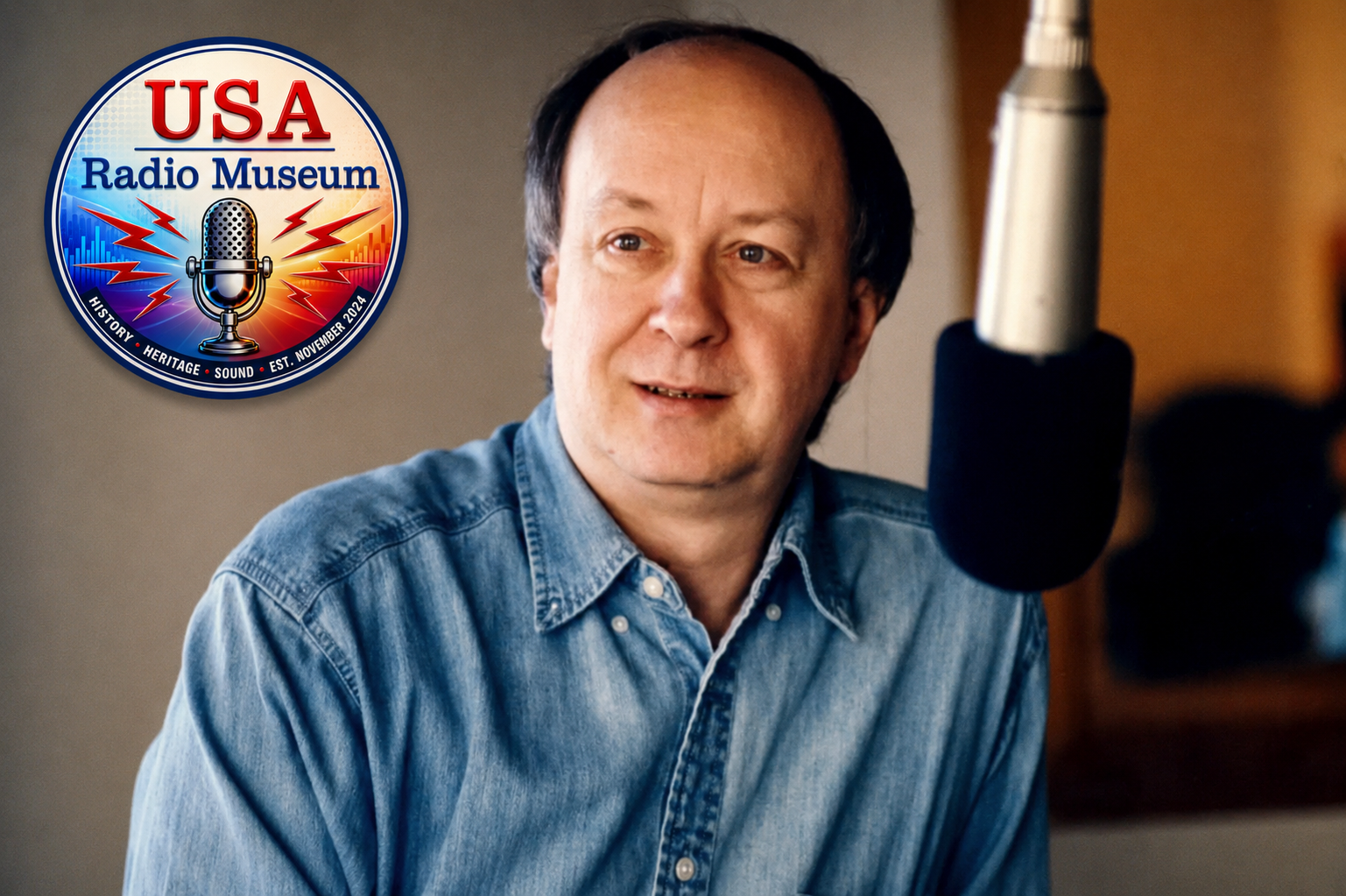
Doug Thompson may not be the voice most listeners remember coming out of their radios, but for more than six decades he has been one of the people beh
Doug Thompson may not be the voice most listeners remember coming out of their radios, but for more than six decades he has been one of the people behind the voices—producing, writing and directing programs heard by millions across Canada and the United States.
From Toronto’s legendary 1050 CHUM to network specials for ABC and NBC, and from Ringo Starr and John Candy to Graham Nash and David Foster, Thompson built a career around a simple philosophy: when opportunity knocks, say yes—even if you’ve never done it before.
It is advice he later gave students during his decade teaching broadcasting at Toronto’s Seneca College.
“You gotta be open to say yes,” Thompson told the USA Radio Museum in a recent interview. “Somebody says, ‘Do you want to do this?’ and you’ve never done that before? You say yes.”
It is difficult to imagine a better description of his career.
A Kid Who Wanted to Work at CHUM
Thompson’s fascination with radio began as a child listening with his mother to programs such as Boston Blackie and The Lone Ranger. But music changed everything.
In 1959, he heard Johnny Horton’s “The Battle of New Orleans” and went searching for a station that would play it. He found 1050 CHUM in Toronto and was hooked.
As a teenager, Thompson would spend entire days watching CHUM broadcast from the Canadian National Exhibition. At about 15, he told one of the station’s personalities that someday he was going to work there.
The disc jockey patted him on the head and essentially told him, “Sure you are, kid.”
Years later, Thompson did exactly that.
His professional start came at CJCA in Edmonton, where he worked while attending school. When Canadian regulations required FM stations simulcasting their AM counterparts to provide original programming, Thompson became one of the operators handling CJCA-FM’s evening classical and opera programming.
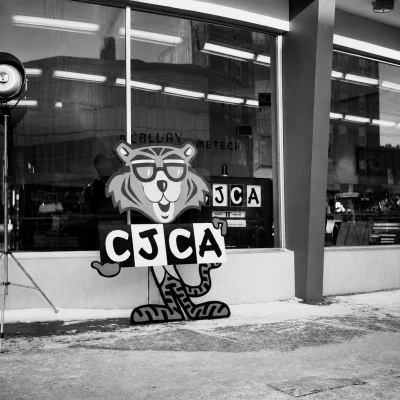
CJCA in Edmonton
Then came his opportunity at CHUM.
On a cross-country train trip, Thompson stopped in Toronto and left an audition tape and letters of recommendation for CHUM program director Allan Slaight. By the time Thompson arrived back in Edmonton, CHUM was calling.
Years later, Slaight told him why.
“We’d never had anybody apply for an operator’s job with an audition tape,” Thompson recalled Slaight telling him. “So I had to hire you.”
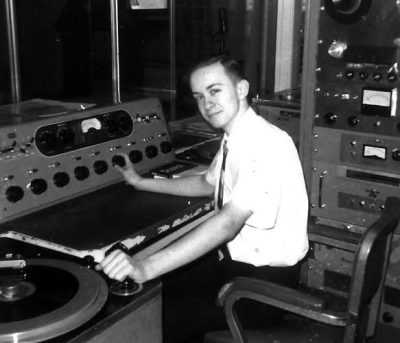
Early Doug at CJCA
Discovering His Place Behind the Microphone
Thompson occasionally went on the air—including an overnight shift on CHUM-FM in 1969, where he called himself “the disembodied voice in the night”—but he quickly realized his real talent was behind the scenes.
He had actually begun experimenting with production as a teenager, creating promos for his high school’s radio club. At CJCA he taught himself production using mono tape machines. At CHUM, he began creating introductions and comedy pieces for nighttime personalities.
Within a few years, he was CHUM’s production manager.
A trip to Los Angeles provided another education. Thompson worked with programmer and consultant Ted Randal, but there was an additional attraction: Randal’s office was in the same building as legendary radio producer Chuck Blore.
Thompson spent his free time watching Blore and his production team work.
“That was an education you can’t pay for,” he said.
Back in Toronto, Thompson and writer Bill McDonald later established That Commercial Place, producing radio advertising. In another of the career’s many full-circle moments, McDonald eventually joined Blore’s company and ultimately became its president.
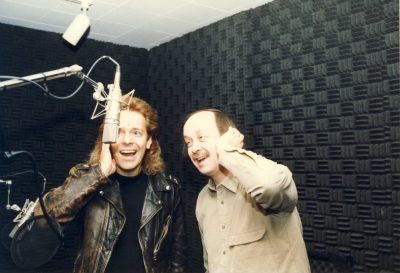
Doug and Peter Frampton
From The Monkees to John Lennon
Thompson’s first radio documentary came while he was still at CHUM—a 1967 one-hour special about The Monkees.
Bigger projects followed.
When CHUM decided to produce a 12-hour Beatles special around 1970, Thompson produced eight of the 12 hours. The program was eventually syndicated to hundreds of stations across North America.
Then came December 8, 1980.
Following the murder of John Lennon, Thompson went into the studio and helped create a two-hour documentary that night. A year later, he produced the three-hour John Lennon: A Celebration, which was carried by NBC’s The Source network in the United States and Telemedia in Canada.
Thompson spent six months researching, writing and conducting interviews for the program.
His attention to detail was extraordinary.
While in New York, Thompson went to the Dakota late at night and recorded the actual traffic and street sounds around the building where Lennon had been killed. He incorporated those sounds into a recreation at the beginning of the documentary.
The opening was considered so powerful that the NBC affiliate in New York declined to air those first minutes, although the rest of the network carried them.
It was, Thompson recalls, the only time one of his radio specials was censored.
This rare audio is the opening segment of Hour 1 of John Lennon: A Celebration, a three-hour special broadcast on NBC’s The Source Network and on 65 Canadian stations through Telemedia Network Radio. Interestingly, the New York affiliate did not air this opening, although the other stations did. The announcer is Ben Chandler of Los Angeles
“I just wanted it to be more authentic than using the Elektra sound-effects records,” he said.
Over the decades, Thompson estimates he has written and produced more than 1,000 hours of documentaries and syndicated radio programming.
A great radio special or documentary, to me, is one that has mass appeal to an audience, but one that brings them information or moments that they did not expect and did not know about. In other words, you have to surprise them to catch and keep their attention.
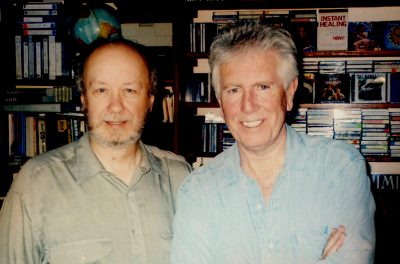
Doug and Graham Nash
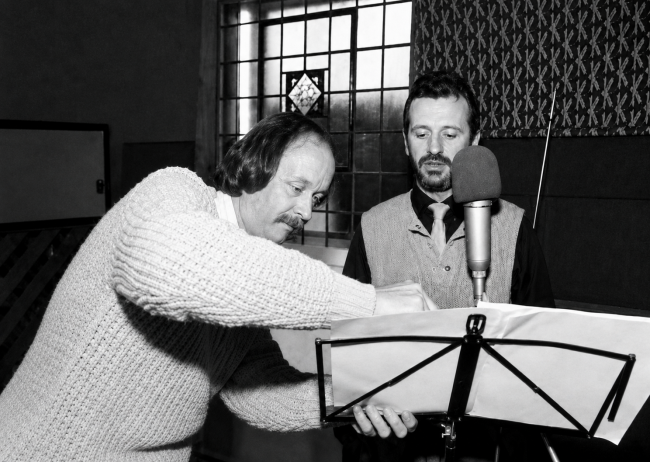
Doug and Ringo working on Yellow Submarine radio show
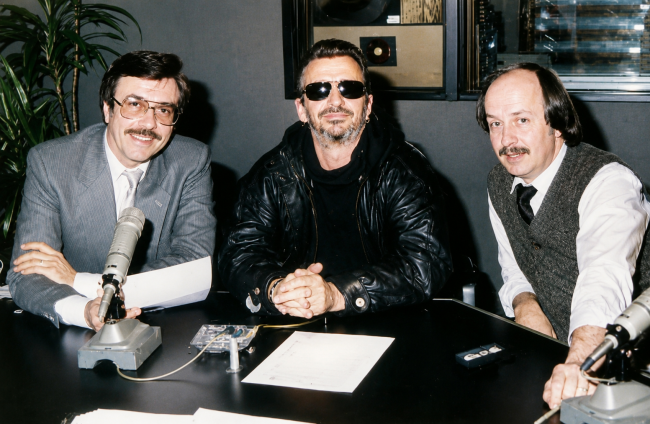
Gary Owens, Ringo, Doug doing live phone-in on KABC-LA
Ringo, Graham Nash and a Parade of Stars
American radio soon came calling.
In 1983, Watermark’s Tom Rounds hired Thompson to write Ringo’s Yellow Submarine, an ABC Radio Network special hosted by Ringo Starr.
The sessions took Thompson to England and Tittenhurst Park, the estate once owned by John Lennon.
Other projects brought him together with an impressive list of performers. Thompson worked on programs with Huey Lewis, Graham Nash, David Foster, Randy Bachman and Denny Doherty of The Mamas & the Papas, among many others.
For a 2005 John Lennon project, Graham Nash served as host—an especially effective choice because Nash had personally known Lennon.
But of all the famous people Thompson encountered, one became much more than another celebrity behind a microphone.
Beginning a music special or documentary, I make an outline of what each hour will contain and then match the interviews to the outline BEFORE I ever start even writing it.
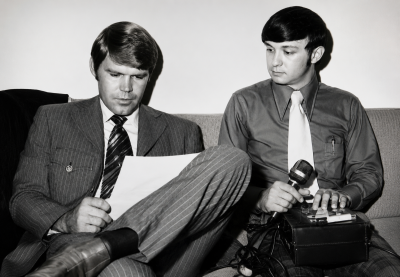
Doug and Glen Campbell
John Candy and the Most Fun He Ever Had
Thompson began hiring performers from Toronto’s Second City and SCTV community for radio work, including John Candy, Eugene Levy, Catherine O’Hara, Joe Flaherty, Dave Thomas and Andrea Martin.
Candy and Thompson became close friends, a friendship that lasted 17 years until Candy’s death in 1994.
Together, they created three radio series—two in Canada and one in the United States.
When Candy moved to Los Angeles in 1987, he called Thompson with a simple question: Could they do some more radio?
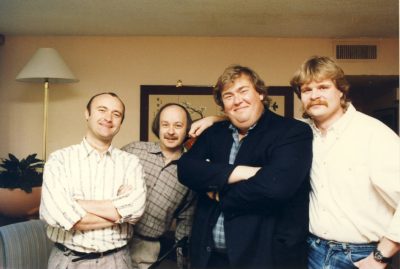
Phil Collins, Doug, John Candy, Jeff Sheridan (engineer/co-producer of Radio Kandy)
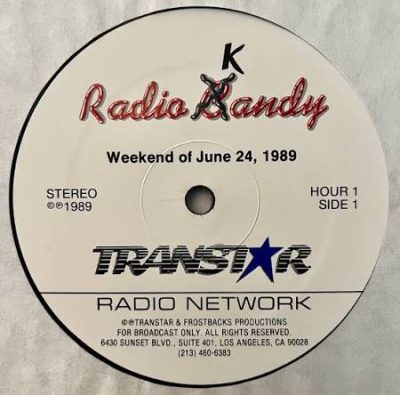
The result was Radio Kandy, a weekly two-hour program carried by roughly 350 stations.
Its premise was pure Candy: John had acquired the world’s most powerful transmitter and simply overpowered another radio station for two hours every week.
Then Candy and Thompson realized their fictional station needed a chief engineer.
Their answer was obvious: Scotty from Star Trek.
Canadian actor James Doohan joined the program, playing off his famous Star Trek persona in introductions and closings with Candy. Thompson estimates he had to write more than 100 of those pieces.
“They were just magic together,” Thompson recalled. “They got along like a house on fire.”
The program became a magnet for performers and musicians.
A sample of Radio Kandy with John Candy
Clarence Clemons of Bruce Springsteen’s E Street Band spent a day with them. Levon Helm of The Band came by, too. Candy, a frustrated drummer himself, kept a small drum kit in the studio. At one point, Helm gave Candy’s young son Christopher an impromptu drumming lesson.
Somewhere, Thompson says, there may still be a cassette containing about an hour of that remarkable encounter.
Catherine O’Hara once spent an entire day recording comedy with Candy. Thompson remembers everyone in the control room laughing at how funny the material was. The following day, however, O’Hara called Candy and said she didn’t think she had been funny and asked that the material not be used.
Candy honored her wishes.
For Thompson, those years remain difficult to top.
Asked which project he would return to if he could relive just one, he considered his sessions with Ringo Starr—but chose Radio Kandy.
“It was the most fun I’ve ever had doing anything.”
My writing style doesn’t change whether I’m writing a music special or documentary. If the subject matter is serious, then I treat it that way, whereas with a music special, I might add some humor. To paraphrase Popeye “I writes what I write and that’s all that I writes.
Saving Radio Before It Disappears
Thompson’s career has increasingly become intertwined with another mission: preserving broadcasting history before it is lost forever.
He has spent roughly two decades digitizing his own enormous collection of programs and recordings and estimates that about 99 percent of his material has now been preserved digitally.
He has learned firsthand how easily history disappears.
Thompson recalled discovering that when Chuck Blore closed his operation, decades of original tapes could not find a permanent home. After efforts to donate material failed, much of it was ultimately discarded.
Thompson was devastated when he learned what had happened.
“If you’d called me when you were doing that, I would have been on the next plane,” he remembers telling Blore. “You would have had every tape digitized.”
Even Thompson hasn’t escaped the consequences of discarded media. When Radio Kandy was distributed on transcription discs, Thompson had sets of the programs but didn’t take all of them when he left his office.
Years later, he wanted the shows back.
He eventually discovered someone selling the series.
“I had to pay a hundred bucks to get the shows that I wrote and produced back,” he laughed.
Preserving Canada’s Broadcasting Heritage
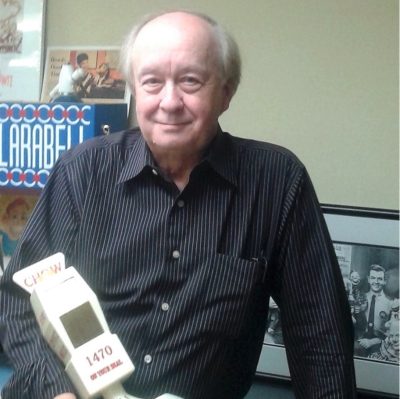
Since 2012, Thompson has served as chairman of the Canadian Broadcast Museum Foundation, working to collect and preserve Canada’s radio and television heritage.
The ambition goes beyond storing boxes of tapes and memorabilia. Thompson wants people to be able to experience the material.
The foundation hopes to develop a virtual museum where visitors from anywhere in the world can see photographs and artifacts and listen to historic recordings.
Thompson also curates CHUM Tribute, an online collection devoted to the history and personalities of 1050 CHUM, the station he dreamed of joining as a teenager.
It brings his career back to where it began.
Still Saying Yes
Thompson eventually expanded into television, applying essentially the same philosophy that had guided his radio career.
When a Canadian television executive suggested that producing television documentaries was simply a matter of taking the kinds of stories Thompson already created for radio and “putting pictures to them,” Thompson said yes.
He went on to produce and direct dozens of television programs, including projects exploring Canadian music and broadcasting history.
And retirement?
He’s not particularly interested.
“I still love what I do,” Thompson said. “A lot of us still love broadcasting.”
Today, he continues working with the Broadcast Museum while pursuing other projects.
Technology has transformed nearly everything about how programs are recorded, produced, distributed and preserved. Tape reels have given way to digital files. Programs once shipped to affiliates in heavy boxes can now travel around the world almost instantly.
But Thompson’s career is a reminder that the technology was never the most important ingredient.
It was curiosity. Imagination. Characters. Storytelling. And a willingness to try something that hadn’t been done before.
More than six decades after a teenage Doug Thompson stood outside a CHUM remote broadcast and announced that someday he would work there, he’s still doing what he has always done.
He’s saying yes.
Watch Jim Hampton’s complete video interview with Doug Thompson accompanying this article.
