
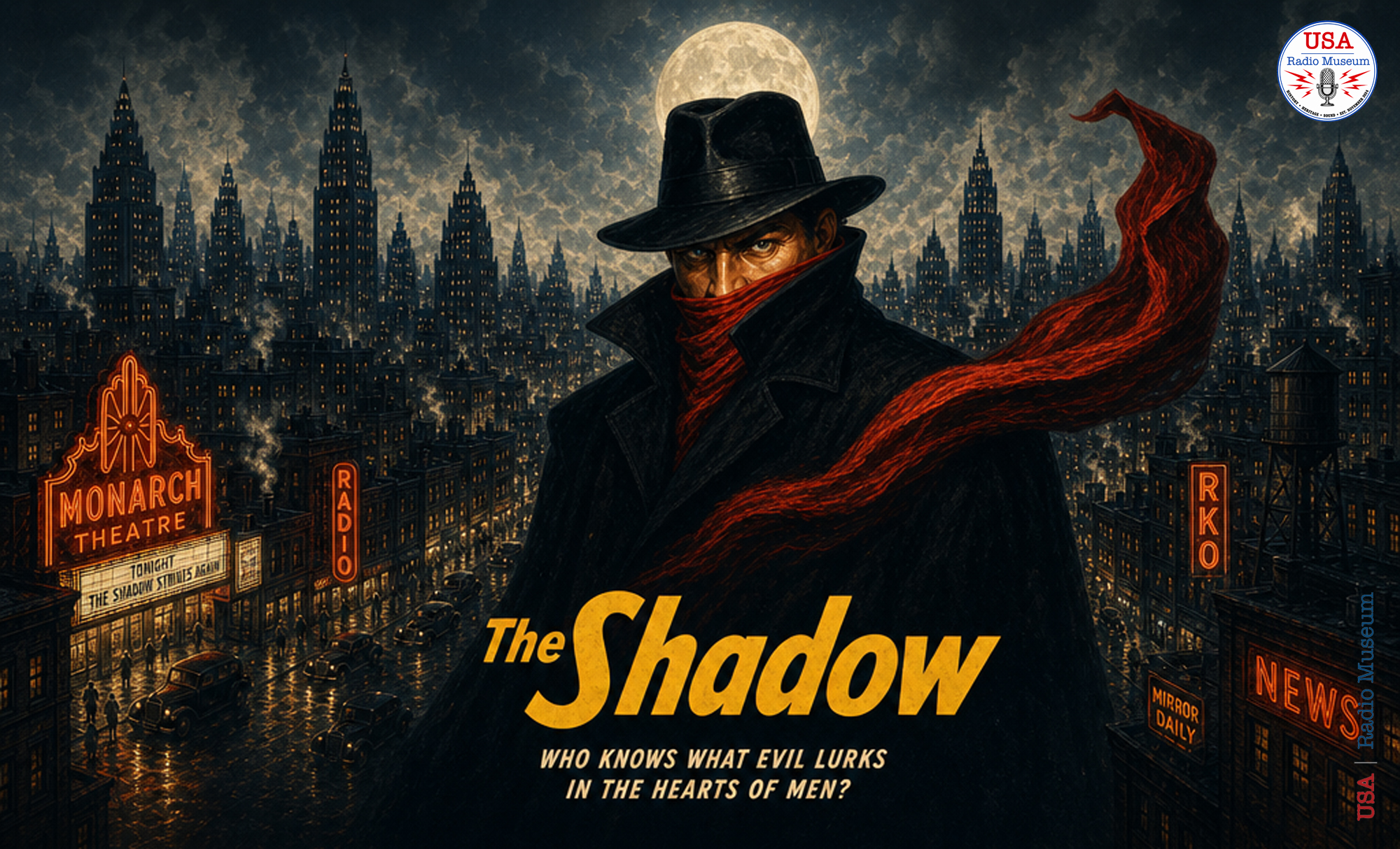
“Who knows what evil lurks in the hearts of men?…The Shadow knows!” In the dim glow of radio’s Golden Age, when imagination painted worlds richer t
“Who knows what evil lurks in the hearts of men?…The Shadow knows!”
In the dim glow of radio’s Golden Age, when imagination painted worlds richer than any screen could offer, one voice rose from the darkness to captivate a nation. The Shadow was more than a character — he was an atmosphere, a whisper, a presence that slipped between the cracks of America’s fears and fascinations. His haunting laugh, his unseen vigilance, and his chilling warning that “crime does not pay” echoed across living rooms for nearly two decades, shaping the very language of suspense. Today, as we revisit those broadcasts through the USA Radio Museum’s extraordinary archive, we step back into an era where mystery ruled the airwaves… and evil learned to tremble in the dark.
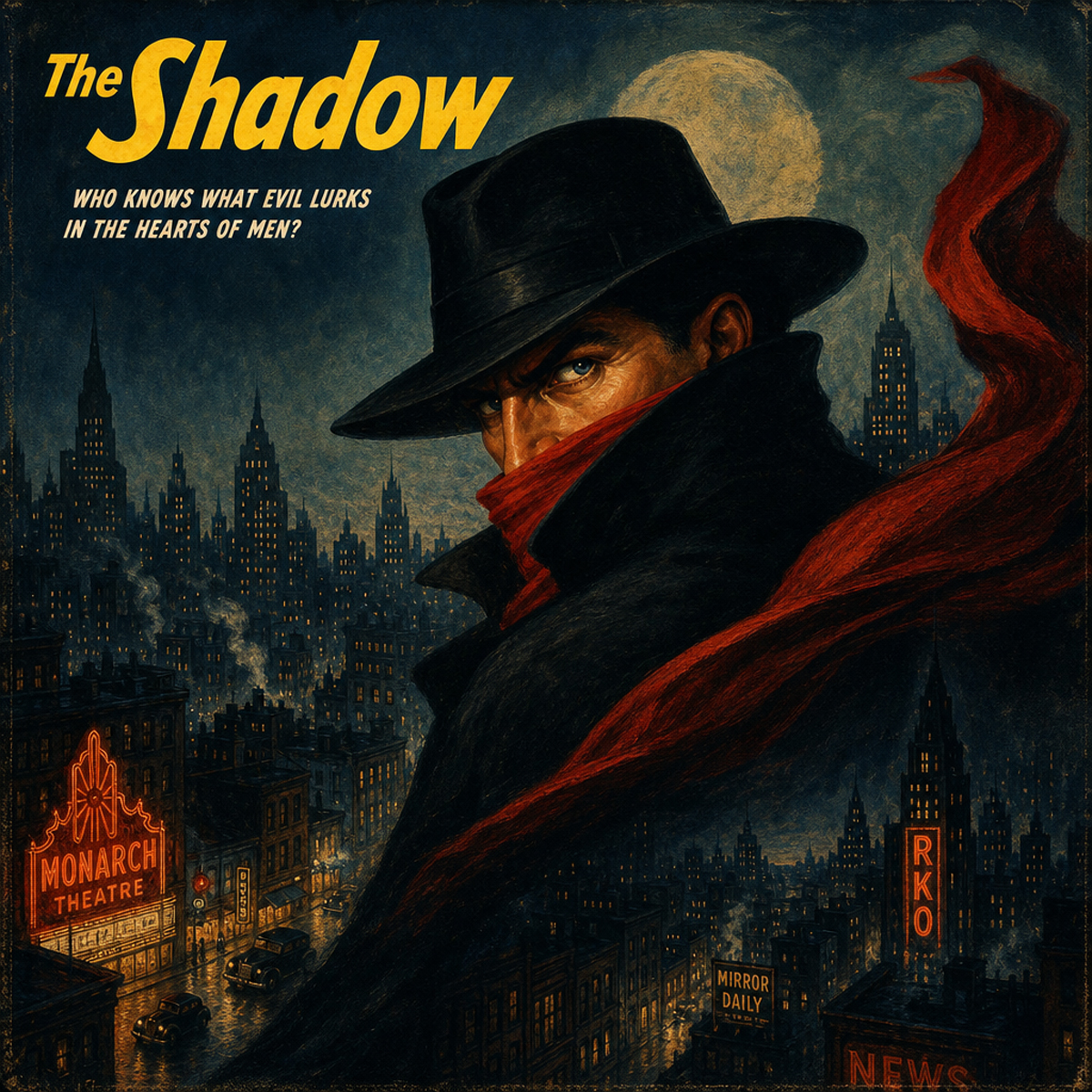 What made The Shadow extraordinary was not merely his ability to “cloud men’s minds,” but the way his stories transformed sound into psychology. Week after week, listeners leaned closer to their radios as Lamont Cranston slipped between identities, guided by Margo Lane’s steady courage and voiced by some of the most gifted actors of the era — Orson Welles, Agnes Moorehead, Bill Johnstone, Bret Morrison. Their performances turned every broadcast into a theater of the mind, where footsteps in an alley or the crackle of a sinister laugh could freeze a nation in place. These episodes weren’t just entertainment; they were masterworks of audio suspense, crafted with precision, imagination, and a moral clarity that resonated far beyond the living room.
As the 1930s gave way to the turbulence of the 1940s, The Shadow became a cultural anchor — a voice of justice in an era shadowed by uncertainty. Families gathered around Philco and Zenith sets not just for diversion, but for reassurance that good could outwit evil, even when unseen. The show’s blend of pulp intrigue, psychological tension, and moral certainty helped define the American crime‑fighter archetype long before comic books and television claimed the spotlight. In many ways, The Shadow laid the groundwork for the heroes who followed, proving that a single voice, properly wielded, could become a national phenomenon.
Today, the USA Radio Museum safeguards one of the largest known collections of surviving Shadow broadcasts — 243 episodes, meticulously preserved and digitized for future generations. These recordings are more than relics; they are living artifacts of American storytelling, capturing the artistry of writers, actors, engineers, and sponsors who shaped the Golden Age of Radio. Each episode is a window into a world where imagination was limitless, where suspense was sculpted from silence, and where a single whispered phrase could send chills across the nation.
Few phrases in American broadcasting have endured with such electric familiarity. For nearly a quarter‑century, The Shadow stood at the center of radio’s Golden Age, chronicling the adventures of Lamont Cranston and his trusted companion, Margo Lane. As The Shadow, Cranston wielded a mysterious “hypnotic power to cloud men’s minds so that they cannot see him,” slipping invisibly into the underworld to confront crime lords, mad scientists, psychopaths, and even the occasional werewolf. Week after week, listeners heard his chilling warning: “The weed of crime bears bitter fruit…crime does not pay!”
This tribute honors the origins, evolution, and legacy of one of radio’s most iconic crime‑fighters — and celebrates the USA Radio Museum’s extraordinary preservation of his broadcasts. — USA Radio Museum
_____________________
Origins on the Airwaves (1930–1932)
The Shadow’s radio life began not as a hero, but as a narrator. In 1930, CBS introduced Detective Story Hour, a program designed to promote Street & Smith’s Detective Story Magazine. The eerie voice known only as The Shadow framed each tale with a sinister laugh and a sense of foreboding that captivated listeners.
The earliest voices included James La Curto and, most memorably, Frank Readick Jr., whose chilling delivery and unforgettable laugh defined the character throughout the early 1930s. Readick’s performance became the template for every Shadow voice that followed.
By 1932, the character had grown so popular that he was given his own program — and soon evolved from narrator to protagonist. This transformation marked the beginning of one of radio’s most enduring crime‑fighters.
_____________________
Mutual Radio | The Shadow | Death House Rescue | September 26, 1937
Audio Digitally Enhanced by USA Radio Museum
_____________________
The Mutual Era and the Rise of a Hero (1937–1954)
On September 26, 1937, The Shadow premiered as a full dramatic series on the Mutual Broadcasting System, sponsored by Blue Coal. The new version introduced Lamont Cranston as a wealthy adventurer who used his hypnotic powers to fight crime, accompanied by the intelligent and resourceful Margo Lane — a character created specifically for radio.
The casting was extraordinary:
Orson Welles (1937–1938)
At just 22, Welles brought theatrical intensity and a brooding intelligence to the role. His voice gave Cranston a commanding presence that helped define the show’s early sound.
Agnes Moorehead (1937–1940)
As Margo Lane, Moorehead’s performance set the standard for female leads in radio drama. Her chemistry with Welles remains one of the most admired partnerships of the era.
Bill Johnstone (1938–1943)
A seasoned radio actor who gave Cranston a steady, authoritative presence during the show’s wartime years.
Bret Morrison (1945–1954)
The longest‑running Shadow, Morrison’s voice became synonymous with the character during its final decade. His portrayal carried the series through its last broadcast on December 26, 1954.
Other performers, including John Archer and Steve Courtleigh, contributed to the role during transitional periods, while actresses such as Marjorie Anderson, Grace Matthews, Gertrude Warner, Margot Stevenson, and Jeanette Nolan brought depth and continuity to Margo Lane.
_____________________
Mutual Radio | The Shadow | The Avenger | March 13, 1938
Audio Digitally Enhanced by USA Radio Museum
_____________________
Themes, Style & Cultural Impact
Episodes typically ran 30 minutes, blending melodrama, suspense, and moral clarity. The Shadow’s invisibility — a device absent from the pulp novels — became a hallmark of radio suspense, allowing him to gather information, unsettle criminals, and deliver justice with psychological precision.
The show’s famous opening line, delivered by Frank Readick, became one of radio’s most iconic phrases. Its closing admonition — “crime does not pay!” — reinforced the program’s moral center and helped shape the crime‑fighter archetype in American popular culture.
The Shadow’s influence extended beyond radio:
- It shaped early comic‑book vigilantes, including prototypes of Batman.
- It established the atmospheric style of mystery broadcasting.
- It demonstrated the power of voice, imagination, and sound design in storytelling.
_____________________
Mutual Radio | The Shadow | The Face | September 21, 1947
Audio Digitally Enhanced by USA Radio Museum
_____________________
A Legacy Preserved
The Shadow’s final broadcast aired in 1954, closing a chapter that had shaped American popular culture. In 1989, the program was formally recognized with induction into the Radio Hall of Fame, cementing its place among the most important works of the broadcast era.
Today, nearly nine decades after its debut, The Shadow remains one of radio’s most studied and beloved dramas — and the USA Radio Museum stands at the forefront of its preservation.
With 243 surviving broadcasts in the USARM archive, the museum holds one of the largest known Shadow collections in the United States, safeguarding nearly 90% of all extant episodes. This extraordinary archive ensures that The Shadow’s voice — its atmosphere, its suspense, and its cultural impact — continues to echo for new generations of listeners, historians, and enthusiasts.
_____________________
Mutual Radio | The Shadow | Vengeance of Angela North | June 27, 1954
Audio Digitally Enhanced by USA Radio Museum
_____________________
Conclusion: The Shadow Knows
 From a mysterious narrator on CBS to a national sensation on Mutual, The Shadow remains one of radio’s most remarkable evolutions. Its longevity, its cast of legendary performers, and its unforgettable opening line have secured its place in the cultural memory of American broadcasting.
And thanks to the USA Radio Museum’s remarkable archive, The Shadow’s legacy is not merely remembered — it is preserved, protected, and ready to inspire future generations.
To revisit The Shadow is to return to a time when darkness held possibility, when heroes operated in the margins, and when radio itself was a stage for the extraordinary. His echoes still linger — in the cadence of modern thrillers, in the legacy of audio drama, and in the hearts of listeners who remember the thrill of that familiar laugh drifting from the speaker. As we honor this legacy within the USA Radio Museum, we celebrate not just a character, but an era when imagination ruled the night . . . and justice spoke from the shadows.
_____________________
Sources & Credits
Street & Smith / Detective Story Hour Origins
- Radio Archives – Detective Story Hour background and early Shadow narration
https://www.radioarchives.com/Detective_Story_Hour_s/197.htm(radioarchives.com in Bing) - Smithsonian Magazine – “The Shadow Knows” historical overview
https://www.smithsonianmag.com/arts-culture/the-shadow-knows-180958620/(smithsonianmag.com in Bing)
The Shadow Magazine & Pulp Origins
- The Pulp Magazine Archive – Street & Smith / Maxwell Grant history
https://archive.org/details/pulpmagazinearchive(archive.org in Bing) - Thrilling Detective – Walter B. Gibson biography and Shadow creation
https://thrillingdetective.com/2019/05/08/the-shadow/(thrillingdetective.com in Bing)
Radio Series History (1937–1954)
- RadioGOLDINdex – Episode logs, Mutual Broadcasting dates
https://radiogoldindex.com/cgi-bin/title.cgi?title=Shadow(radiogoldindex.com in Bing) - Old Time Radio Researchers Group (OTRR) – Series documentation
https://otrr.org/Pages/OTRR_The_Shadow.htm(otrr.org in Bing) - Radio Spirits – Historical essays on The Shadow’s broadcast evolution
https://www.radiospirits.com/blog/tag/the-shadow/(radiospirits.com in Bing)
Cast & Production Credits
- Radio Hall of Fame – Orson Welles, Agnes Moorehead, Bret Morrison, Bill Johnstone https://www.radiohalloffame.com
- Internet Archive – Surviving broadcasts featuring Welles, Moorehead, Morrison
https://archive.org/details/TheShadow_201303(archive.org in Bing) - Radio Preservation Task Force – Mutual Broadcasting System history
https://www.loc.gov/programs/national-recording-preservation-plan/about-this-program/radio-preservation-task-force/(loc.gov in Bing)
Signature Lines & Cultural Impact
- Smithsonian Magazine – Analysis of “Who knows what evil lurks…”
https://www.smithsonianmag.com/arts-culture/the-shadow-knows-180958620/(smithsonianmag.com in Bing) - Library of Congress – Golden Age of Radio cultural context
https://www.loc.gov/collections/golden-age-of-radio/about-this-collection/(loc.gov in Bing)
Episode Survival & Archival Notes
- Digital Deli Too – Episode survival lists and rarity notes
http://www.digitaldeliftp.com/DigitalDeliToo/dd2jb-Shadow.html(digitaldeliftp.com in Bing) - OTRR Certified Sets – Surviving episode counts
https://otrr.org/Pages/OTRR_Certified_Sets.htm(otrr.org in Bing)
Radio Hall of Fame Induction (1989)
- Museum of Broadcast Communications – Hall of Fame listings
https://www.museum.tv/eotvsection.php?entrycode=shadowthe(museum.tv in Bing)
USA Radio Museum Archive Count
- Internal USARM holdings: 243 surviving Shadow broadcasts preserved in the museum’s collection (2026).
_____________________
Contact: jimf.usaradiomuseum@gmail.com
_____________________
A USARM Viewing Tip: On your PC? Mouse/double-click over the images for expanded views. On your mobile or tablet device? Finger-tap all the above images inside the post and stretch image across your device’s screen for LARGEST digitized view. Then click your browser’s back arrow to return to the featured post.
© 2026 USA Radio Museum. All Rights Reserved.

But The Shadow was also adapted in the big screen in the ’90’s too as well.