
Christian: A Visionary Who Transformed Local Radio into an Enduring American Saga In the long arc of American broadcasting, few figures shaped the
Christian: A Visionary Who Transformed Local Radio into an Enduring American Saga
In the long arc of American broadcasting, few figures shaped the medium with the depth, conviction, and quiet force of Ed Christian. Over more than five decades, he rose from a teenage board operator in northern Michigan to one of the most influential executives in American radio. As founder, chairman, president, and CEO of Saga Communications, Christian built a company rooted in localism, disciplined programming, and a belief that radio’s greatest strength lies in its connection to community. His passing on August 19, 2022, at age 78, marked the end of a remarkable chapter, but the adventure he set in motion continues to echo across the industry he loved.
Born in 1944 in St. Helen, Michigan, Christian discovered radio early and completely. At sixteen, he earned $52 a week working at a small northern Michigan station, running the control board and anchoring weekend newscasts. Those early shifts taught him the rhythms of a station, the intimacy of the medium, and the responsibility of serving a community. His small‑town upbringing shaped his understanding of radio’s purpose: to inform, to connect, and to reflect the lives of the people it served. After graduating from Wayne State University in 1966 with a degree in mass communications, he worked at stations in Rogers City, Lansing, and Flint, juggling roles in news, sales, and operations. These experiences gave him a rare, ground‑level view of radio’s ecosystem. He later earned a master’s degree in management from Central Michigan University, equipping him with the business discipline that would define his executive career.
At twenty‑six, Christian purchased WCER‑AM‑FM in Charlotte, Michigan. Owning a station in a small market was a risk, but it revealed his entrepreneurial instincts and his belief that radio was a business best led by people who loved it. Three years later, he sold the stations to take on a role that would change the trajectory of his career: vice president and general manager of WNIC‑AM‑FM in Detroit. In 1974, WNIC had been repossessed by State Mutual Life Insurance Co. and was hemorrhaging money. Within three months, Christian turned it around. His formula was rooted in compelling, community‑focused programming, respect for advertisers, and a belief that profits follow purpose. “If you have compelling radio that serves your community, if you have great people, if you treat advertisers with respect, then profits will follow,” he later said. Under his leadership from 1974 to 1984, WNIC became one of Detroit’s most influential stations, known for its warm sound, disciplined programming, and strong community presence. The turnaround solidified Christian’s reputation as a leader who understood both the art and the business of radio.

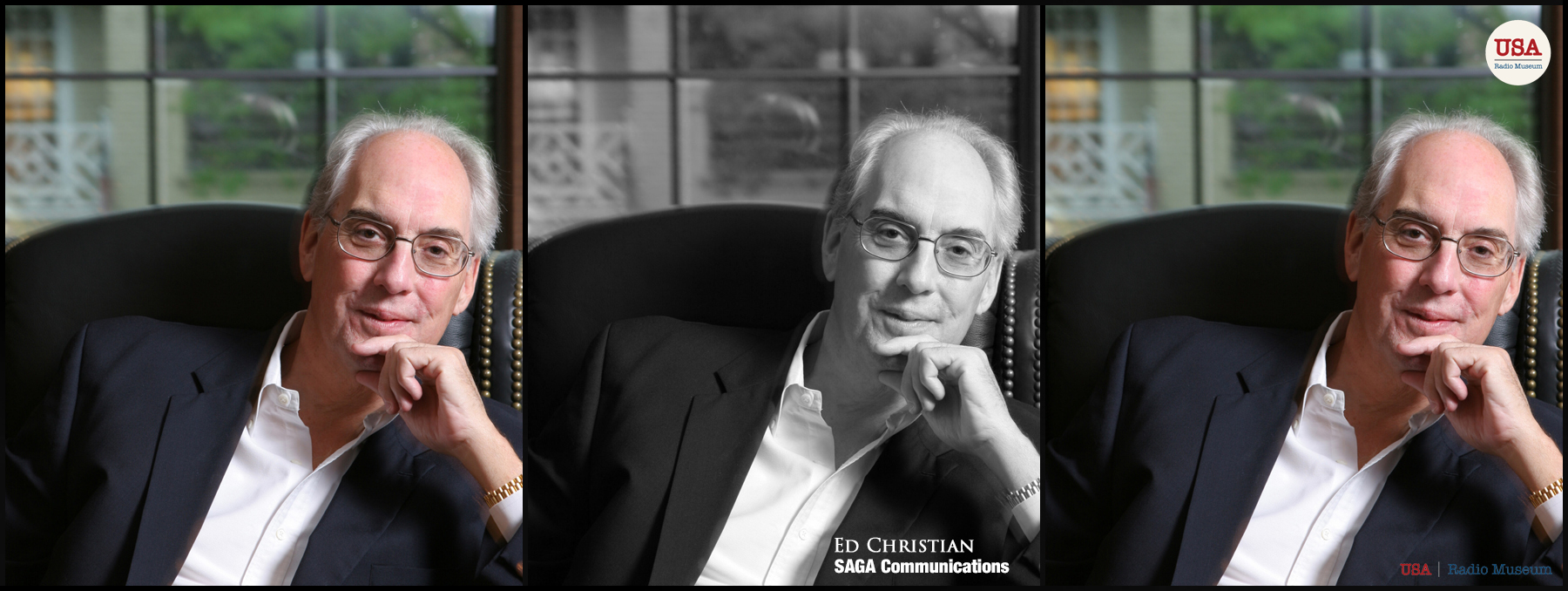
Ed Christian, founder, SAGA Communications. (Credit: Radio World)
Christian joined Josephson International in the late 1970s, first as executive vice president and later as president. Josephson was expanding its radio holdings, and Christian’s leadership helped sharpen its strategy and strengthen its operations. For a decade, he guided acquisitions, improved station performance, and developed a reputation as an executive who could see around corners. In 1986, he raised $38.5 million to buy out Josephson’s radio division—three AM and five FM stations—and founded Saga Communications. The name “Saga,” drawn from the Nordic word for “an ongoing adventure,” reflected Christian’s view of both his company and his life. “This is how I view my company and my life,” he said. “Our company is really an ongoing adventure.”
Saga grew rapidly under his guidance. By 1992, it became a publicly traded company on Nasdaq under the ticker SGA. At its peak, Saga owned 79 FM stations, 35 AM stations, and 80 translators across 27 markets, with additional interests in television and radio networks. Christian’s broadcasting philosophy was rooted in localism. He believed radio’s power came from its ability to speak directly to the people it served—not from corporate centralization, not from automation, and not from chasing digital trends at the expense of community. This philosophy guided Saga’s acquisitions, programming strategies, and market positioning. It also shaped Christian’s approach to leadership: hands‑on, attentive, and grounded in the belief that great radio begins with great people.
Christian’s leadership style blended bold vision with personal warmth. He described himself as an “admitted iconoclast,” often zigging when others zagged. During a 2012 earnings call, he criticized the industry’s obsession with digital platforms, arguing that radio’s strength lay in its on‑air content. “A lot of companies have been focusing on the icing of the cupcake, rather than the cupcake itself,” he said. Yet he was not dogmatic. He embraced streaming in larger markets, championed FM translators, and demonstrated fiscal conservatism when he pulled Saga’s streams in smaller markets to avoid rising royalty costs. His decisions were guided not by trends but by principle.
Colleagues described Christian as both mentor and friend. Bill Velez of the Radio Music License Committee recalled Christian’s support during difficult personal times. Erica Farber of the Radio Advertising Bureau praised his authenticity and his habit of adding a happy face to notes when pleased with an outcome. Steve Goldstein, Saga’s former head of programming, described working with Christian as “an ongoing master class,” citing his knowledge, innovation, and perspective. Christian’s influence extended beyond Saga. He served as chairman of the Radio Music License Committee, advocated for favorable royalty rates, and held board positions with the National Association of Broadcasters, the Michigan Association of Broadcasters, and other organizations. His commitment to public service included roles with the National Autoimmune Related Disease Association, St. John Hospital in Detroit, and his work as an Honorary Consul for Iceland.
His contributions were recognized with numerous accolades, including the NAB’s National Radio Award in 2009 and the Michigan Association of Broadcasters Lifetime Achievement Award in 2012. Radio Ink named him one of the most influential radio executives in the United States. As an adjunct professor at Central Michigan University, he shared his expertise with students, emphasizing the importance of understanding the industry from the inside. His lectures covered audience measurement, programming trends, and marketing, offering practical guidance to aspiring broadcasters.
Stations like WNIC in Detroit and WSNY in Columbus became cornerstones of his legacy. WNIC’s turnaround showcased his ability to revitalize struggling stations through innovative programming and community engagement. WSNY, part of Saga’s Columbus cluster, became a model for Saga’s strategy in mid‑sized markets, thriving through local talent, community presence, and disciplined programming. Christian’s death in 2022 marked the end of an era, but his legacy endures. Radio Ink founder Eric Rhoads described him as “one of the brightest, most innovative, and most unconventional” executives in the industry. Christian’s focus on the “cupcake itself”—the core of radio broadcasting—reminded the industry of its roots at a time when digital distractions threatened to overshadow its mission.
He was survived by his wife, Judy, daughter Dana Raymant, and son Eric Christian, all of whom shared his commitment to community and education. Wayne State University honored him with a Distinguished Alumni Award in 2015, recognizing his contributions to broadcasting and his alma mater. His amateur radio call sign, W8EKC, remained a quiet reminder of the passion that first drew him to the medium.
Ed Christian’s contributions to American broadcasting were further recognized with his induction into the Radio Hall of Fame, a distinction reserved for those whose influence has shaped the medium at its core. His induction affirmed what colleagues, students, and broadcasters had long known: that his vision, leadership, and devotion to local radio placed him among the true giants of the industry.
And thanks to Ed Christian, the broadcast legacy he shaped—as programmer, owner, and guardian of local radio—endures as a story worth honoring. His life’s work reminds us that radio’s greatest power lies not in its technology, but in the people who believe in its purpose. Because of him, that purpose continues to elevate the craft and inspire new generations entering the broadcasting profession with the same passion he exemplified throughout his enduring, lifelong love for radio.
_____________________
Sources & Credits
This tribute to Ed Christian draws upon a range of authoritative industry sources, historical records, and published reflections from colleagues who worked alongside him throughout his five‑decade career in broadcasting. Key reference materials include biographical reporting from Radio World (https://www.radioworld.com), Radio Ink (https://radioink.com), and Crain’s Detroit Business (https://www.crainsdetroit.com), as well as archival profiles from Saga Communications (https://sagacom.com) and Josephson International. Additional insights were informed by statements from the National Association of Broadcasters (https://nab.org), the Radio Advertising Bureau (https://www.rab.com), and the Radio Music License Committee (https://www.radiomlc.org).
Historical context regarding Christian’s early career, his leadership at WNIC Detroit and WSNY Columbus, and his founding of Saga Communications was supported by publicly available interviews, industry retrospectives, and corporate filings. Quotations from colleagues — including Bill Velez, Erica Farber, Steve Goldstein, Curtis LeGeyt, and Eric Rhoads — were drawn from published tributes and professional commentaries following Christian’s passing in 2022.
Academic references include materials from Wayne State University (https://wayne.edu) and Central Michigan University (https://www.cmich.edu) recognizing Christian’s contributions as an alumnus and adjunct professor. Supplemental information regarding Saga Communications’ growth, market strategy, and technological innovations was sourced from company statements, earnings call transcripts, and historical summaries of Saga’s mid‑market broadcasting model.
This tribute was written and curated for the USA Radio Museum to honor the life, leadership, and enduring legacy of Ed Christian, whose influence on American radio remains an ongoing adventure.
_____________________
Contact: jimf.usaradiomuseum@gmail.com
_____________________
A USARM Viewing Tip: On your PC? Mouse/double-click over the images for expanded views. On your mobile or tablet device? Finger-tap all the above images inside the post and stretch image across your device’s screen for LARGEST digitized view. Then click your browser’s back arrow to return to the featured post.
© 2026 USA Radio Museum. All Rights Reserved.
