
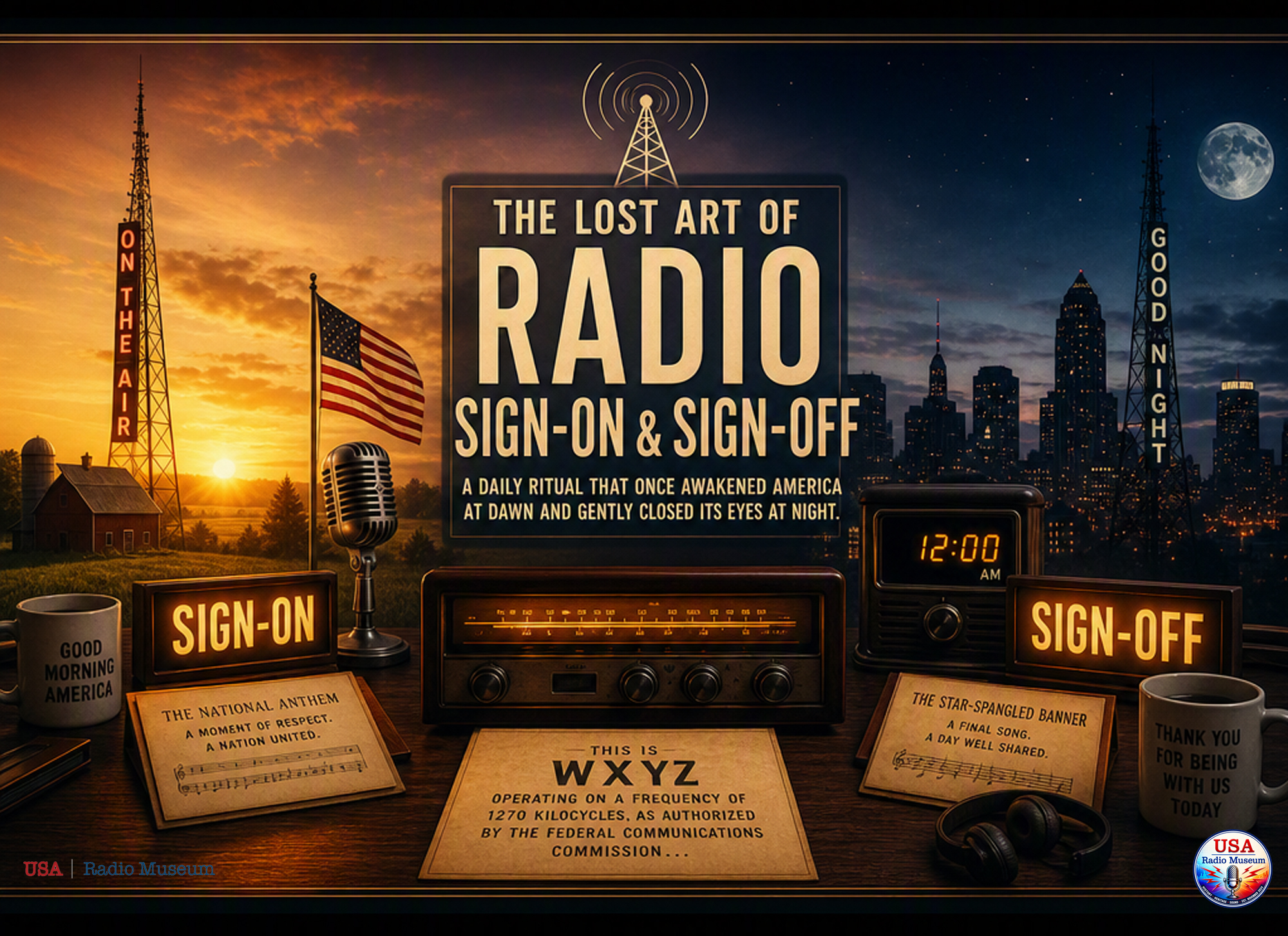
A Daily Ritual that Once Awakened America at Dawn and Gently Closed its Eyes at Night There was a time — not so long ago, yet already drifting into
A Daily Ritual that Once Awakened America at Dawn and Gently Closed its Eyes at Night
There was a time — not so long ago, yet already drifting into the soft haze of memory — when radio stations began and ended their broadcast day with ceremony. Before 24‑hour programming, before automation, before satellite feeds and nonstop content, radio lived by a daily rhythm. It woke up with its listeners, and it went to sleep with them. The sign‑on and sign‑off were more than technical necessities; they were rituals. They were moments of identity, reverence, pride, and connection. And for millions of Americans, they were the bookends of daily life.
Today, these rituals survive mostly in archival recordings, museum collections, and the recollections of those who grew up with AM and FM in the 1950s through the 1980s. But their legacy remains powerful. They remind us that radio was once a companion with a heartbeat — rising each morning, resting each night, and marking time in a way no other medium could.
This is the faded chapter of that lost art. — USA Radio Museum
The Dawn Ritual: When Stations Awakened
In the pre‑24‑hour era, most stations signed on at a specific time each morning — often between 5:00 and 6:00 AM. For early risers, farmers, factory workers, and paperboys, the sign‑on was a familiar friend. It began with silence, then a soft hum, then the unmistakable sound of a transmitter warming to life.
And then came the moment everyone remembers: The National Anthem.
Whether performed by a military band, a symphony orchestra, or a choral ensemble, the anthem signaled that the station was officially awake. It was a gesture of respect, patriotism, and continuity. Many stations followed it with a prayer, an invocation, or a brief message acknowledging the start of a new day.
After the anthem, the station would often deliver a formal announcement:
“This is WXYZ, licensed and operating on a frequency of 1270 kilocycles, as authorized by the Federal Communications Commission…”
These engineering statements were more than regulatory requirements. They were part of the station’s identity — a declaration of place, purpose, and professionalism. They told listeners exactly where the station lived on the dial, where its transmitter stood, and who it served.
Only then did programming begin: farm reports, weather forecasts, early news, or the first music of the day. The sign‑on was a gentle transition from silence to sound, from night to morning, from stillness to community.
The Sun-down Farewell: When Stations Slept
If sign‑ons felt like sunrise, sign‑offs felt like sunset.
Most stations ended their broadcast day around midnight, though some signed off earlier depending on staffing and local tradition. The sign‑off was often more emotional than the sign‑on. It carried a sense of closure — a final word, a final song, a final moment shared between station and listener.
Again, the National Anthem was the centerpiece. For many Americans, hearing the anthem at midnight became a cherished ritual. It marked the end of the day with dignity and calm.
After the anthem, stations delivered their closing announcements:
“This concludes our broadcast day…”
Some stations added a prayer or benediction. Others played a signature instrumental theme — a piece of music that became synonymous with the station’s nightly farewell. A few even displayed a test pattern or a still image on television simulcasts, accompanied by a steady tone.
And then, silence.
The transmitter powered down. The station rested. And listeners drifted into sleep knowing their radio companion would return in the morning.
A Detroit Memory: Honey Radio at Sundown
For many Detroiters, the sign‑off ritual wasn’t just something stations did — it was something listeners felt. In the 1980s, WHND‑AM 560 — Honey Radio — became one of the most beloved examples. Broadcasting oldies from studios in Birmingham and later Royal Oak, with its powerful transmitter in Monroe, WHND followed the sun. When daylight faded, so did the station. And every evening, listeners heard one of the most charming sign‑offs in American radio.
_____________________
WHND/WHNE FM | Sign-Off (Drake/Chenault (Jingle) | 1980
Audio Digitally Remastered by USA Radio Museum
_____________________
In a playful nod to Disney’s famous chant, the singers in the jingle would intone:
“Double‑you H‑N‑E, H‑O‑N‑E‑Y…” — a warm, whimsical farewell that felt like a signature wink from the station itself.
Then came the formal FCC‑mandated close of day, spoken with the calm authority of mid‑century engineering tradition:
“WHND now concludes its broadcast day. WHND is licensed to operate on a frequency of 560 kilocycles with studios in Birmingham and transmitter facilities in Monroe, Michigan. WHND now concludes its broadcast day. We will resume our broadcasting day at 6:00 AM tomorrow morning.”
And finally, as always, The Star‑Spangled Banner — the last sound before the transmitter fell silent and Honey Radio drifted into the night.
For countless Detroit listeners, that sequence became a nightly ritual: familiar, comforting, and unmistakably Honey Radio. It was the sound of a station with personality, pride, and a sense of time — a reminder that radio once lived by the rhythm of the day.
Identity Through Ritual
Sign‑ons and sign‑offs were more than technical bookends. They were expressions of identity.
Stations used these moments to reinforce who they were:
- Geography: Announcing transmitter locations tied stations to their communities.
- Professionalism: Engineering statements demonstrated precision and pride.
- Patriotism: The anthem connected stations to national unity.
- Tradition: Repeated daily rituals created familiarity and trust.
Listeners came to know these moments intimately. They recognized the exact recording of the anthem, the cadence of the announcer, the tone of the engineering message. These rituals became part of the station’s personality — as distinctive as its jingles, DJs, or news format.
The FCC Requirement Behind the Ritual
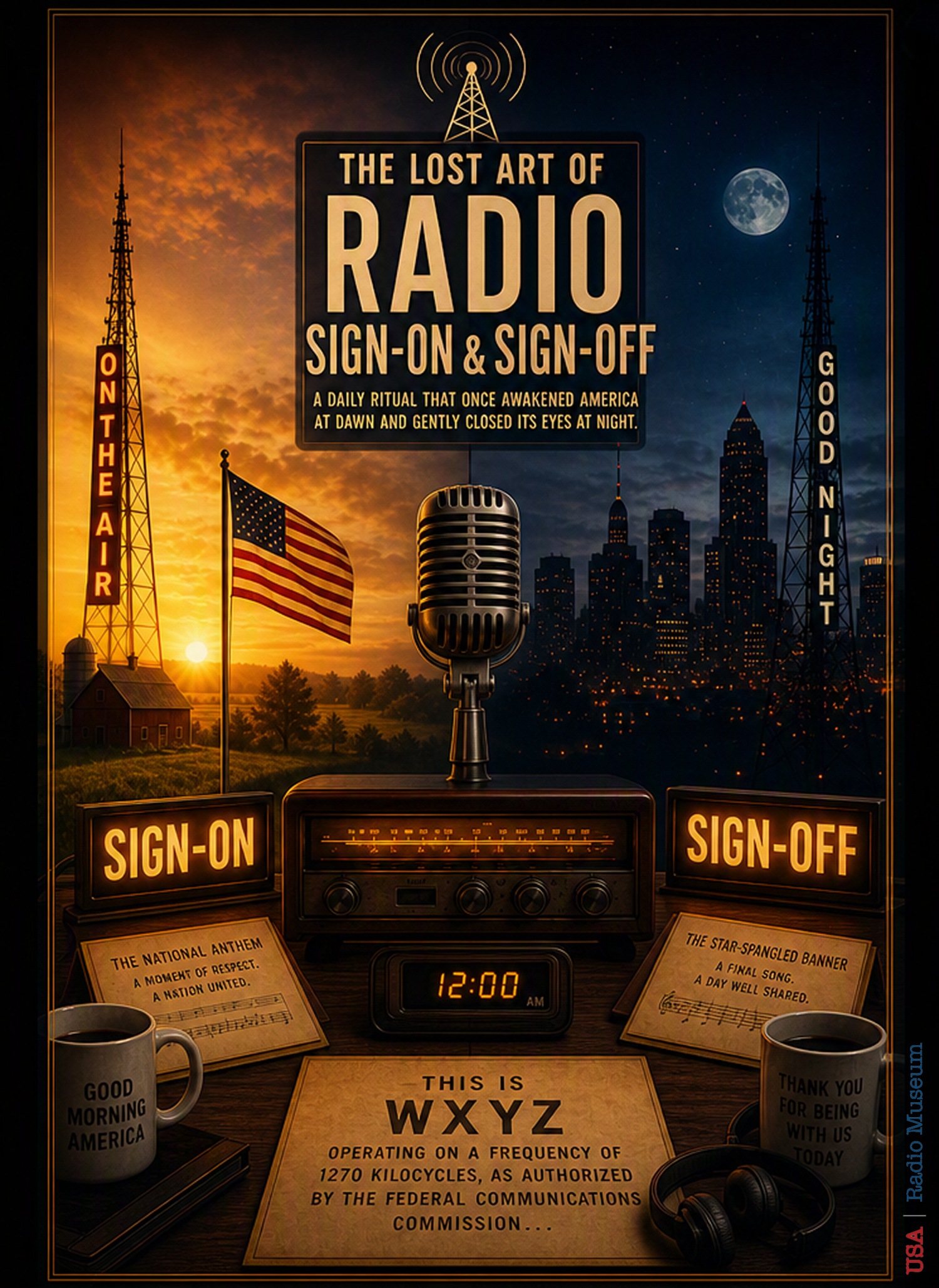
[This Artwork is AI Generated/Created for USARM 2026]
Stations were required to announce:
- Their call letters
- Their assigned frequency
- Their licensee or ownership
- Their transmitter location
- Their city of license
These announcements ensured transparency, accountability, and technical clarity for listeners and regulators alike. They also reinforced a station’s identity in a way that became deeply familiar to audiences.
A typical FCC‑compliant sign‑off sounded like this:
“This concludes our broadcast day. [Station] operates on a frequency of [kilocycles or megahertz], with studios located in [city] and transmitter facilities in [location]. We will resume broadcasting at [time] tomorrow morning.”
Though the exact wording varied from station to station, the structure remained consistent nationwide. The FCC’s requirement gave broadcasters a framework — and stations often added their own personality, music, or patriotic elements around it.
This regulatory backbone is what made the ritual feel so universal. Whether you were listening in Detroit, Atlanta, Chicago, or Los Angeles, the cadence of a sign‑on or sign‑off felt instantly recognizable. It was radio speaking in its most formal voice, fulfilling its duty while simultaneously creating a moment of connection.
The Shift to 24‑Hour Broadcasting
By the late 1970s and early 1980s, the landscape began to change. Automation systems allowed stations to run overnight without live staff. FM stereo’s rise created demand for continuous music. News stations expanded their coverage. Talk radio grew. And the idea of “signing off” began to fade.
Some stations held onto the ritual longer than others, but by the 1990s, sign‑ons and sign‑offs had largely disappeared from American radio.
The loss was subtle but profound. Without daily bookends, radio became constant — always on, always available, always awake. The medium gained convenience but lost a small piece of its soul.
Why the Ritual Still Matters
Today, sign‑ons and sign‑offs are treasured artifacts. They remind us of a time when radio felt human — when it breathed, rested, and rose again with the sun.
For historians, these recordings offer:
- Technical insight into early broadcasting practices.
- Cultural insight into mid‑century American values.
- Emotional resonance for generations who grew up with radio as a companion.
For museums like USARM, they are powerful storytelling tools. They evoke memory, nostalgia, and reverence. They remind visitors that radio was once a daily ritual woven into the fabric of American life.
A Final Reflection
The sign‑on and sign‑off may be gone from modern broadcasting, but their legacy endures. They represent a time when radio was not merely a medium, but a presence — one that greeted listeners each morning and bid them goodnight each evening.
In remembering these rituals, we honor the stations, engineers, announcers, and listeners who shared those moments. For it was a part of Radio Americana that no longer exists today. And that’s why we preserve a piece of radio’s heart — a quiet, dignified rhythm that once defined the American day.
_____________________
Sources & Credits
Primary Source Material
- Personal recollections of WHND‑AM 560 Honey Radio sign‑off procedures, Detroit (1980s).
- Listener‑verified accounts of Honey Radio’s nightly “W‑H‑N‑D, H‑O‑N‑E‑Y” chant and FCC‑mandated closing announcement.
- Regional broadcast engineering references documenting WHND’s studio locations (Birmingham, Royal Oak) and transmitter site (Monroe, Michigan).
- Historical practices of U.S. radio sign‑on and sign‑off procedures as preserved through mid‑century broadcast engineering manuals and FCC public documentation.
Federal Communications Commission (FCC)
- General broadcast identification requirements for AM/FM stations, including call letters, frequency, licensee, transmitter location, and city of license.
- Historical FCC guidelines governing the beginning and end of the broadcast day (pre‑24‑hour era).
Cultural & Archival Context
- Collective listener memories from Detroit‑area radio communities.
- Museum‑grade interpretation and narrative synthesis by the USA Radio Museum editorial team.
Imagery
- Custom panoramic, vertical artwork created for USARM’s publication of “What Was Once Heard in Broadcasting: The Lost Art of Radio Sign‑On and Sign‑Off.”
_____________________
Contact: jimf.usaradiomuseum@gmail.com
_________________________
A USARM Viewing Tip: On your PC? Mouse/double-click over the images for expanded views. On your mobile or tablet device? Finger-tap all the above images inside the post and stretch image across your device’s screen for LARGEST digitized view. Then click your browser’s back arrow to return to the featured post.
© 2026 USA Radio Museum. All Rights Reserved.

Actually Jim it is really “Double-you H-N-D, H-O-N-E-Y…..”
Vaughn, just as I thought THAT was how I used to hear it on WHND!
Well i think you’ve mistyped “Double-you H-N-D” with “Double-you H-N-E” because WHNE was the short lived FM version of WHND back in the ’70’s correct?
Vaughn, not really a mistype. I just brought it out as anyone would verbally say it (just without the W in this case) 🙂
Yet but still the Drake-Chenault jingle singers says “Double-you H-N-D” because WHND-AM and WHNE-FM are two different frequencies.