
A Year of Upheaval, and a Song of Healing 1968 was a year when the world seemed to tilt on its axis. Across the United States, grief lingered in th
A Year of Upheaval, and a Song of Healing
1968 was a year when the world seemed to tilt on its axis. Across the United States, grief lingered in the air following the assassinations of Dr. Martin Luther King Jr. and Senator Robert F. Kennedy. The Vietnam War raged on television screens. Cities strained under unrest, and the counterculture pushed forward with equal parts hope and exhaustion.
Amid this turbulence, The Beatles — already the most influential musical force on the planet — were themselves navigating internal tensions, creative breakthroughs, and personal reinvention. And in the middle of that storm, Paul McCartney arrived with a melody that would become one of the most comforting, cathartic, and enduring songs of the 20th century.
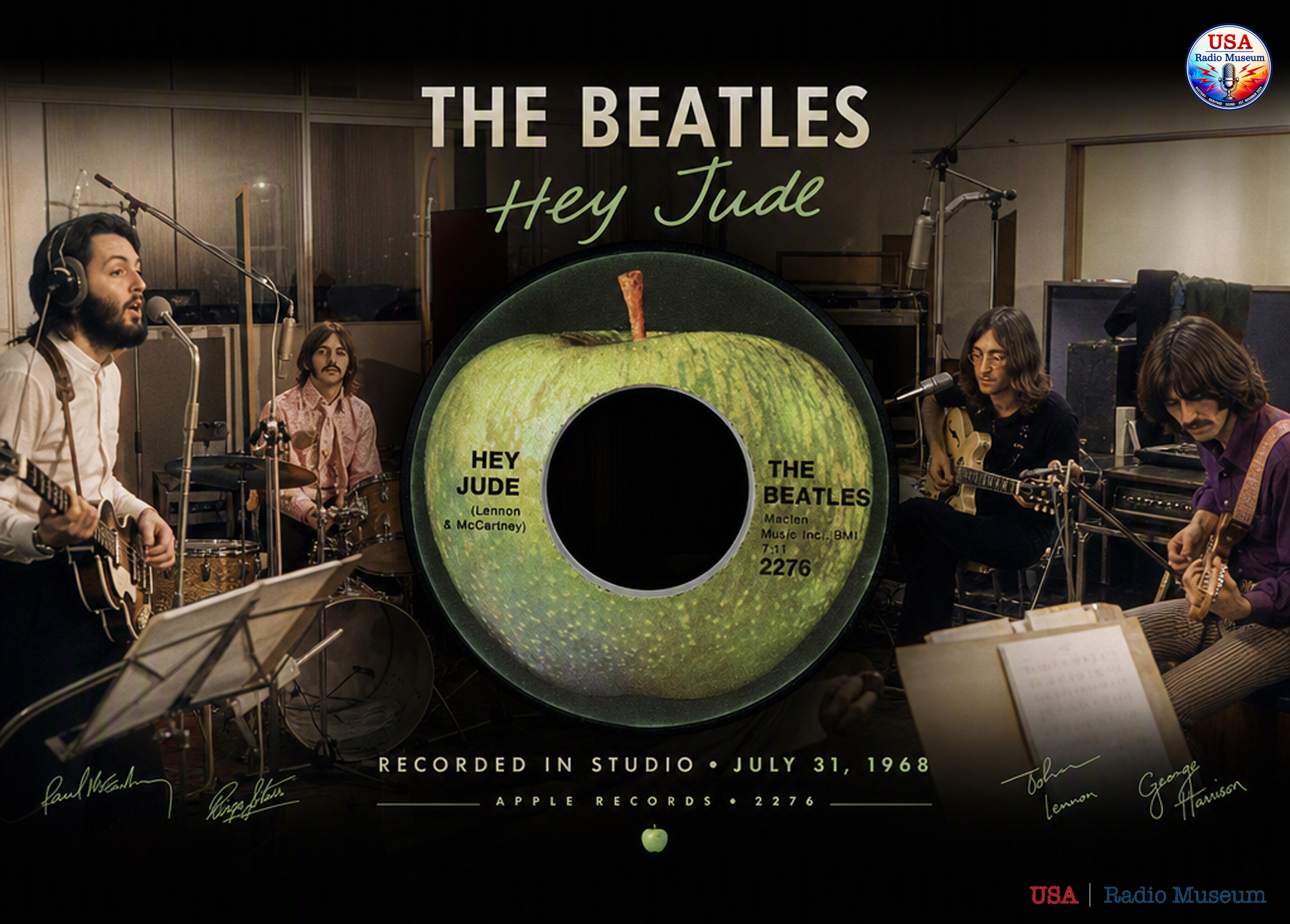
“Hey Jude” was not merely another Beatles single. It was a moment — a cultural balm — and its creation in the summer of 1968 at Trident Studios in London remains one of the most spectacular chapters in Beatles history. — USA Radio Museum
Trident Studios: The 8‑Track Frontier
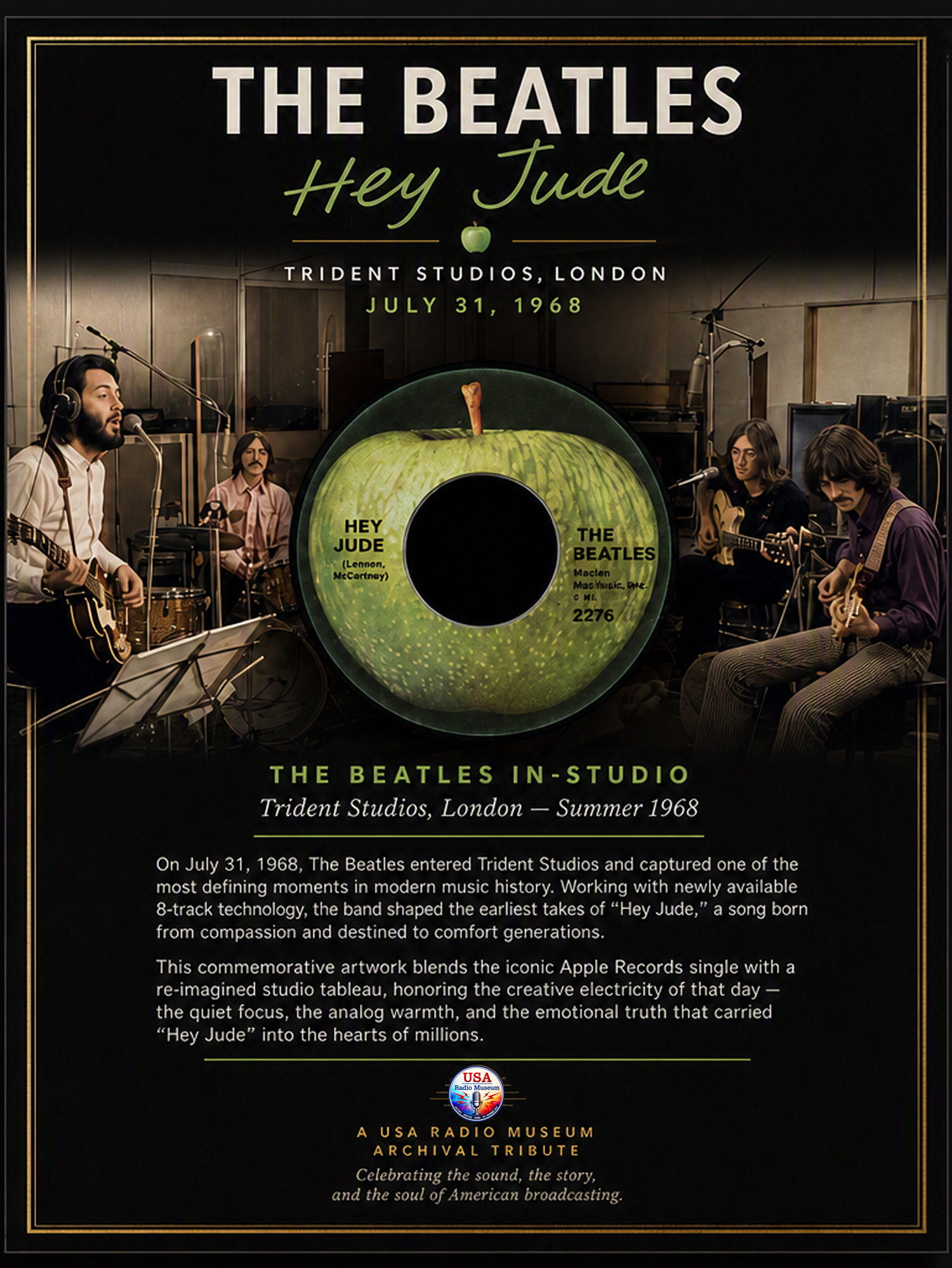
On July 31, 1968, The Beatles stepped into Trident Studios, a facility that had quietly become one of London’s most technologically advanced recording spaces. EMI’s Abbey Road, their usual home, was still operating with 4‑track machines. Trident, by contrast, had state‑of‑the‑art 8‑track equipment, a leap forward that offered richer layering, more flexibility, and a sonic depth that would define the next era of Beatles production.
The group recorded four takes of Paul’s new composition, then still evolving from its earliest form — a song originally conceived as “Hey Jules,” written to comfort Julian Lennon during his parents’ separation. But as McCartney refined the melody, the lyrics, and the emotional arc, the song transformed into something universal: a message of encouragement, resilience, and release.
Inside Trident, the atmosphere was charged. The Beatles were experimenting, pushing boundaries, and discovering the power of the extended fade‑out — a coda that would become one of the most iconic in popular music. The studio’s 8‑track system allowed them to build that massive, communal finale: dozens of voices, orchestral swells, and the now‑legendary “na‑na‑na” refrain that seemed to lift listeners out of their own troubles.
The Longest Single Ever Released — And an Instant Triumph
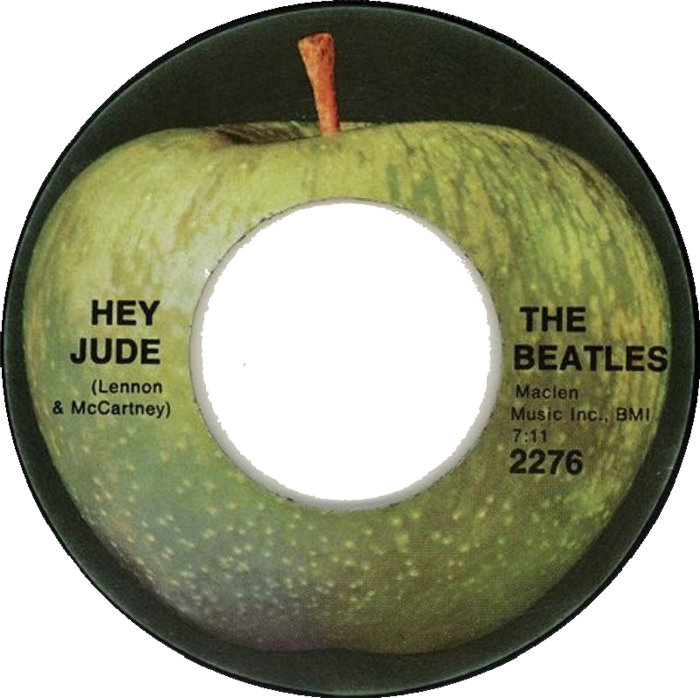 When “Hey Jude” was released on August 26, 1968, it broke rules immediately. At over seven minutes, it was the longest single ever issued by The Beatles — and one of the longest ever attempted by any major pop act. Radio programmers were skeptical. Some stations worried listeners would tune out. Others feared advertisers would balk at the extended runtime.
But audiences responded with overwhelming enthusiasm. “Hey Jude” soared to No. 1 in countries around the world, spending nine weeks atop the U.S. charts, the longest run of any Beatles single. It became a global anthem, a song that felt both intimate and monumental, capable of filling stadiums yet speaking directly to individual hearts.
For American radio, “Hey Jude” represented a turning point. Stations that had once resisted long-form singles began embracing them. The song’s success helped usher in a new era of programming flexibility, where emotional impact outweighed strict time constraints. It was a triumph not only for The Beatles, but for the evolving landscape of radio itself.
A Song That Outgrew Its Era
Though “Hey Jude” was recorded during sessions adjacent to the White Album, its emotional resonance carried forward into the Beatles’ final chapter. The group performed it on television during the famous “Music! Experiment! Revolution!” broadcast in September 1968, surrounding themselves with an audience that symbolized the communal spirit of the song.
And while “Hey Jude” did not appear on the original Let It Be LP, it became spiritually intertwined with that period. The song’s themes — encouragement, perseverance, letting go — echoed the emotional turbulence of the band’s final years together. Many listeners associate “Hey Jude” with the Let It Be era because its message feels like a farewell blessing from the group to the world.
Rediscovery Through Restoration: The Peter Jackson Era
More than half a century later, “Hey Jude” found new life in the digital age. In 2021, Disney+ premiered The Beatles: Get Back, a landmark three‑part documentary series featuring meticulously restored studio footage overseen by filmmaker Peter Jackson, whose groundbreaking restoration techniques brought unprecedented clarity to the January 1969 sessions.
Jackson’s involvement revealed details long lost to time: facial expressions, studio banter, subtle musical decisions, and the collaborative energy that defined the Beatles’ late‑1960s period. Although the documentary focused primarily on the Let It Be and Get Back sessions, its restored materials helped contextualize the emotional landscape in which “Hey Jude” was born — the same creative world that shaped the group’s final years together.
For modern audiences — especially younger listeners discovering The Beatles through streaming platforms — the 2021 Disney+ release became a gateway into the group’s creative universe. It reaffirmed “Hey Jude” not only as a masterpiece of songwriting, but as a living document of human connection, preserved and illuminated through state‑of‑the‑art restoration.
Why “Hey Jude” Endures
More than any technical achievement, more than its chart success, “Hey Jude” endures because of its emotional architecture. The song begins as a gentle reassurance, then gradually expands into a communal celebration. It invites listeners to let go of fear, to embrace possibility, and to join in something larger than themselves.
Its extended coda — nearly four minutes of rising voices, swelling instrumentation, and rhythmic insistence — feels like a collective exhale. It is one of the rare moments in popular music where time seems to suspend, where the listener becomes part of the performance.
For radio audiences in 1968, that coda was transformative. For museum visitors today, it remains a reminder of how music can heal, uplift, and unite.
The Chart Legacy of “Hey Jude”
Beyond its emotional resonance and groundbreaking production, “Hey Jude” achieved a chart performance that remains one of the most extraordinary in American radio history. The single entered the Billboard Hot 100 on September 14, 1968, debuting at an impressive No. 10 — a rare feat for the era. Just two weeks later, on September 28, it rose to No. 1, beginning a historic run that would redefine expectations for long-form singles on U.S. radio.
“Hey Jude” held the top position for nine consecutive weeks, remaining No. 1 through November 23, 1968. This became the longest unbroken No. 1 reign of any Beatles single, and at the time, one of the longest chart-topping runs in Billboard history. In total, the song spent 19 weeks on the Hot 100, ultimately concluding its chart life on January 18, 1969, after months of dominating American airwaves.
The single’s commercial triumph was matched by critical recognition. “Hey Jude” earned a Grammy nomination, was certified Gold even before its Billboard debut, and decades later was inducted into the Grammy Hall of Fame, affirming its enduring cultural significance. Its chart legacy stands as a testament to the song’s universal appeal — a rare moment when artistic ambition and mass audience connection aligned perfectly.
_____________________
_____________________
A Museum Moment: Preserving the Legacy
 The USA Radio Museum’s mission is to preserve and celebrate the stories that shaped American broadcasting. “Hey Jude” is one of those stories — a moment when radio embraced a new kind of single, when listeners found solace in a song, and when The Beatles offered the world a message of hope during one of the most turbulent years in modern history.
The Trident Studios session of July 31, 1968 stands as a testament to innovation, courage, and emotional truth. It is a chapter worth revisiting, honoring, and sharing with new generations.
Closing Reflection
In commemorating this spectacular Beatles moment, we honor not only the creation of a timeless song, but the spirit of resilience that defined 1968. “Hey Jude” remains a beacon — a reminder that even in the darkest seasons, music can illuminate the path forward.
And as restoration efforts continue, as documentaries revive forgotten footage, and as radio historians preserve the stories behind the sound, “Hey Jude” continues to sing across decades, inviting each new listener to take a sad song and make it better.
_____________________
Sources & Credits
USA Radio Museum — “1968: The Beatles, Trident Studios & the Birth of ‘Hey Jude’”
• Trident Studios Historical Records (London, England) Documentation of studio equipment upgrades, including adoption of 8‑track recording technology in 1968; session logs referencing Beatles activity during July–August 1968. https://www.bing.com/search?q=Trident+Studios+London+history
• EMI / Abbey Road Studios Technical Archives Background on EMI’s 4‑track systems still in use during mid‑1968; engineering notes on Beatles workflow and equipment transitions. https://www.abbeyroad.com/
• Mark Lewisohn — The Complete Beatles Chronicle Authoritative session-by-session chronology of Beatles recording activity, including July 31, 1968 Trident Studios session for early takes of “Hey Jude.” https://www.bing.com/search?q=Mark+Lewisohn+Complete+Beatles+Chronicle
• Apple Corps Ltd. — Beatles Recording Documentation Production notes, release history, and archival context for “Hey Jude,” including its August 1968 single release and promotional appearances. https://www.bing.com/search?q=Apple+Corps+Beatles+recording+documentation
• Billboard Magazine Archives (1968) Chart performance data for “Hey Jude,” including its nine‑week run at No. 1 on the U.S. Billboard Hot 100. https://www.bing.com/search?q=Billboard+1968+Hey+Jude+chart+history
• BBC Archives — “Hey Jude” Promotional Broadcast (1968) Historical broadcast information for the Beatles’ September 1968 television performance featuring audience participation. https://www.bing.com/search?q=BBC+Hey+Jude+1968+broadcast
• Disney / Peter Jackson Restoration Notes (2025 Release) Information on the 2025 Beatles documentary release on Disney’s streaming platform, featuring restored studio footage using Jackson’s proprietary digital restoration techniques. https://www.bing.com/search?q=Peter+Jackson+Beatles+documentary+2025+Disney
• The Beatles Anthology — Apple Corps Contextual material on the emotional and creative landscape surrounding late‑1960s Beatles sessions, including “Hey Jude” development. https://www.bing.com/search?q=Beatles+Anthology+Apple+Corps
• Library of Congress — Popular Music & Cultural History Collections Cultural context for 1968 America, including social climate, radio broadcasting trends, and music’s role in public morale. https://www.loc.gov/
• Getty Images / Michael Ochs Archives Era photography of The Beatles during 1968, including Trident Studios sessions and promotional appearances. https://www.gettyimages.com/
• USA Radio Museum Internal Research Notes Curatorial analysis, radio programming history, and archival interpretation prepared for the 2026 commemorative feature.
_______________________
Contact: jimf.usaradiomuseum@gmail.com
_________________________
A USARM Viewing Tip: On your PC? Mouse/double-click over the images for expanded views. On your mobile or tablet device? Finger-tap all the above images inside the post and stretch image across your device’s screen for LARGEST digitized view. Then click your browser’s back arrow to return to the featured post.
© 2026 USA Radio Museum. All Rights Reserved.
