
A Resilient Signal that has Served Generations Now Needs Congress to Serve it in Return Editorial Disclaimer This article serves as an official foll
A Resilient Signal that has Served Generations Now Needs Congress to Serve it in Return
Editorial Disclaimer
This article serves as an official follow‑up to the USA Radio Museum’s original AM‑radio editorial first published on February 17, 2026. Today’s continuation expands upon that foundation, offering updated context, renewed urgency, and additional analysis as Congress moves closer to a defining decision on the future of AM radio in America.
_____________________
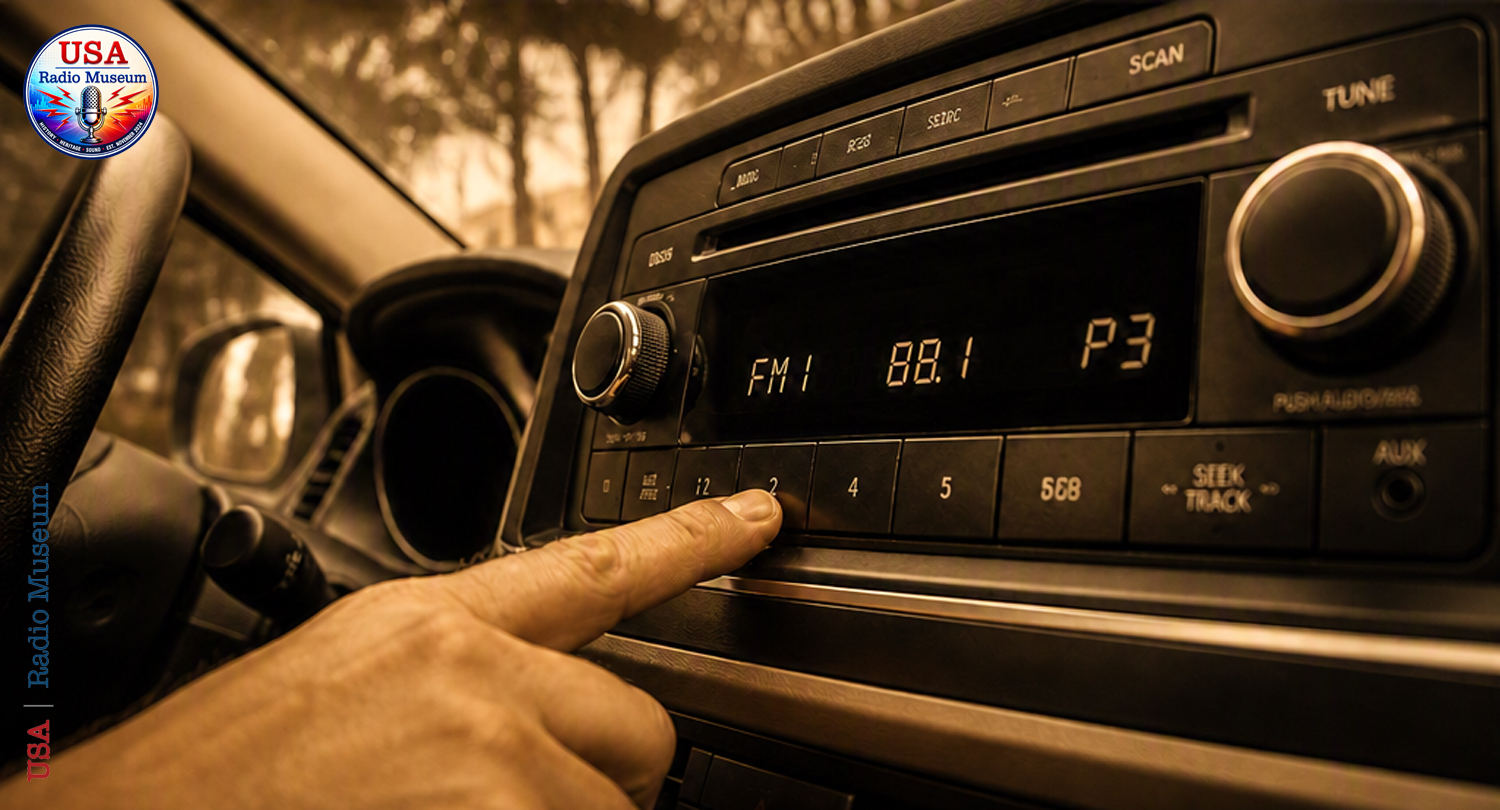
For more than a century, AM radio has been the quiet constant in American life — a medium that has carried the country through war, disaster, celebration, upheaval, and ordinary days that needed only a familiar voice in the background. It is the oldest broadcast technology still in daily use, the backbone of the Emergency Alert System, and the home of countless community voices that never appear on national platforms. Yet today, AM radio stands at a precarious crossroads, not because listeners have abandoned it, but because the automotive industry has begun quietly removing it from the dashboard — the last place where most Americans still encounter radio at all.
Two decades ago, nearly every household in the United States owned at least one radio. Today, that number has fallen dramatically, with in‑home radio ownership dropping from roughly 96 percent in the early 2000s to around 60 percent. At the same time, more than 70 percent of all AM/FM listening now happens in the car. The automobile has become the final refuge of radio — the last universal receiver in American life, subscription‑free, always on, and always local. When everything else fails, the car radio still works.
This is what makes the recent trend among automakers so alarming. Beginning around 2023, several manufacturers — including Tesla, BMW, Volvo, Audi, and Porsche — removed AM radio from certain new models, particularly electric vehicles. Their justification centered on interference concerns and dashboard redesigns. But the consequences of that decision extend far beyond convenience or engineering preference. Removing AM radio from vehicles severs a critical public‑safety lifeline, undermines decades of federal broadcast policy, and threatens the survival of hundreds of stations that serve rural, agricultural, multilingual, and minority communities.
AM radio is not a relic. It is a living, essential service. Its long‑distance reach remains unmatched. Its resilience during emergencies is irreplaceable. When power grids fail, cell towers collapse, and broadband networks go dark, AM signals continue to travel hundreds of miles, often becoming the only verified source of information for days at a time. In wildfire zones, hurricane corridors, tornado alleys, and rural regions where digital infrastructure is thin or nonexistent, AM radio is not nostalgia — it is necessity.
International reporting reinforces this reality. CBC News coverage from 2023 highlighted the global implications of removing AM receivers from vehicles, noting that AM remains vital in countries with vast rural territories, harsh weather, and long‑distance travel. Experts emphasized AM’s ability to penetrate terrain where FM and digital signals fail, its cultural significance, and its role in emergency communication. The international perspective makes one point unmistakably clear: AM radio’s challenges are not technological inevitabilities. They are policy choices.
And policy choices can be reversed.
Removing AM radios from new vehicles doesn’t just weaken public safety — it threatens the economic survival of all‑news AM stations in major cities. Outlets in Dallas, New York, Los Angeles, Detroit, San Francisco, Tampa, and dozens of other markets depend on in‑car listening to sustain their newsrooms, advertising revenue, and market relevance. As automakers strip AM from dashboards, these stations lose their most reliable audience base, accelerating an already severe decline in listenership and revenue. For owners, the math becomes brutal: fewer commuters means fewer advertisers, fewer reporters, and fewer reasons to maintain costly all‑news operations. In a medium already facing layoffs, consolidations, and network upheavals, removing AM from cars pushes some of America’s most essential news stations closer to the edge.
That is why the AM Radio for Every Vehicle Act — introduced by Senators Ted Cruz and Ed Markey, and Representatives Gus Bilirakis and Frank Pallone — represents one of the most consequential bipartisan broadcast‑policy efforts in decades. With more than 60 Senators and over 260 House members supporting the bill, Congress has a rare opportunity to protect a medium that remains central to public safety, rural communication, cultural preservation, and community identity. More than 125 national organizations have endorsed the legislation, including emergency‑management agencies, agricultural groups, broadcasters, and public‑interest advocates. Former FEMA officials have issued stark warnings: eliminating AM radio will put public safety at risk.
Yet despite overwhelming support, the bill awaits floor action in both chambers. The Senate Commerce Committee advanced the legislation by voice vote, placing it in line for a full Senate vote. The House version, with its extraordinary bipartisan backing, remains ready for passage. What stands between AM radio and its protection is not opposition — it is scheduling. The bill is alive, viable, and strongly supported, but it has not yet been placed on the congressional calendar.
This is the moment when public pressure matters. Congress often moves widely supported bills during legislative windows when bipartisan measures can be bundled into larger packages — transportation bills, public‑safety initiatives, or year‑end omnibus legislation. The post‑election lame‑duck session is historically the period when such bills finally clear. The AM Radio for Every Vehicle Act is perfectly positioned for that kind of movement. But momentum must be maintained.
The stakes extend far beyond emergency communication. Removing AM radio from vehicles would destabilize the entire regulatory framework that broadcasters have operated under for decades. AM licenses — scarce public resources regulated by the FCC — were acquired and maintained under the assumption that the automotive dashboard would remain a guaranteed point of access for the public. If automakers eliminate AM receivers, the value of those licenses collapses. Minority‑owned stations, rural broadcasters, and community‑service outlets would face sudden, unanticipated losses through no fault of their own. This is not merely a technological shift; it is a policy failure with real economic consequences.
Culturally, the loss would be immeasurable. AM radio is America’s memory. It is the medium that carried Roosevelt’s fireside chats, World War II bulletins, the moon landing, local high‑school sports, dawn farm reports, and the voices of neighborhoods and small towns that never appear on national networks. To lose AM radio in the car is to lose the last place where America still hears itself.
The road ahead is clear. Congress must act. Automakers must listen. And the public must understand what is at stake. The AM Radio for Every Vehicle Act is not about preserving nostalgia. It is about protecting a resilient, indispensable public service that continues to safeguard lives, inform communities, and preserve the diverse voices that define the nation.
The last radio in the house may be in the car. If we lose that, we lose far more than a frequency band. We lose a piece of America’s identity — and a critical layer of its safety.
_____________________
Sources & Credits
Primary Reporting & Analysis CBC News — “Some carmakers are removing AM radios from dashboards. How big of a loss will it be?” Reporting by Mouhamad Rachini (May 24–25, 2023) Used for international context, expert commentary, and technical insights regarding AM radio interference, rural coverage, and emergency‑communication relevance.
Legislative Documentation U.S. Senate: S.315 — AM Radio for Every Vehicle Act Introduced by Senators Ted Cruz and Ed Markey; cosponsor data and committee actions sourced from publicly available congressional records.
U.S. House of Representatives: H.R.979 — AM Radio for Every Vehicle Act Introduced by Representatives Gus Bilirakis and Frank Pallone; cosponsor counts and legislative status sourced from official House records.
Public‑Safety & Emergency‑Management Commentary Statements from former FEMA officials and national emergency‑management organizations regarding AM radio’s role in the Emergency Alert System and disaster‑response infrastructure.
Industry & Advocacy Sources National Association of Broadcasters National Emergency Management Association American Farm Bureau Federation Native Public Media SAG‑AFTRA National Association of Black Owned Broadcasters Referenced for coalition support and public‑interest positions on AM radio preservation.
Historical Context & Museum Interpretation USA Radio Museum archival research, broadcast‑history documentation, and curator‑level analysis of AM radio’s cultural, rural, and emergency‑alert significance.
_____________________
Contact: jimf.usaradiomuseum@gmail.com
___________________
© 2026 USA Radio Museum. All rights reserved.

I Don’t think that the “Savior Of The Free World” would not listen to that.