
From Club 21 to CBS: The Early Years of a Broadcasting Icon Ed Sullivan’s rise to national prominence is usually told as a television story — a tal
From Club 21 to CBS: The Early Years of a Broadcasting Icon
Ed Sullivan’s rise to national prominence is usually told as a television story — a tale of Sunday nights, of Elvis and The Beatles, of a stiff‑shouldered host who somehow became the most powerful gatekeeper in American entertainment. But long before the cameras rolled, before the theater lights warmed his face, Sullivan lived another life in broadcasting, one carried not by images but by voice. His radio years, largely forgotten today, reveal a man learning how to speak to America, how to steady it, how to guide it through moments of uncertainty. And thanks to rare surviving recordings, including a newly clarified May 22, 1944 broadcast preserved by the USA Radio Museum, that earlier Sullivan — the one behind the microphone — can finally be heard again.
He began as a newspaperman, a Broadway columnist whose clipped prose in the New York Daily News made him one of the most widely read entertainment writers in the country. The column was brisk, omnivorous, and unpretentious, reflecting Sullivan’s own temperament. He was not a performer; he was a reporter. But radio was becoming the nation’s heartbeat, and CBS recognized that Sullivan’s instincts — his ability to read a room, a trend, a moment — could translate to the airwaves. Throughout the 1930s, he appeared on CBS programs as a commentator and occasional host, his voice carrying the same plainspoken authority that defined his writing. He did not sound like a radio star. He sounded like someone telling you the truth.
When the United States entered World War II, Sullivan’s role deepened. The country needed voices that could explain the world without theatrics, and Sullivan’s steady cadence fit the moment. His wartime broadcasts were not dramatic; they were clarifying. He spoke as though he were still writing a column, only now the column was spoken aloud to millions. In those years, he became something rare: a cultural interpreter who could move seamlessly between entertainment and national concern.
The USA Radio Museum’s May 22, 1944 recording captures Sullivan at precisely that intersection. The broadcast, originally mislabeled as May 24 but now correctly aligned with the Monday schedule of his CBS program Ed Sullivan Entertains, finds him addressing a question that was circulating through newspapers, military briefings, and public speculation: What does the “D” in D‑Day mean? Thirteen days before the Normandy invasion, Sullivan used his 15‑minute slot to explain the terminology that had already entered the American vocabulary. His tone is calm, conversational, almost intimate. He is not announcing news; he is preparing a nation for what is coming.
_____________________
Columbia Broadcasting System | Ed Sullivan Reports the News | Monday, May 22, 1944
Audio Digitally Remastered by USA Radio Museum
_____________________
The program itself was a curious hybrid — part entertainment, part wartime commentary, part celebrity salon. Sponsored by Mennen Shaving Products and broadcast live from New York’s famed Club 21, Ed Sullivan Entertains aired every Monday evening at 7:15 p.m. Eastern War Time. The clatter of dishes, the hum of conversation, the presence of Broadway personalities drifting through the background gave the show a texture unlike anything else on radio. Sullivan’s sign‑off, preserved perfectly in the Museum’s recording, is a small masterpiece of period broadcasting: “Goodnight, until next Monday night, this is Ed Sullivan your Mennen reporter… M‑E‑N‑N‑E‑N, the greatest name in shaving.” Moments later, the announcer delivers the era’s definitive network signature: “This is the Columbia Broadcasting System.”
These details matter because they confirm the recording’s provenance with remarkable clarity. It is not a stray news segment or a syndicated transcription. It is a genuine CBS network transmission from the final weeks of Ed Sullivan Entertains, a program whose surviving episodes are exceedingly rare. OTR catalogs list only two known broadcasts: May 22 and June 5, 1944. The Museum’s recording, now correctly identified, is one of the few remaining windows into Sullivan’s wartime voice.
_____________________
_____________________
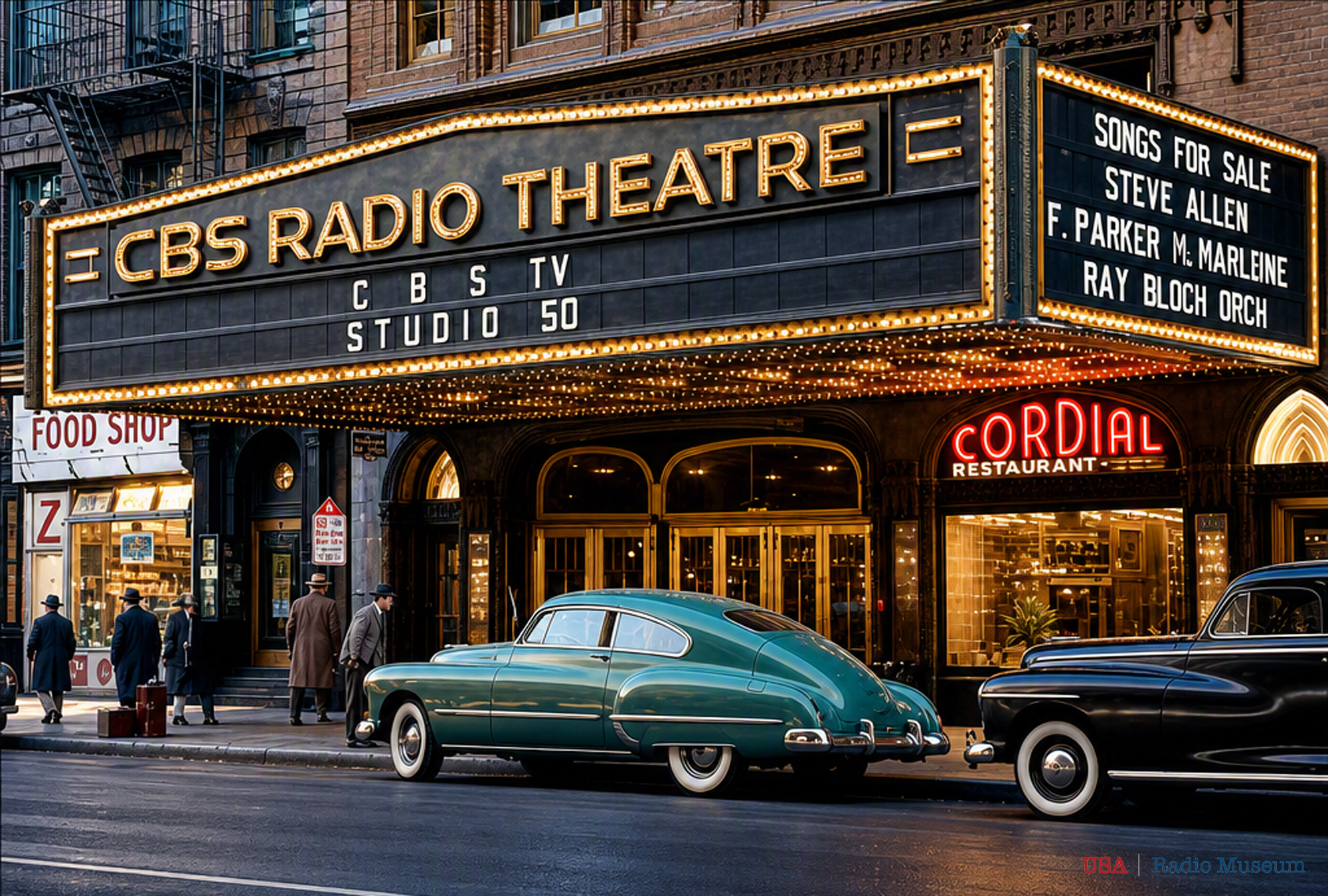
CBS Radio Theater — Late 1940s, New York City Restored and colorized from the USA Radio Museum archive, this panoramic image captures the grandeur of CBS Radio Theater, later known as the Ed Sullivan Theater. The marquee glows with mid‑century brilliance, announcing Songs for Sale with Steve Allen and the Ray Bloch Orchestra — a glimpse into the golden age of live broadcasting. Beneath the lights, vintage cars and passersby evoke the pulse of Manhattan’s entertainment district at its height. Enhanced to modern clarity, this restoration honors the building’s dual legacy as both radio landmark and television icon — the stage where American broadcasting found its voice and, later, its face.
_____________________
By the time the program ended — on June 5, 1944, the eve of D‑Day — Sullivan had already proven himself as a broadcaster capable of commanding national attention. When CBS later sought a host for its new television variety program in 1948, Sullivan’s radio years made him the natural choice. His timing, his presence, his ability to connect with audiences across class, region, and generation — all of it had been forged behind the microphone. The television era that followed would reshape American culture. Toast of the Town, later renamed The Ed Sullivan Show, became a national ritual, introducing America to Elvis Presley, The Beatles, Broadway stars, comedians, opera singers, and countless performers who might never have found a national stage without him. For twenty‑three years, Sullivan presided over the most influential variety program in television history, a show that mirrored the country’s tastes, tensions, and transformations.
When Sullivan died on October 13, 1974, at the age of 73, his obituary described him as a man with “an unerring instinct for what Americans wanted to see.” But the rediscovered radio recordings suggest something deeper: he also had an instinct for what Americans needed to hear. Before the spotlight, before the screaming teenagers and the cultural earthquakes of the 1950s and 1960s, Sullivan was a voice — steady, curious, and unmistakably American. His radio years reveal a broadcaster shaped by the intimacy of sound, by the urgency of wartime America, and by the discipline of speaking directly to millions without the safety net of spectacle.
The USA Radio Museum’s preservation of the May 22, 1944 broadcast restores a missing chapter in that story. It reveals Sullivan not as the stern television host frozen in cultural memory, but as a man learning how to guide a nation through uncertainty. In the clatter of Club 21, in the calm of his Mennen sign‑off, in the CBS chimes that closed each broadcast, Ed Sullivan was already becoming the figure who would later define the sound and shape of American entertainment. The microphone came first. And in those early years, he was already speaking to America in a voice that would echo for decades.
_____________________
Sources & Credits — USA Radio Museum
Primary archival material drawn from the USA Radio Museum Collection, including the preserved CBS Radio broadcast of Ed Sullivan Entertains, originally labeled May 24, 1944 and now correctly identified as May 22, 1944 based on internal audio evidence, sponsor identification, and CBS network sign‑off.
Historical broadcast context informed by contemporary 1943–1944 CBS network listings, wartime radio schedules, and sponsor documentation for Mennen Shaving Products, confirming the program’s Monday 7:15 p.m. Eastern War Time placement and Club 21 origin.
Supplementary research supported by period trade publications, including Tune In magazine’s April 1944 feature on Ed Sullivan’s Club 21 broadcasts, and cross‑reference with surviving OTR catalogs identifying extant episodes of Ed Sullivan Entertains (May 22 and June 5, 1944).
Biographical framing and post‑war career context based on widely available public historical records documenting Sullivan’s transition to television in 1948, his 23‑year tenure as host of Toast of the Town / The Ed Sullivan Show, and his passing on October 13, 1974 at age 73.
Editorial synthesis, narrative development, and historical integration prepared by USA Radio Museum / USARM Research Department, honoring the preservation of American broadcast heritage.
_____________________
The Feature Post Main Image
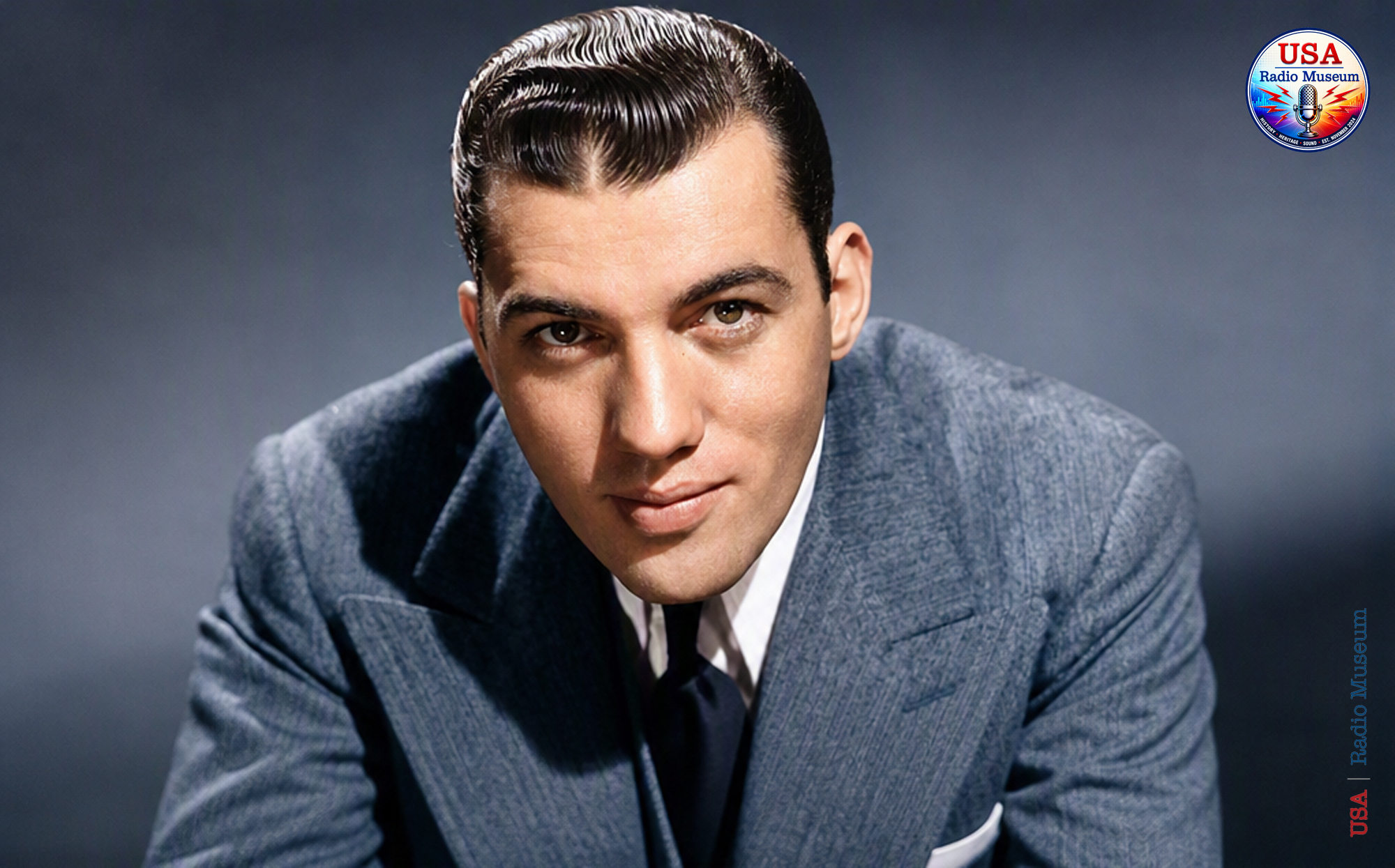
Ed Sullivan — CBS Radio Era, circa 1944 Restored and colorized from the USA Radio Museum archive, this portrait captures Sullivan at the height of his wartime broadcasting years. The image has been enhanced to modern clarity while preserving the dignity and composure that defined his early career. Before he became television’s Sunday‑night icon, Sullivan was already a trusted voice on CBS Radio — a journalist, commentator, and cultural interpreter whose calm authority helped guide America through the 1940s. This restoration honors the enduring presence of a man who bridged the microphone and the spotlight.
_____________________
Contact: jimf.usaradiomuseum@gmail.com
_____________________
© 2026 USA Radio Museum. All Rights Reserved
