
There are moments in broadcasting history when an industry seemingly destined for extinction discovers one final burst of life. For American radio d
There are moments in broadcasting history when an industry seemingly destined for extinction discovers one final burst of life. For American radio drama, that moment arrived in January 1974 when CBS unveiled a program few industry observers expected to succeed. Television had long ago become the nation’s dominant storyteller. The golden age of radio drama had faded into memory. The grand adventures, mysteries, thrillers, and suspense programs that once gathered families around glowing consoles appeared to belong to another era.
Yet CBS was willing to gamble on something many considered obsolete.
The result was CBS Radio Mystery Theater, a series that would become one of the most remarkable preservation efforts in broadcasting history, not through nostalgia alone, but through the simple act of proving that powerful storytelling never truly goes out of style.
Hosted by the legendary E.G. Marshall, whose measured introductions became as familiar to listeners as the creaking door that opened each episode, the series embraced the traditions of radio’s golden age while introducing them to a new generation. Night after night, listeners were invited into worlds of suspense, mystery, supernatural encounters, science fiction, psychological drama, and classic literary adaptation. The formula was deceptively simple. There were no visual effects, no elaborate production sets, and no cinematic spectacle. There were only voices, music, sound effects, and an audience willing to imagine the rest.
_____________________
CBS Radio Mystery Theater | Old Ones Are Hard To Kill | January 06, 1974
Audio Digitally Enhanced by USA Radio Museum
_____________________
That imagination became the program’s greatest special effect.
At a time when media executives increasingly measured success through visual impact, CBS Radio Mystery Theater offered something profoundly different. It trusted its audience. Rather than showing listeners what a haunted house looked like, it allowed them to create one in their minds. Rather than presenting a villain’s face, it invited each listener to imagine their own. In doing so, the series demonstrated a truth radio pioneers had understood since the 1920s: the mind often creates pictures more vivid than any screen.
What made the series particularly extraordinary was its timing. By the 1970s, radio drama was widely considered a relic. The network dramas that once dominated evening schedules had largely vanished by the early 1960s. Industry attention shifted toward music formats, personality-driven stations, and emerging FM radio audiences. Conventional wisdom suggested that scripted audio drama belonged to history.
CBS disagreed.
_____________________
CBS Radio Mystery Theater | One Of The Missing | January 01, 1976
Audio Digitally Enhanced by USA Radio Museum
_____________________
The network recognized that while technology changes, the human appetite for stories remains constant. Under the stewardship of producer Himan Brown, whose career stretched back to radio’s formative years, CBS Radio Mystery Theater became both a tribute to broadcasting heritage and a bridge to the future. Episodes drew from original scripts as well as adaptations of works by Edgar Allan Poe, Charles Dickens, H.G. Wells, Arthur Conan Doyle, and countless other literary giants. Accomplished actors from stage, screen, and radio lent their talents to the productions, creating a level of quality seldom heard in contemporary broadcasting.
For many listeners, the nightly broadcast became a ritual. Long-distance truck drivers tuned in from deserted highways. Shift workers listened during overnight hours. Students discovered a medium they had never experienced before. Older Americans, meanwhile, found echoes of an era they thought had disappeared forever. Across generations, the program cultivated a loyal audience that appreciated the unique intimacy radio could provide.
Its influence extended well beyond its original run. Today, audio storytelling enjoys a renaissance through podcasts, audiobook productions, and narrative streaming content. Entire industries now thrive on the concept that compelling stories can succeed without accompanying images. The success of fiction podcasts and serialized audio dramas has introduced millions to an experience remarkably similar to what CBS Radio Mystery Theater offered decades earlier.
In many respects, the show was ahead of its time.
Listening today reveals why the series continues to endure. The performances remain engaging. The sound design remains effective. Most importantly, the stories still work. The absence of visual elements has not aged the productions; if anything, it has preserved them. A television drama from the 1970s may reveal its era through fashions, hairstyles, or special effects. A radio drama exists in a realm largely untouched by those limitations. Once the listener closes their eyes, the production becomes timeless.
Perhaps that explains why archives devoted to broadcasting heritage have worked so diligently to preserve these recordings. They represent far more than entertainment. They are evidence of radio’s resilience. They demonstrate that innovation does not always require inventing something entirely new. Sometimes it means rediscovering a medium’s original strengths and presenting them to a new audience.
The network may have changed, the studios may have fallen silent, and the business itself may have moved on, but the stories endure. Every preserved episode is a reminder that broadcasting history belongs not only to the companies that created it, but to the listeners who cherished it and the archivists who refused to let it disappear.
For the USA Radio Museum, the preservation of 1,399 episodes of CBS Radio Mystery Theater is more than an archival achievement. It represents the safeguarding of one of the final great chapters in network radio drama. Within those recordings live thousands of performances, countless stories, and a remarkable testament to the enduring power of sound.
Today, that preservation carries even greater significance. As the broadcasting landscape continues to evolve and the familiar institutions of network radio become increasingly distant memories, collections such as these serve as living bridges to a nearly forgotten era. What was once heard through dashboard speakers, bedside radios, and late-night affiliate broadcasts now survives because archivists, historians, and listeners understood its value before it was too late.
Decades after the final episode aired, the creaking door still opens.
And listeners still step through.
_____________________
CBS Radio Mystery Theater | Revenge Is Not Sweet | January 02, 1980
Audio Digitally Enhanced by USA Radio Museum
_____________________
In an age overflowing with screens, algorithms, and endless visual distractions, CBS Radio Mystery Theater remains a reminder that some of the most unforgettable images are the ones we create for ourselves.
Long after the transmitters have gone silent and the corporate names have faded from the headlines, the voices remain. In the archives of the USA Radio Museum, CBS Radio Mystery Theater still opens its creaking door, inviting new generations to enter the last great theater of the mind.
Its legacy endures not because it was the last major radio drama, but because it proved that radio’s oldest magic never disappeared.
It was simply waiting for someone to turn out the lights and let the imagination begin.
_____________________
Sources and Credits
Article written for the USA Radio Museum.
Primary Historical Sources
• CBS Radio Mystery Theater broadcast recordings preserved within the USA Radio Museum archive collection.
• CBS Radio Mystery Theater (1974-1982), created and produced by Himan Brown for CBS Radio.
• Historical network radio and program reference materials documenting the production and broadcast history of CBS Radio Mystery Theater.
• Contemporary and archival biographical sources regarding E.G. Marshall, longtime host and narrator of CBS Radio Mystery Theater.
Image Credits
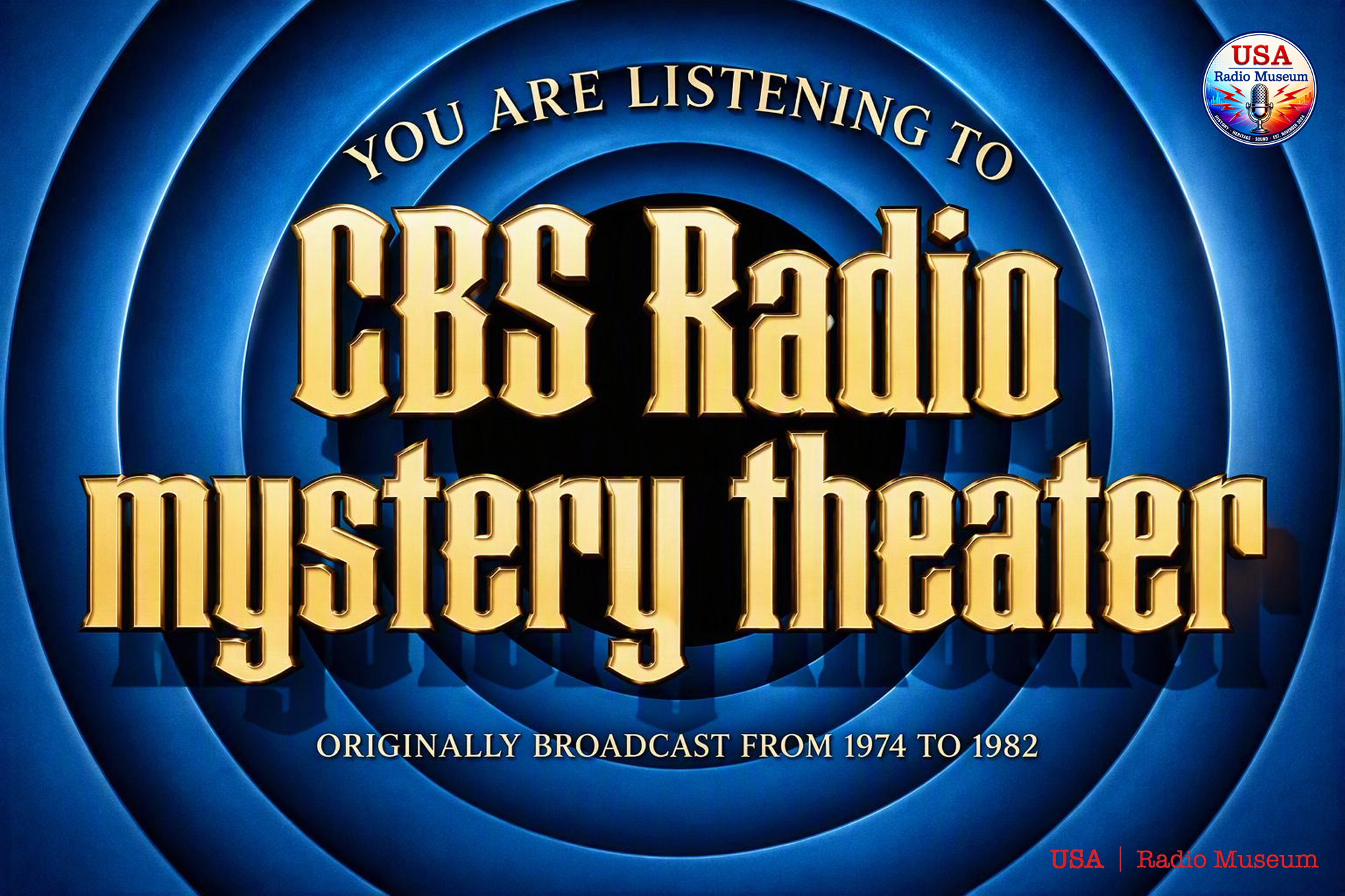
• Featured CBS Radio Mystery Theater promotional image restored and digitally enhanced for presentation by the USA Radio Museum.
• Original CBS Radio Mystery Theater branding and related broadcast imagery remain the property of their respective copyright holders and are presented for historical and educational purposes.
Special Acknowledgment
The USA Radio Museum proudly preserves 1,399 episodes of CBS Radio Mystery Theater, helping ensure that one of the final great achievements of American network radio drama remains available for future generations of listeners, researchers, historians, and broadcasting enthusiasts.
Preservation Statement
The USA Radio Museum is dedicated to preserving America’s broadcasting heritage through the collection, restoration, documentation, and presentation of historically significant radio recordings, artifacts, and related materials.
Preserving the past is more than an act of remembrance. It is a promise that the voices which once filled America’s airwaves will continue to be heard.
_____________________
Contact: jimf.usaradiomuseum@gmail.com
_____________________
© 2026 USA Radio Museum. All Rights Reserved
