
For More Than a Century, Cincinnati's Legendary WLW Has Remained One of American Radio's Most Enduring Call Signs and Most Powerful Voices In
For More Than a Century, Cincinnati’s Legendary WLW Has Remained One of American Radio’s Most Enduring Call Signs and Most Powerful Voices
In the grand story of American broadcasting, there are radio stations that achieved success, stations that defined their era, and then there are a select few whose very call letters became woven into the fabric of the nation. WLW of Cincinnati belongs to that rare company. Since first signing on the air on March 23, 1922, WLW has remained under the same iconic call letters, a distinction few American radio stations can claim today. More than a century later, across generations, technological revolutions, shifting audience habits, and dramatic changes in the media landscape, WLW remains what it has always been: a trusted voice carried across the Midwest and beyond.
For many radio listeners, WLW is more than a station. It is a living monument to broadcasting itself.
The history of WLW stretches back to radio’s formative years when the medium was still discovering its identity and America was learning the remarkable possibilities of sound carried invisibly through the air. While countless stations have appeared and disappeared, changed ownership, altered formats, or abandoned their original identities, WLW has carried its famous call letters through the decades, becoming one of the nation’s most recognizable broadcasting brands.
Its story is inseparable from the rise of Cincinnati broadcasting and from the ambitions of businessman and radio pioneer Powel Crosley Jr., whose vision transformed a local outlet into a national powerhouse. Under Crosley’s leadership, WLW emerged as one of America’s most influential stations. During a period when radio was rapidly becoming the country’s dominant mass medium, WLW demonstrated just how powerful a single station could become.
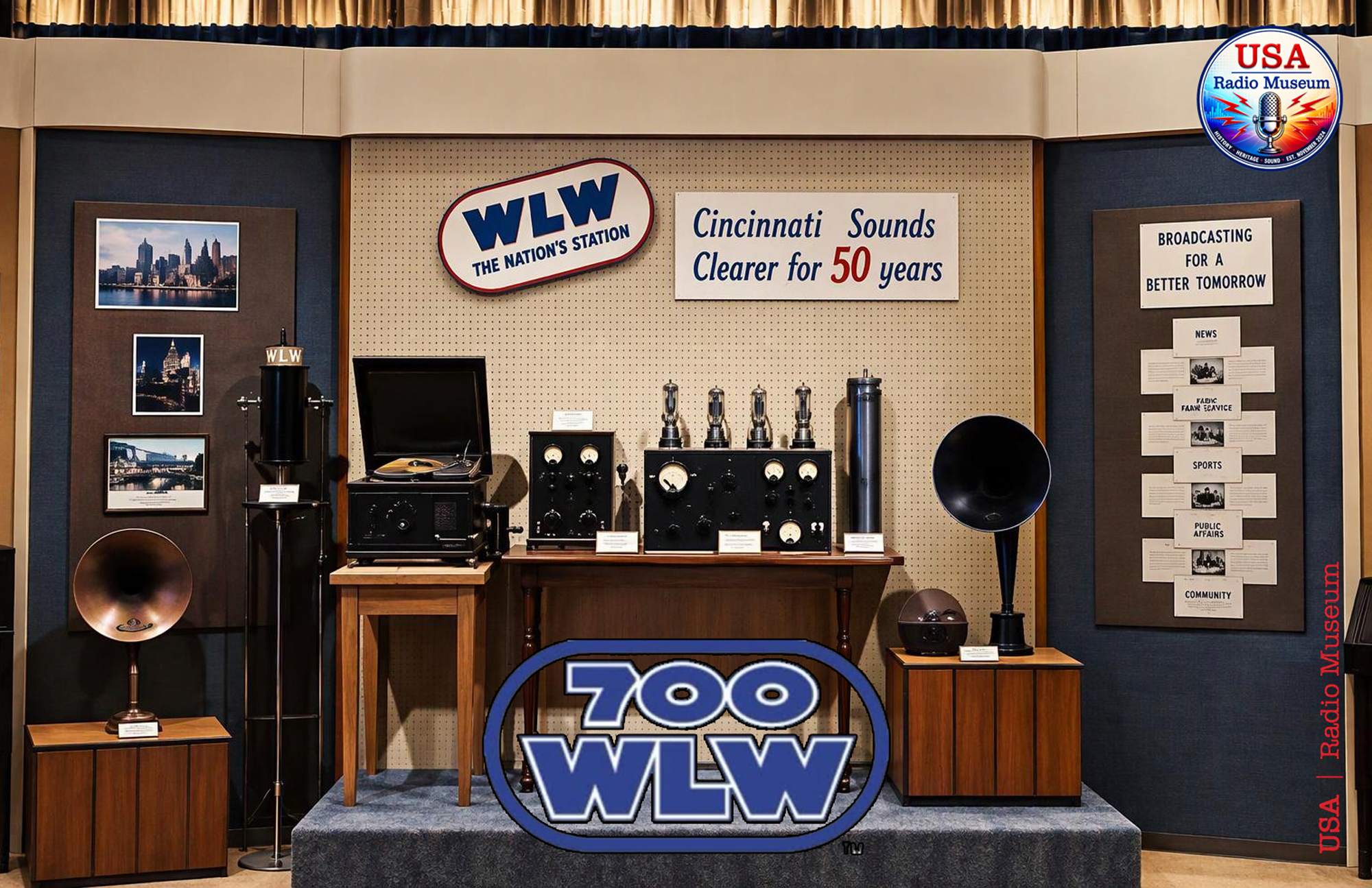
For a brief but unforgettable chapter in broadcasting history, WLW earned the nickname “The Nation’s Station.” It was more than a slogan. Thanks to its extraordinary reach and technical innovation, voices and programs originating from Cincinnati could be heard hundreds, and often thousands, of miles away. Farmers in rural communities, families gathered around living room consoles, truck drivers traveling America’s roadways, and listeners in distant states all came to know those three simple letters: W-L-W.
The station became an emblem of what radio could accomplish at its best. Information traveled instantly. Entertainment crossed state lines. Communities were connected through a shared experience. Long before social media, streaming platforms, or smartphones, radio united Americans through a common soundtrack, and WLW stood among its most powerful practitioners.
Yet the station’s significance cannot be measured solely by signal strength. The true legacy of WLW rests in its programming and its people.
Over the decades, WLW served as a launching pad and home for countless broadcasters, performers, journalists, and personalities who helped shape American media. It became a proving ground for talent and a destination for listeners seeking companionship, information, and conversation. Like every legendary station, its greatest asset was not its transmitter or studio equipment, but the human voices that brought it to life.
Listeners developed relationships with those voices. Morning hosts marked the start of the workday. News anchors guided audiences through moments of triumph and crisis. Sportscasters narrated victories and heartbreaks. Entertainers provided laughter and comfort during uncertain times. Through wars, economic downturns, celebrations, and social change, WLW became part of the daily rhythm of Midwestern life.
Generations of families experienced the station together. Parents who grew up listening to WLW introduced it to their children and grandchildren. The station’s signal became intertwined with memories of kitchen radios, dashboard receivers, front-porch evenings, and late-night listening sessions when the rest of the world seemed asleep.
Perhaps that continuity explains why WLW remains so significant today.
What makes WLW’s story even more remarkable is that it is not confined to museum exhibits, archival recordings, or memories shared by longtime listeners. More than a century after first signing on the air in 1922, WLW remains an active and influential broadcasting force. Today, the station continues to serve Cincinnati and the surrounding region with news, talk, sports, and public affairs programming, maintaining its role as one of the Midwest’s most recognized electronic voices.
While its legendary 700 AM signal remains the foundation of its identity, WLW has also adapted to modern listening habits. Its programming is available on a companion FM translator at 94.5 FM and through digital HD Radio channels, ensuring that audiences can continue to hear the station through newer technologies while preserving the heritage that made it famous in the first place. It is a fitting evolution for a broadcaster that has spent more than a century embracing innovation while never losing sight of its roots. The result is a rare achievement in American broadcasting: a station that honors its past while continuing to speak confidently to the present.
American broadcasting has experienced transformations that would have seemed unimaginable to the station’s founders. Television altered entertainment. FM reshaped music listening. Satellite radio expanded choices. The internet revolutionized communication. Streaming services changed audience habits entirely. Through every wave of disruption, observers repeatedly predicted the decline of traditional radio.
And yet radio endured.
More importantly, stations like WLW endured.
Its persistence serves as a reminder that while technology evolves, the fundamental human desire for connection remains unchanged. People still seek trusted voices. They still want companionship during a morning commute. They still appreciate local perspectives amid an increasingly fragmented media environment. They still value the immediacy that radio provides.
WLW’s survival is therefore not merely a business success story. It is evidence of radio’s unique resilience.
There is also something profoundly reassuring about the station’s continuing presence on the AM dial. In an age when brands are routinely reinvented, logos redesigned, formats replaced, and identities discarded, WLW remains WLW. The call letters that listeners recognized generations ago still occupy their place in American broadcasting.
That continuity carries meaning.
The preservation of historic call letters is not simply an exercise in nostalgia. It represents an unbroken chain connecting today’s audiences with radio’s pioneering past. Every time those three letters are spoken on the air, they evoke more than a station. They evoke decades of innovation, public service, entertainment, and community engagement.
For historians, collectors, broadcasters, and radio enthusiasts, WLW stands as one of the medium’s greatest success stories. Its legacy extends far beyond Cincinnati. It belongs to the broader history of American broadcasting and to every listener who discovered the magic of radio through a distant signal arriving in the darkness.
_____________________
_____________________
As the years pass and new technologies continue to emerge, that legacy only grows more remarkable. Each additional year that WLW remains on the air strengthens its place among broadcasting’s most respected institutions.
Many stations have left their mark on radio history.
Only a few became radio history.
WLW is one of them.
And after more than a century of broadcasting, its voice continues to echo across the American landscape, reminding us that while media may change, greatness never goes out of style.
_____________________
Sources and Credits
Primary historical information regarding WLW’s broadcasting history, station development, technical operations, and legacy was compiled from publicly available historical broadcasting references, including WLW historical records, Cincinnati broadcasting archives, and station historical summaries. Special reference was made to documented accounts of WLW’s March 23, 1922 sign-on, its association with broadcasting pioneer Powel Crosley Jr., its historic role as “The Nation’s Station,” and its continuing operation as Cincinnati’s legendary 700 AM radio station.
Additional contemporary information regarding WLW’s current operations, FM translator service, and modern broadcasting presence was referenced from station and broadcasting industry resources.
Article written exclusively for USA Radio Museum by Microsoft Copilot in collaboration with the USA Radio Museum editorial staff.
Historic photographs and illustrations remain the property of their respective copyright holders and are used for historical and educational purposes where applicable.
_____________________
Contact: jimf.usaradiomuseum@gmail.com
_____________________
© 2026 USA Radio Museum. All Rights Reserved
