
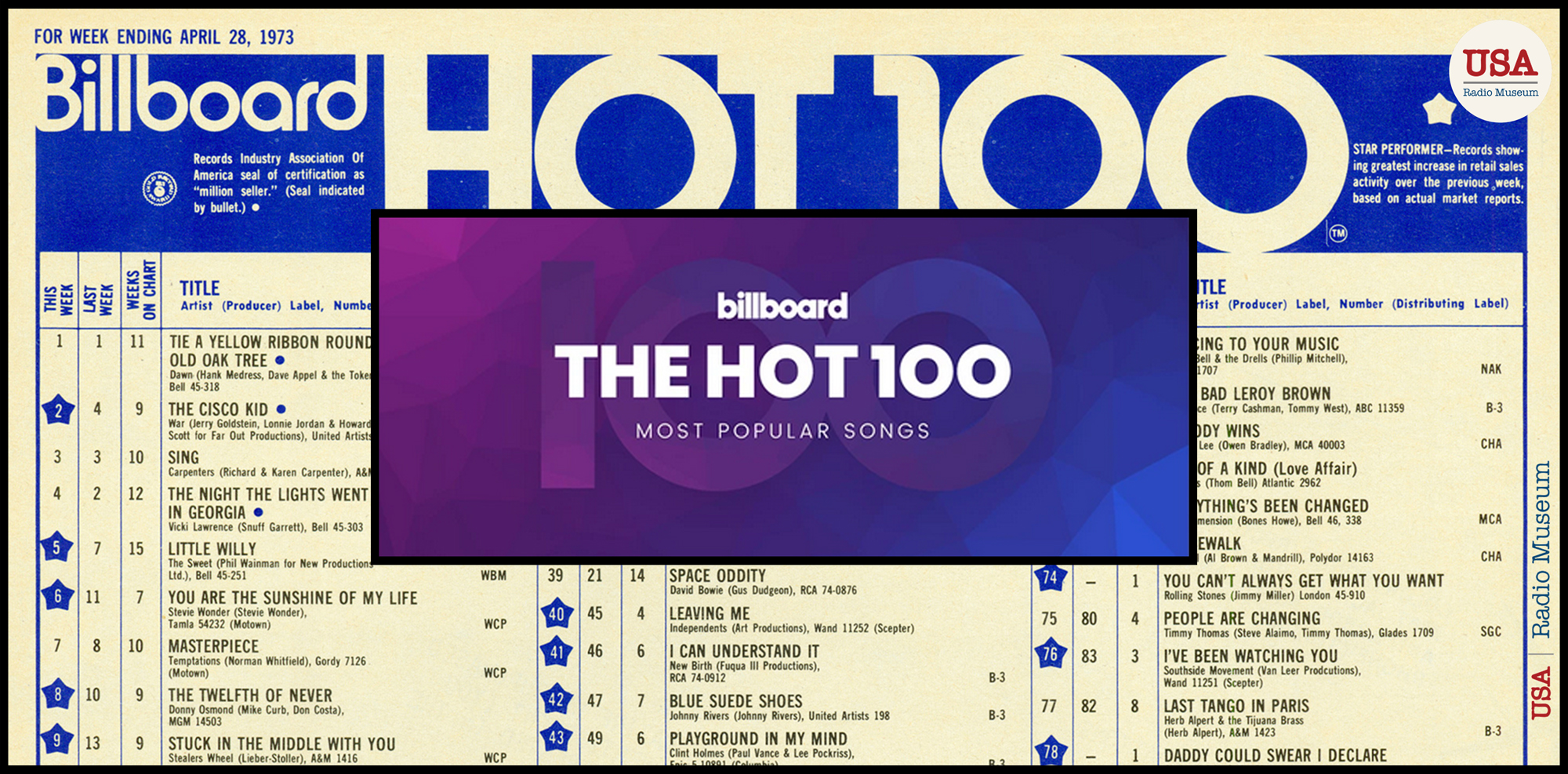
Hitmakers, Song Hits, and the Enduring Pulse of American Radio: A Tribute to Billboard’s Hot 100 Introduction For more than eight decades, the B
Hitmakers, Song Hits, and the Enduring Pulse of American Radio: A Tribute to Billboard’s Hot 100
Introduction
 For more than eight decades, the Billboard music charts have served as the heartbeat of American popular culture—an evolving mirror of what the nation was buying, requesting, dancing to, and carrying with them through the transistor‑radio age and beyond. Long before playlists were automated, before algorithms predicted our tastes, and before streaming placed the world’s music in our pockets, Billboard’s charts offered something essential: a weekly, authoritative snapshot of America’s musical pulse.
From the post‑war Popular Music Chart of 1945, to the Honor Roll of Hits that guided programmers through the 1950s, to the revolutionary debut of the Billboard Hot 100 in January 1960, these charts became the backbone of Top 40 radio. They shaped programming decisions, influenced careers, and helped define the sound of entire generations.
This tribute honors that legacy—how Billboard’s charts became the compass for radio programmers, the scoreboard for artists, and the soundtrack for listeners from the dawn of Formula Radio in the 1950s through the Top 40 boom of the 1960s, the FM renaissance of the 1970s, the MTV‑infused 1980s, and into the digital present. — USA RADIO MUSEUM
_____________________
THE RISE OF A NATIONAL MUSIC SCOREBOARD: 1945–1959
The Popular Music Chart: A Post‑War Beginning
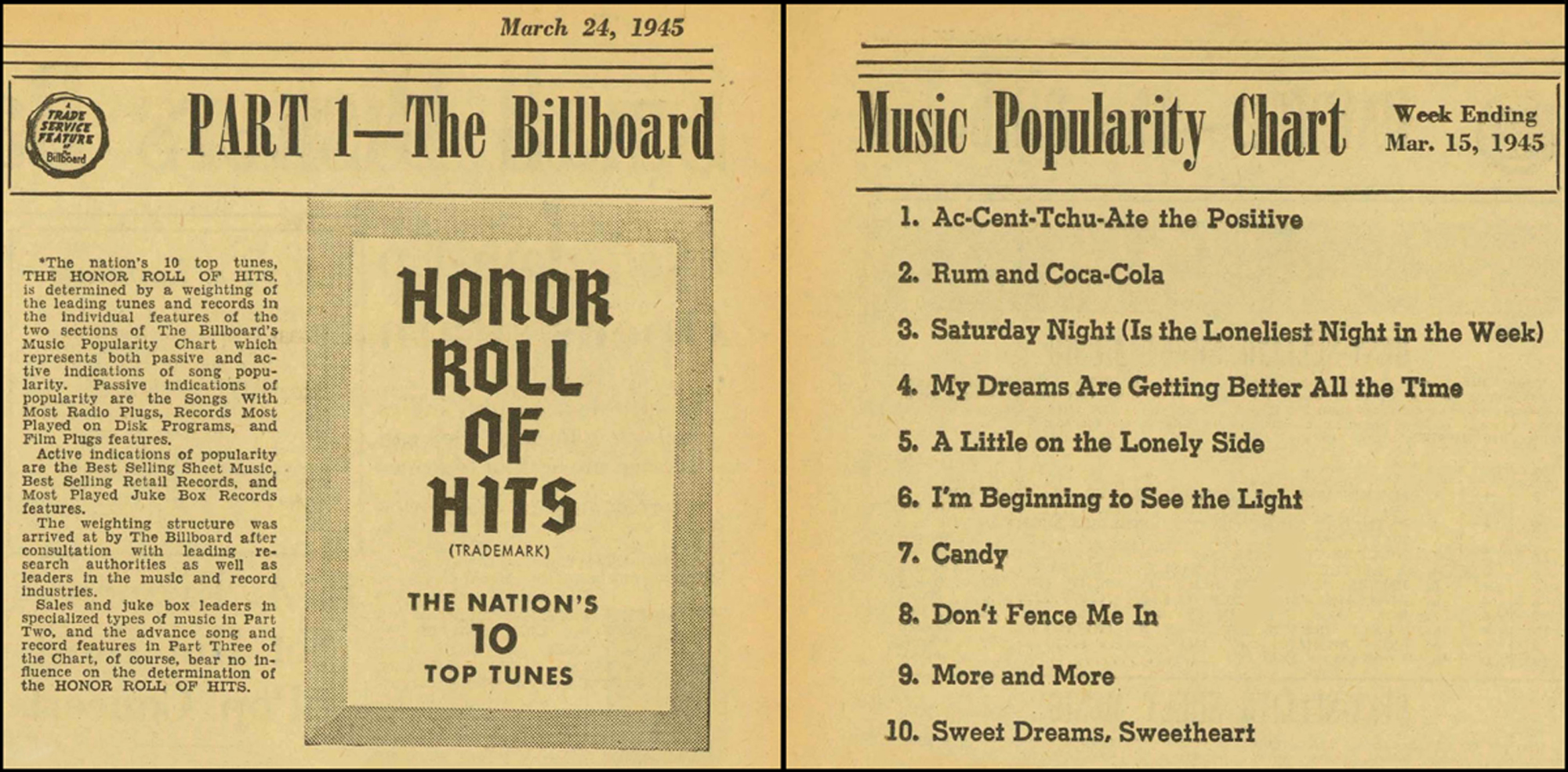
Billboard: Honor Roll of Hits, March 24, 1945
Billboard’s charting authority began in earnest on March 24, 1945, when the magazine published its first Popular Music Chart. America was emerging from World War II, and radio—already the nation’s most trusted medium—was entering a golden age of music programming. The chart offered something new: a standardized, national measurement of what Americans were listening to.
This early charting system was modest by later standards, but it established the principle that would guide Billboard for decades: music popularity could be measured, compared, and ranked. For radio programmers, this was a revelation. Suddenly, stations in Chicago, Los Angeles, and New York could speak a common musical language.
The Honor Roll of Hits: The 1950s Compass
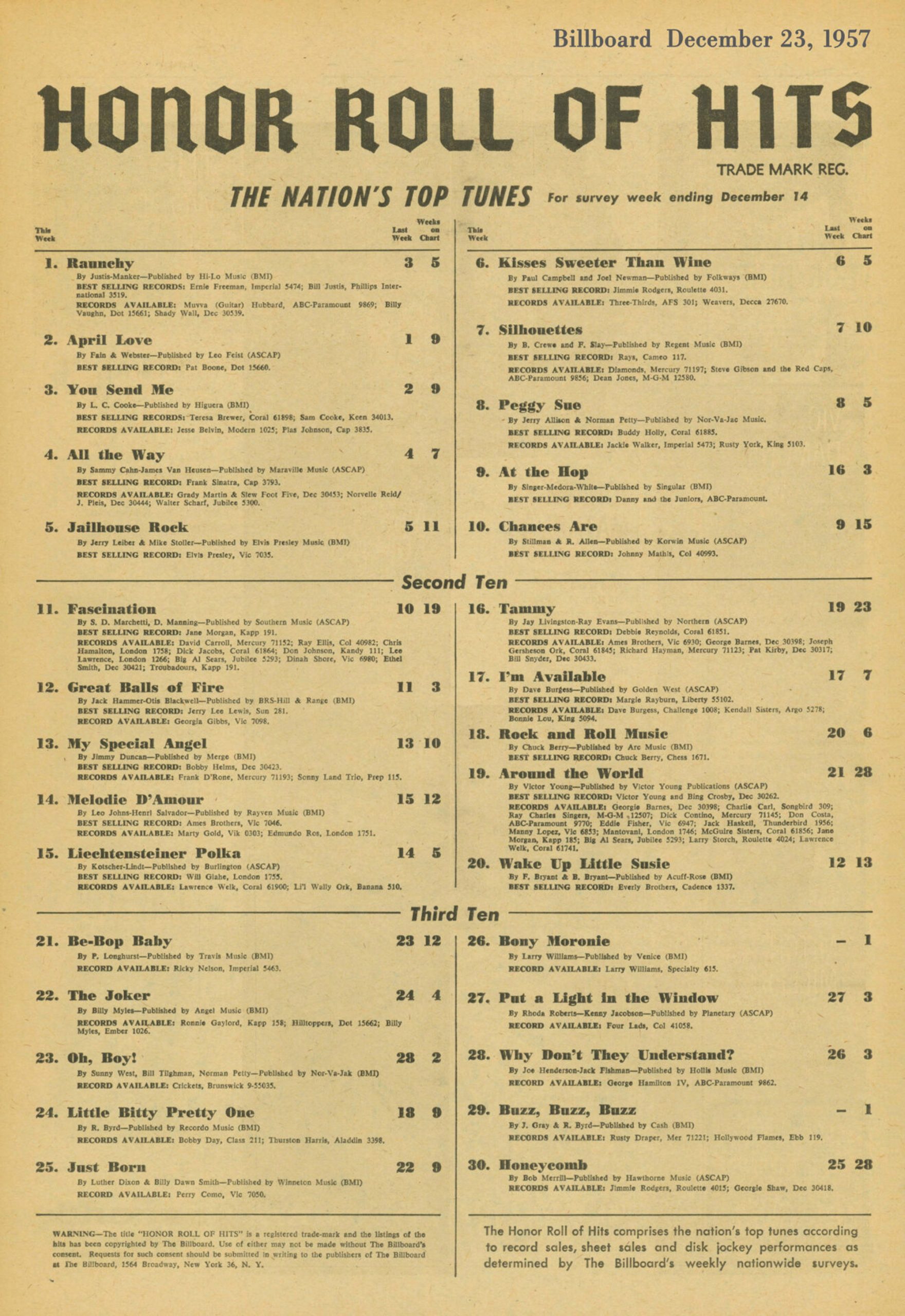
Billboard: Honor Roll of Hits, December 23, 1957
By the early 1950s, Billboard’s Honor Roll of Hits became the industry’s most trusted chart. A Top 30 list that blended sales, jukebox plays, and radio airplay, it served as the de facto guide for programmers during the birth of rock ’n’ roll.
Stations like WINS in New York, WKBW in Buffalo, and WJBK in Detroit relied on the Honor Roll to shape their playlists. It was the chart that helped usher in the era of Elvis Presley, Chuck Berry, Little Richard, and the first wave of teen‑driven pop culture.
The Honor Roll’s final edition—November 16, 1963—closed an era. But its legacy lived on in the chart that would soon define modern radio.
THE BIRTH OF THE HOT 100: 1958
A New Standard Arrives
 On August 4, 1958, Billboard published the first Billboard Hot 100 chart. It was a watershed moment. For the first time, the magazine offered a unified, data‑driven ranking of America’s 100 best‑selling and most‑played singles. The No. 1 song on the brand-new Hot 100 chart listing (August 4): “Poor Little Fool” by Ricky Nelson.
 The Hot 100 was more than a new chart—it was a new philosophy. It recognized that America’s musical tastes were expanding, diversifying, and accelerating. A Top 30 could no longer capture the nation’s appetite. A Top 100 could.
Radio Takes Notice
 Program directors across the country quickly embraced the Hot 100. It offered precision, breadth, and a weekly narrative that fit perfectly with the emerging “Formula Radio” approach—tight playlists, fast pacing, and a focus on the biggest hits.
Stations like KFWB and KRLA in Los Angeles, WABC in New York, and WJBK in Detroit built their programming around the Hot 100’s momentum. The chart became the scoreboard of American pop.
THE TOP 40 ERA: 1960s–1980s
1960s: The Soundtrack of a Changing Nation
 The 1960s were the Hot 100’s first great decade. The Beatles, Motown, Stax, the Beach Boys, the British Invasion, folk‑rock, soul, and psychedelic pop all surged through the chart.
Top 40 radio—powered by the Hot 100—became the nation’s shared cultural experience. Teenagers carried transistor radios everywhere. DJs became celebrities. Stations competed fiercely to be the first to spin a rising hit.
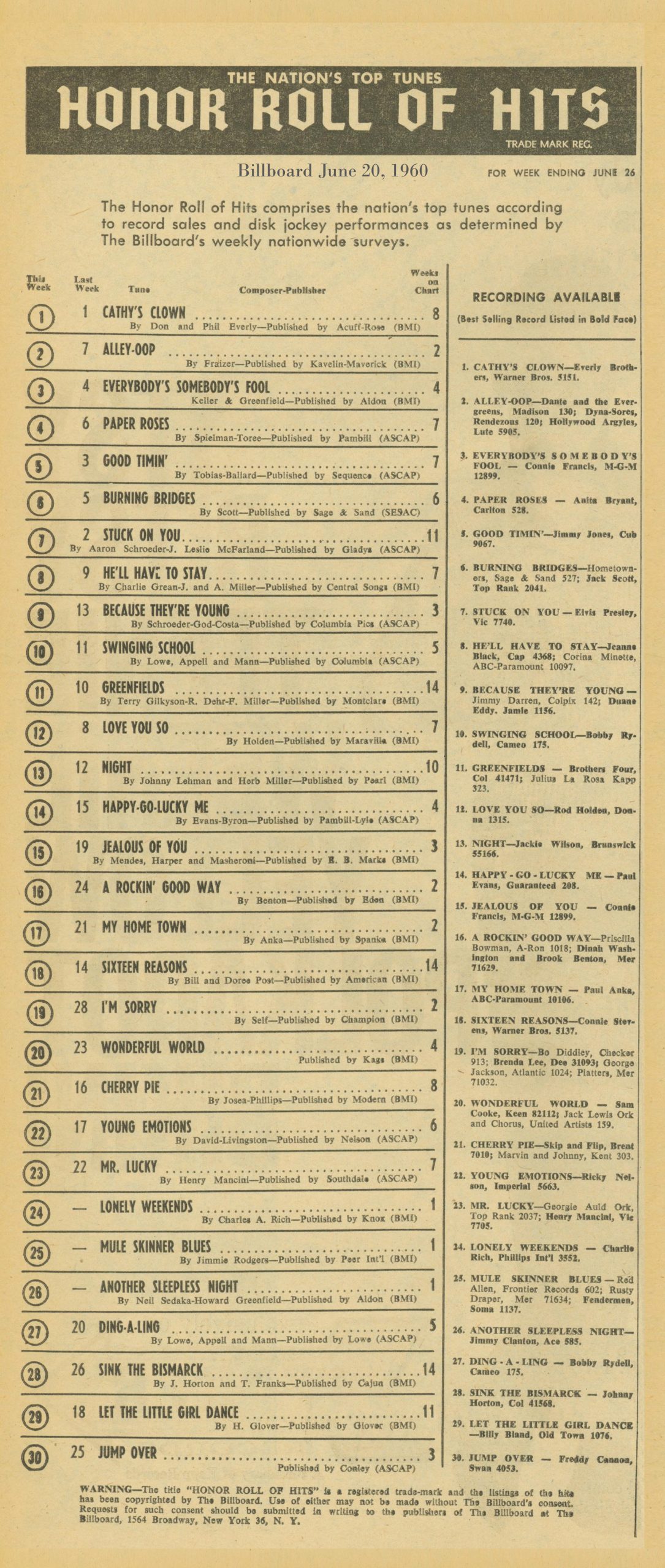
Billboard: Honor Roll of Hits, February 2, 1960
The Hot 100 didn’t just reflect the culture; it shaped it. When a song jumped 20 places, America felt it. When a new No. 1 arrived, it became a national radio event.
1970s: FM, Album Rock, and the Expanding Universe
The 1970s brought FM stereo, album‑oriented rock, and a broader musical palette. Yet the Hot 100 remained the definitive measure of pop success.
Disco, soft rock, singer‑songwriters, funk, and early R&B crossover acts all found their place on the chart. Casey Kasem’s American Top 40, launched in 1970, brought the Hot 100 directly into millions of homes every weekend.
Kasem’s warm storytelling and Billboard’s authoritative data created a ritual: America counted down together.
1980s: The MTV Generation and the Chart’s Second Golden Age
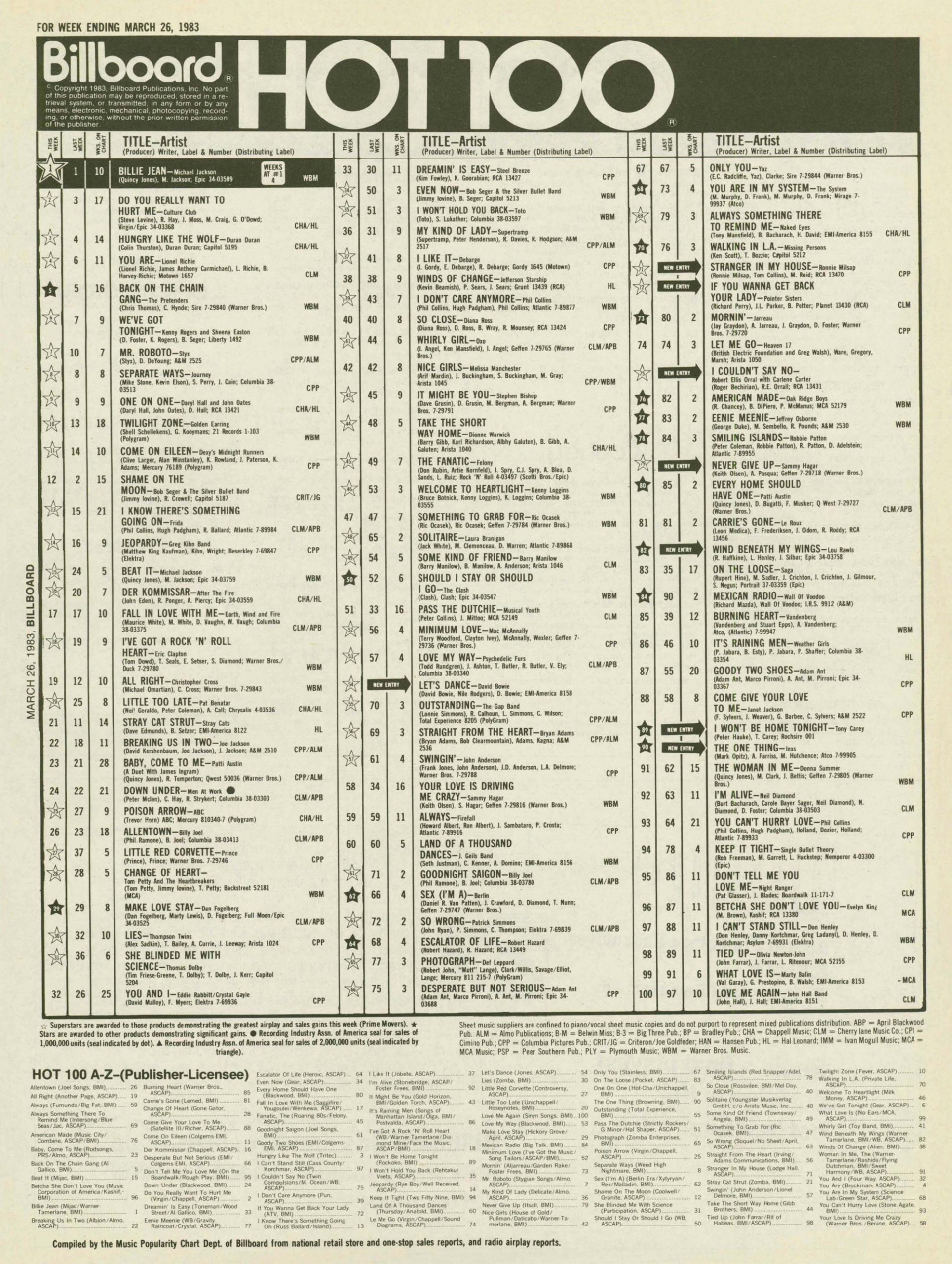
Billboard: Hot 100, March 26, 1983
The 1980s fused radio, television, and the Hot 100 into a powerful cultural engine. MTV’s arrival in 1981 reshaped the industry, but Billboard’s chart remained the ultimate arbiter of success.
Michael Jackson, Madonna, Prince, Whitney Houston, Bruce Springsteen, and countless others built careers on Hot 100 triumphs. Radio programmers used the chart to navigate a decade of rapid stylistic change—from new wave to hair metal to early hip‑hop.
The Hot 100 was the bridge between the FM dial and the television screen.
THE DIGITAL TURN: 1990s–PRESENT
1990s: The SoundScan Revolution
 In 1991, Billboard adopted Nielsen SoundScan, bringing barcode‑verified sales data into the Hot 100. The impact was immediate and dramatic. Genres that had been under‑represented—country, hip‑hop, alternative rock—suddenly surged.
Radio programmers adjusted overnight. The Hot 100 was no longer just a reflection of radio; it was a force that pushed radio toward new sounds.
2000s: The Streaming Era Begins
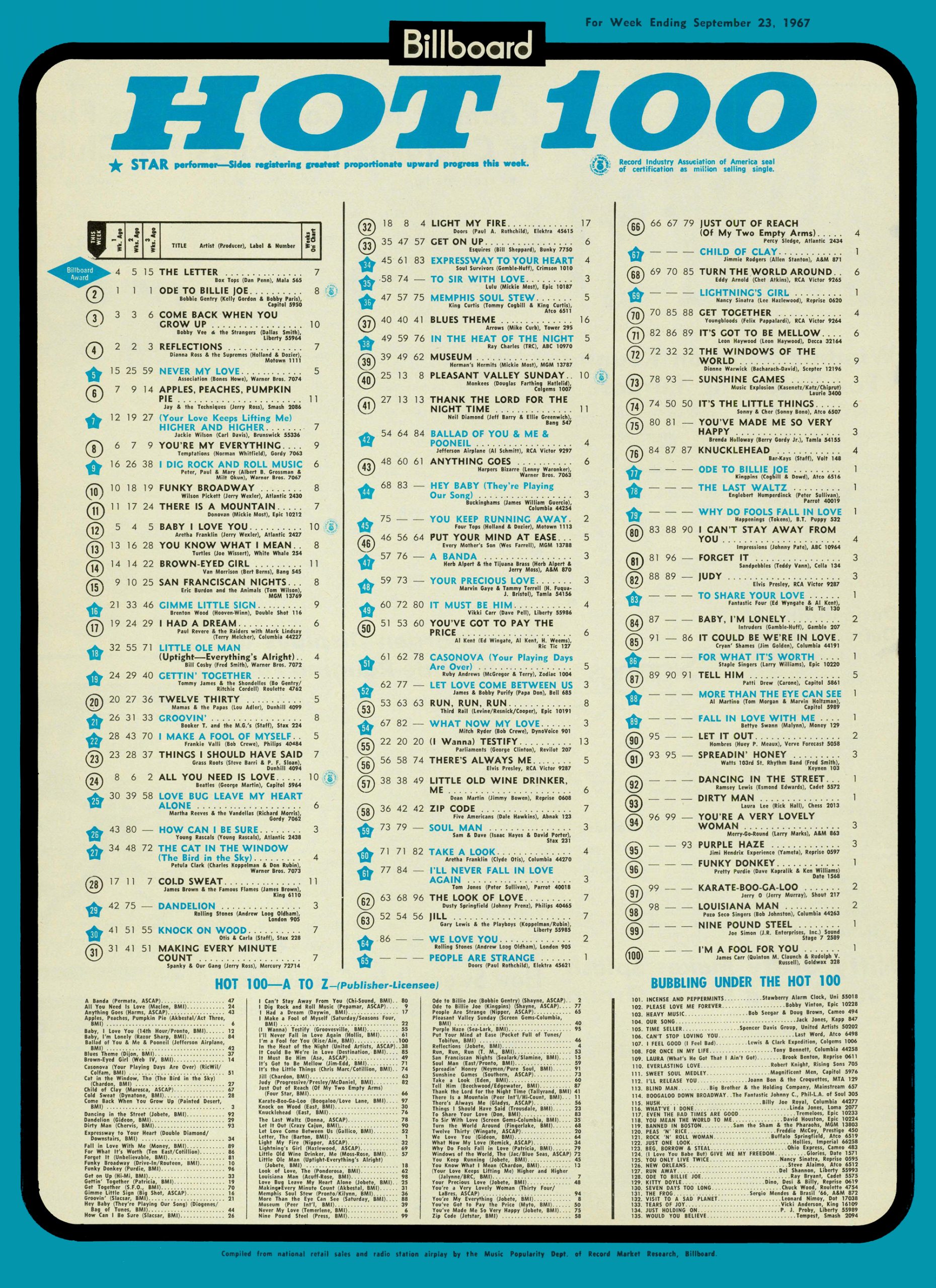
Billboard: Hot 100, September 23, 1967
As digital downloads and early streaming platforms emerged, Billboard adapted again. The Hot 100 incorporated digital sales in 2005 and streaming data in 2007.
Radio remained essential, but the chart now captured a broader picture of how Americans consumed music.
2010s–2020s: A Chart for a Borderless World
Today’s Hot 100 reflects a globalized, multi‑platform music ecosystem. Songs rise through TikTok virality, YouTube views, Spotify streams, and traditional radio airplay.
Yet the chart’s purpose remains unchanged: to measure what America loves most.
THE HOT 100 AND RADIO: A SYMBIOTIC LEGACY
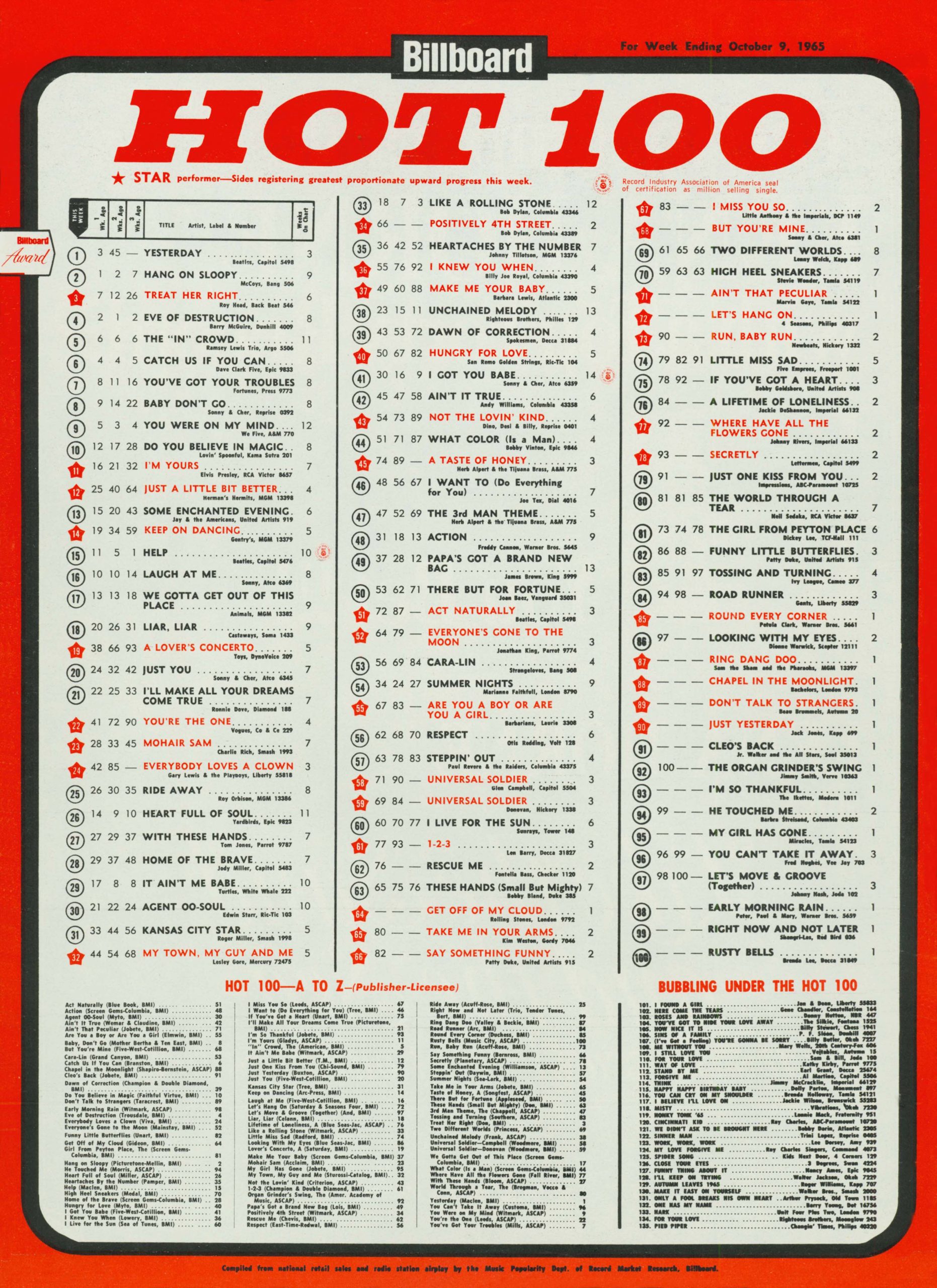
Billboard: Hot 100, October 9, 1965
From the moment the Billboard charts became the industry’s weekly scoreboard, radio programmers understood their value. In the 1950s and early 1960s, as Top 40 formats took shape and stations sought a reliable compass for their playlists, Billboard provided something no other source could match: a national, data‑driven reflection of what America was truly listening to. Its methodology—rooted in sales, jukebox plays, and later airplay—gave programmers confidence that their rotations aligned with the country’s musical heartbeat. A weekly chart unified stations across markets, allowing a listener in Detroit, Los Angeles, or Miami to feel connected to the same rising hits. And the movement of songs up and down the chart created a built‑in narrative that radio could dramatize: the thrill of a fast‑climbing single, the suspense of a new No. 1, the emotional arc of a hit’s rise and fall.
But Billboard needed radio just as deeply. Radio transformed the charts from printed data into living cultural moments. DJs championed new artists, introduced unfamiliar sounds, and celebrated chart‑toppers with the enthusiasm of storytellers. Stations turned chart movement into on‑air theater—countdowns, “chart‑jumpers,” “big movers,” and the coveted “No. 1 song in the nation.” Programs like American Top 40 made the Hot 100 part of America’s weekly ritual, a shared listening experience that united millions. Through radio, the chart became more than numbers; it became a national conversation.
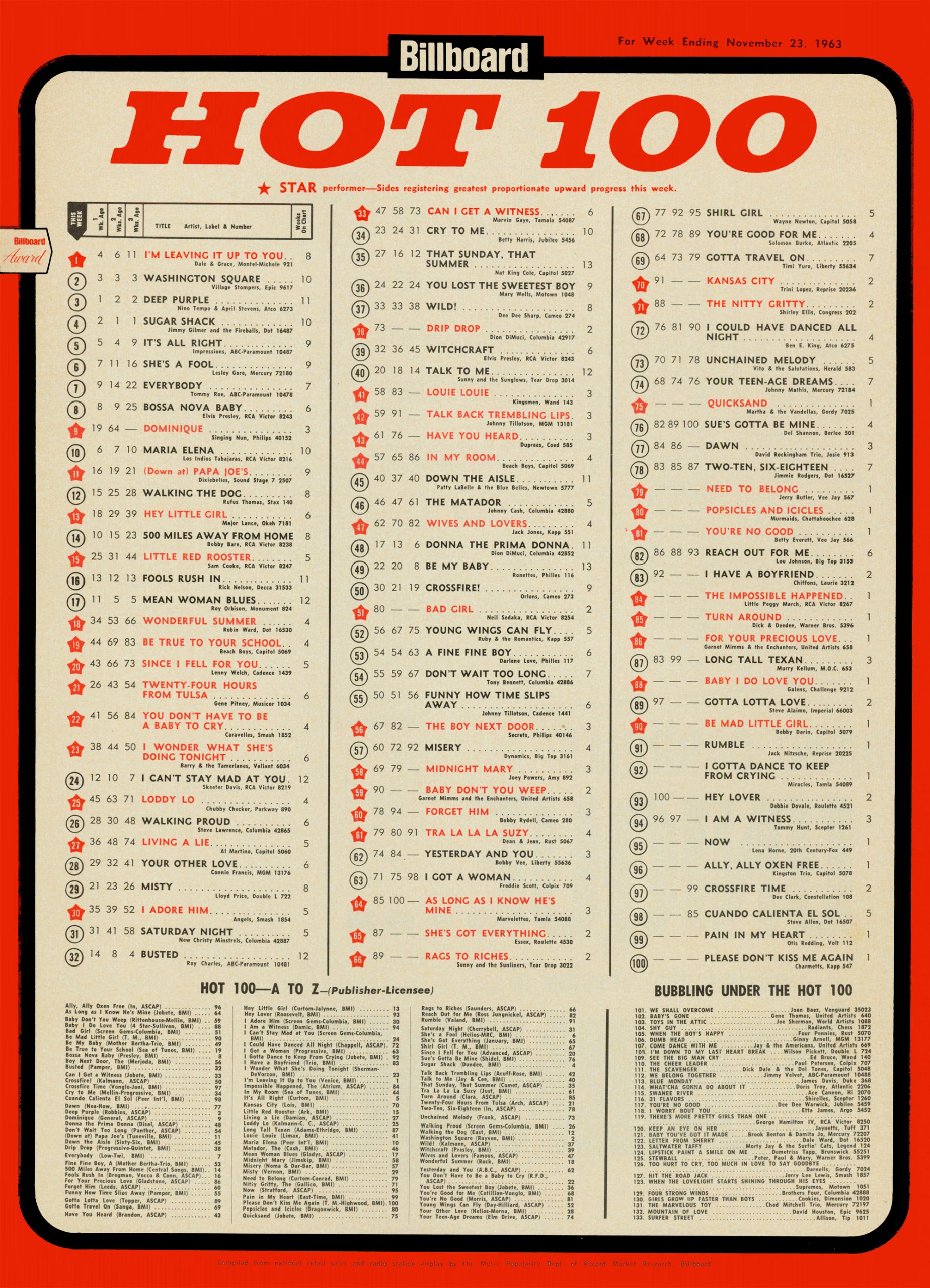
Billboard: Hot 100, November 23, 1963
Behind this symbiosis stood one of the most important figures in modern chart history: Joel Whitburn (1939–2022). A meticulous researcher and passionate music historian, Whitburn founded Record Research, Inc. in 1970 and devoted his life to documenting, preserving, and interpreting Billboard’s charts with unmatched accuracy. His books—more than 200 volumes spanning genres, decades, and formats—became the definitive reference works for broadcasters, collectors, archivists, and musicologists. Whitburn’s scholarship ensured that the Hot 100’s weekly story was not only recorded but understood. His work gave radio programmers and historians a reliable map of the modern Top 40 era, and his influence quietly shaped how generations of broadcasters talked about chart history.
Whitburn’s passing in 2022 marked the loss of a singular steward of American musical memory. Yet his legacy lives on in every chart historian who consults his research, every DJ who references chart peaks and debut dates, and every museum—like ours—that seeks to preserve the story of American radio with precision and reverence.
Together—Billboard, radio, and the scholarship of Joel Whitburn—they formed a feedback loop that defined the sound of modern music. Billboard measured the nation’s taste. Radio amplified it. Whitburn preserved it. And through that triad, the Hot 100 became not just a chart, but a chronicle of American life.
A LEGACY STILL UNFOLDING
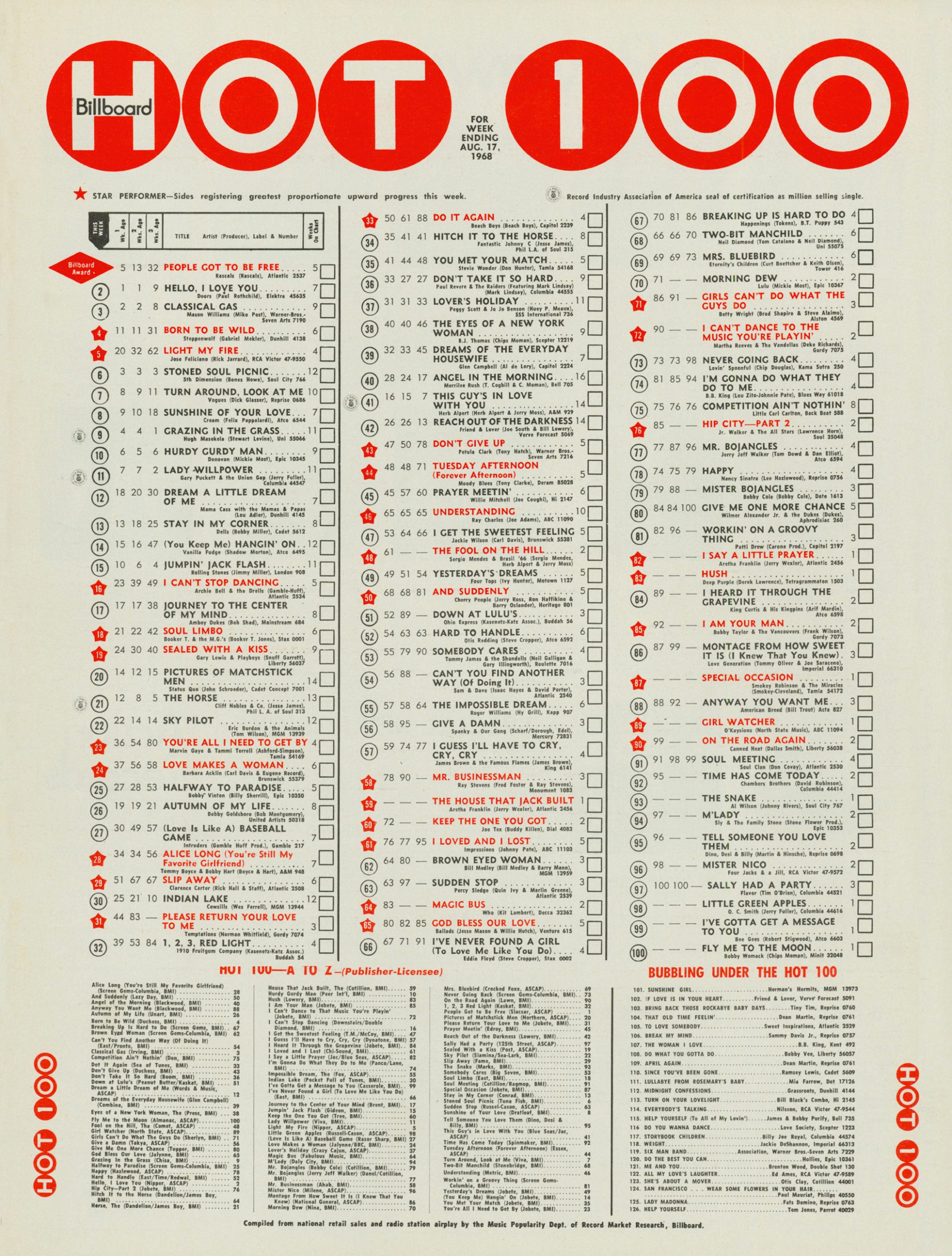
Billboard: Hot 100, July 17, 1968
The Billboard Hot 100 is more than a list of songs. It is a living archive of American taste, technology, and cultural change. It has survived format wars, technological revolutions, and generational shifts.
From the Honor Roll of Hits to the first Hot 100 in 1958 . . . From the Beatles to Beyoncé… From transistor radios to streaming apps . . .
The chart remains the industry’s gold standard—a weekly chronicle of what moves us, unites us, and defines us.
For radio, the Hot 100 has been both compass and companion. It guided the birth of Formula Radio, fueled the Top 40 explosion, and continues to inform programming in the digital age.
Its legacy is inseparable from the story of American broadcasting.
The Billboard Hot 100 endures because the music endures. And as long as a nation listens, the chart will continue to chronicle who we are—one week, one song, one unforgettable hit at a time.
_____________________
Sources & Credits
This feature draws upon the historical archives of Billboard magazine, including the Popular Music Chart (est. 1945), the Honor Roll of Hits (1940s–1963), and the Billboard Hot 100, first published on August 4, 1958. • Billboard Chart Archives: https://www.billboard.com/charts • Billboard Hot 100 History: https://www.billboard.com/charts/hot-100/
Additional chart chronology and statistical verification are informed by the lifelong research of Joel Whitburn (1939–2022) and the Record Research, Inc. catalog. Whitburn’s work remains the definitive reference for chart historians, broadcasters, and archivists. • Record Research (Joel Whitburn’s Official Site): https://www.recordresearch.com • Joel Whitburn Biography (Wikipedia): https://en.wikipedia.org/wiki/Joel_Whitburn (en.wikipedia.org in Bing)
Contextual details regarding radio programming, Top 40 development, and the evolution of American hit radio are supported by industry trade publications, historical broadcasting journals, and archival materials curated by the USA Radio Museum.
Contact: jimf.usaradiomuseum@gmail.com
_____________________
A USARM Disclaimer:
All Billboard charts and logos referenced herein are the property of Billboard Magazine and are used for historical and educational purposes only.
_____________________
A USARM Viewing Tip: On your PC? Mouse/double-click over the images for expanded views. On your mobile or tablet device? Finger-tap all the above images inside the post and stretch image across your device’s screen for LARGEST digitized view. Then click your browser’s back arrow to return to the featured post.
© 2026 USA Radio Museum. All Rights Reserved.

I’m confused.
You say, several times, that The Billboard Hot 100 debuted January 4, 1960.
Actually the Hot 100 made its debut in the issue dated August 4, 1958.
A crucial error that should be fixed.
Hi Paul,
Thank you for reaching out — and thank you for catching that error. We don’t always get it right, and I genuinely appreciate you bringing this to my attention.
You are absolutely correct: The Billboard Hot 100 made its debut in the issue dated August 4, 1958, not January 4, 1960. I double‑checked the records, and the first No. 1 song on that inaugural Hot 100 was Ricky Nelson’s “Poor Little Fool”
We mistakenly cited the wrong date, and I’ll make sure this is corrected. Your note helps us keep the historical record accurate, and I’m grateful you took the time to point it out.
Thanks again, Paul. Much appreciated.
Best regards, Jim, USA Radio Museum