
A Visionary Whose Format Revolution Shaped the Sound of A Nation In the long arc of American broadcasting, few figures reshaped the medium as profo
A Visionary Whose Format Revolution Shaped the Sound of A Nation
In the long arc of American broadcasting, few figures reshaped the medium as profoundly as Ron Jacobs. Before Casey Kasem ever counted down a chart, before American Top 40 became a weekly ritual in millions of homes, Jacobs was already engineering the sonic architecture that made the countdown format possible. His work at KHJ Los Angeles — the Boss Radio revolution he co‑created with Bill Drake — didn’t just redefine Top 40 programming; it laid the foundation for the national sound that American Top 40 would carry across the country and eventually around the world.
Jacobs’ legacy is often summarized in a few towering achievements: KHJ’s meteoric rise, the creation of The History of Rock and Roll, the Cruisin’ series, and his role in launching American Top 40. But the fuller story — the one that belongs in a museum, and in the cultural memory of American media — begins thousands of miles from Hollywood, in Honolulu, where a teenage Jacobs first stepped behind a microphone and began to understand the power of radio as both a community force and a cultural engine.
Born in Honolulu in 1937, Jacobs entered broadcasting at just 15, working as a reporter before becoming an all‑night DJ at KHON after leaving high school. In the 1950s, Hawaii was not yet a state, but its youth culture was already pulsing with rock ’n’ roll — and Jacobs was among the first to bring that sound to island airwaves. At KHVH, he and fellow DJ Tom Moffatt introduced rock concerts to Honolulu and forged relationships with Elvis Presley and Colonel Tom Parker, ties that would last decades. By 1958, Jacobs had become Hawaii’s youngest program director at KPOA. A year later, he launched KPOI, the islands’ first Top 40 station, where the “Poi Boys” quickly dominated the ratings. His early success revealed a pattern that would follow him throughout his career: Jacobs didn’t simply program stations — he built ecosystems, atmospheres, and identities.
His move to the mainland in 1962 marked the beginning of his national influence. Promoted to vice president of programming for the Colgreene Corporation, he fine‑tuned his emerging format ideas at KMEN in San Bernardino and KMAK in Fresno, where both stations reached number one under his direction. It was in Fresno that Jacobs encountered Bill Drake — first as a competitor, then as a collaborator. Drake’s “more music” philosophy and Jacobs’ promotional genius formed a combustible partnership. When RKO General sought to reinvent KHJ Los Angeles, Drake hired Jacobs, then just 27, to bring the new format to life.
What followed was one of the most dramatic turnarounds in radio history. KHJ’s “Boss Radio” debuted in 1965, a tightly engineered format that stripped away clutter, sharpened pacing, and foregrounded the music. DJs spoke less but sounded bigger; jingles snapped like sonic logos; contests rolled out with cinematic flair. Within six months, KHJ was number one in Los Angeles — a market then defined by fierce competition and cultural volatility. Jacobs’ programming was not merely efficient; it was theatrical. He staged promotions that felt like civic events, including a 93‑cent Hollywood Bowl concert celebrating KHJ’s first anniversary. He pushed AM radio’s boundaries with playlists that embraced the Byrds, Bob Dylan, the Doors, and the Mamas and the Papas — artists who were reshaping the American imagination.
His coaching of talent was equally influential. Under Jacobs, KHJ became a proving ground for some of radio’s most iconic voices: Robert W. Morgan, the Real Don Steele, Charlie Tuna, Sam Riddle, and Humble Harve. He demanded excellence, detested mediocrity, and believed that radio personalities should feel as vivid as the records they introduced.
In 1969, Jacobs produced The History of Rock and Roll, a 48‑hour epic he called a “rockumentary.” It was the first long‑form audio history of the genre, weaving narration, interviews, and music into a sweeping cultural chronicle. The Library of Congress later accepted it as the first aural history of rock music — a testament to Jacobs’ belief that radio could be both entertainment and documentation.
That instinct — to preserve, contextualize, and elevate — reached another milestone in the early 1970s with Jacobs’ creation of the Cruisin’ series for Increase Records. Each album — Cruisin’ 1955, Cruisin’ 1956, and onward — recreated a specific year in American radio, complete with period‑correct jingles, commercials, DJ patter, and hit records. Jacobs recruited legendary disc jockeys to reprise their on‑air personas, effectively resurrecting the sound of 1950s and 1960s radio with museum‑grade authenticity. The series became a cult favorite, a time capsule of early American broadcasting that honored the pioneers who shaped rock ’n’ roll’s first generation.
In 1970, Jacobs co‑founded Watermark Inc. with Tom Rounds, launching American Top 40 with Casey Kasem. The show became the most widely syndicated radio program in history, a weekly ritual that stitched together the country’s musical consciousness. Jacobs also produced The Elvis Presley Story, further blending radio craft with cultural preservation. Later, at KGB San Diego, he programmed the station to Billboard’s “Station of the Year” in 1974, proving once again that his instincts were not confined to one market or one era.
As the years passed, Jacobs turned to writing — not to retire from radio, but to document it. His book KHJ: Inside Boss Radio offered a vivid, first‑person account of the station’s creation and the cultural earthquake it triggered. Sharp, funny, and unfiltered, the book captured Jacobs’ voice exactly as colleagues remembered it. It remains one of the most detailed insider chronicles of the Drake‑Chenault era, preserving the story of Boss Radio in Jacobs’ own words.
Jacobs returned to Hawaii in his later years, continuing to broadcast and write until health issues prompted retirement. The Hawaii State Legislature honored him for his cultural impact — a fitting tribute to a man who had spent his life shaping how communities heard themselves. His leadership style blended discipline with showmanship. He believed radio should feel alive, immediate, and unmistakably human. He treated popular music as cultural memory, not disposable entertainment. And he understood that the right format — executed with precision and passion — could change not just a station, but an entire industry.
Ron Jacobs died in 2016 at age 78, leaving behind a legacy that continues to reverberate through American broadcasting. His fingerprints remain on every tightly formatted Top 40 station, every countdown show, every radio documentary that seeks to tell the story of music with both rigor and heart. For the USA Radio Museum, Jacobs represents more than a programmer. He is a reminder of radio’s power to reinvent itself — and of the individuals whose vision makes reinvention possible. His work didn’t just define an era; it set a standard. His storytelling didn’t just chronicle history; it preserved it. And his belief in radio — as art, as craft, as cultural force — remains a beacon for every broadcaster who still feels the magic of a great record introduced at exactly the right moment.
_____________________
SOURCES & CREDITS
Research and historical verification for this tribute were drawn from KHJ and RKO General archival materials, Watermark Inc. documentation, and published accounts of Ron Jacobs’ work in Los Angeles and Hawaii. Additional context on Jacobs’ contributions to Boss Radio, American Top 40, The History of Rock & Roll, and the Cruisin’ series was informed by industry retrospectives, contemporary trade reporting, and Jacobs’ own published reflections, including KHJ: Inside Boss Radio.
Special acknowledgment to Increase Records for preserving the Cruisin’ series and its cultural significance in American radio history.
USA Radio Museum extends gratitude to the broadcasters, historians, and archivists who continue to safeguard the legacy of Ron Jacobs and the era he helped define.
_____________________
Notes
RON JACOBS: THE PROGRAMMER WHO REWIRED AMERICAN TOP 40 RADIO “A visionary whose love for radio shaped the sound of a nation.”
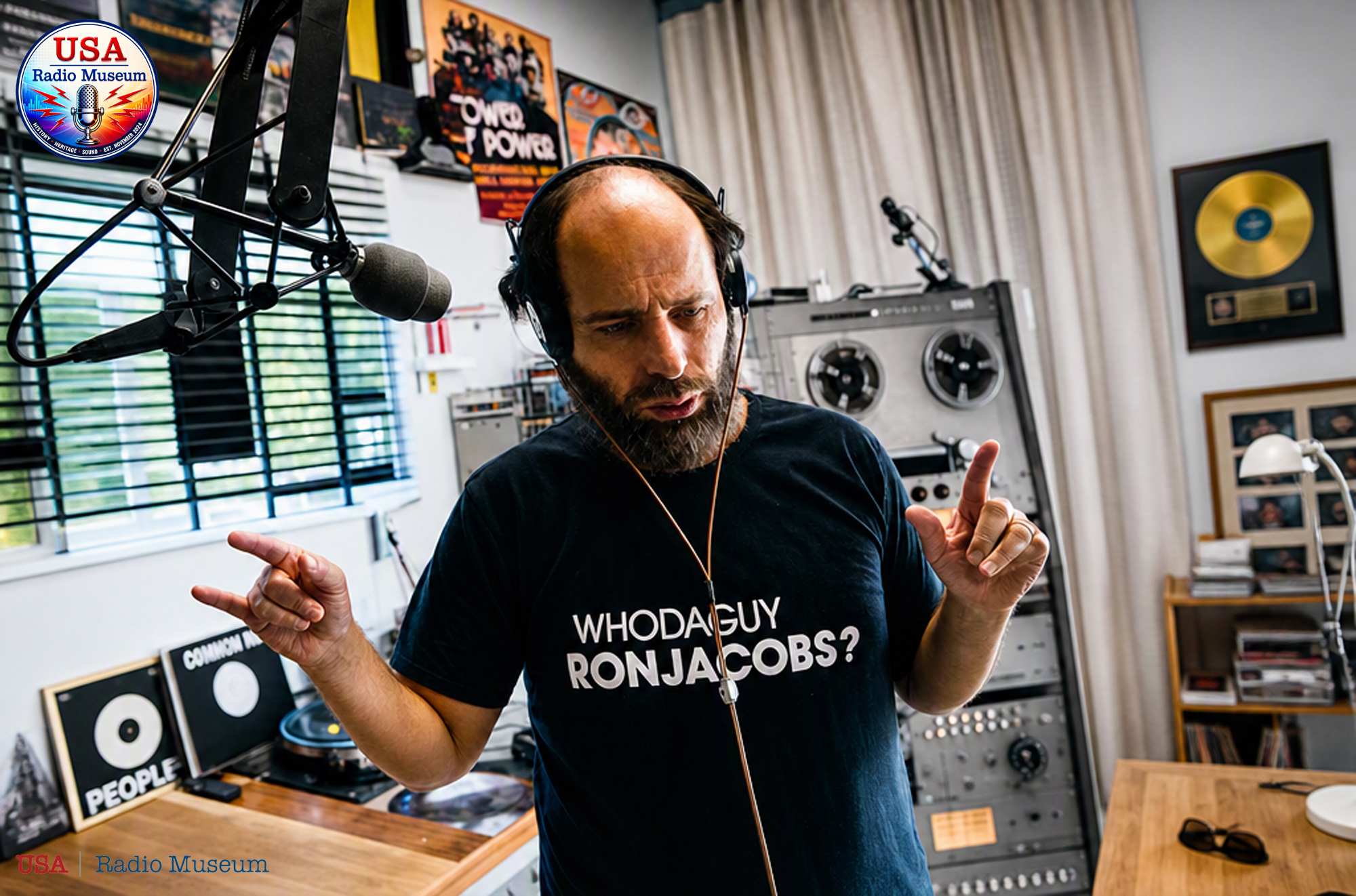
The above image captured his creative element; Ron Jacobs stands amid the heartbeat of broadcast history — in one of his production studios that defined an era. His innovations at KHJ Los Angeles and his role in shaping American Top 40 transformed radio from a local voice into a national rhythm. This image honors the man whose imagination turned airwaves into art.
_____________________
Contact: jimf.usaradiomuseum@gmail.com
_____________________
© 2026 USA Radio Museum. All Rights Reserved
