
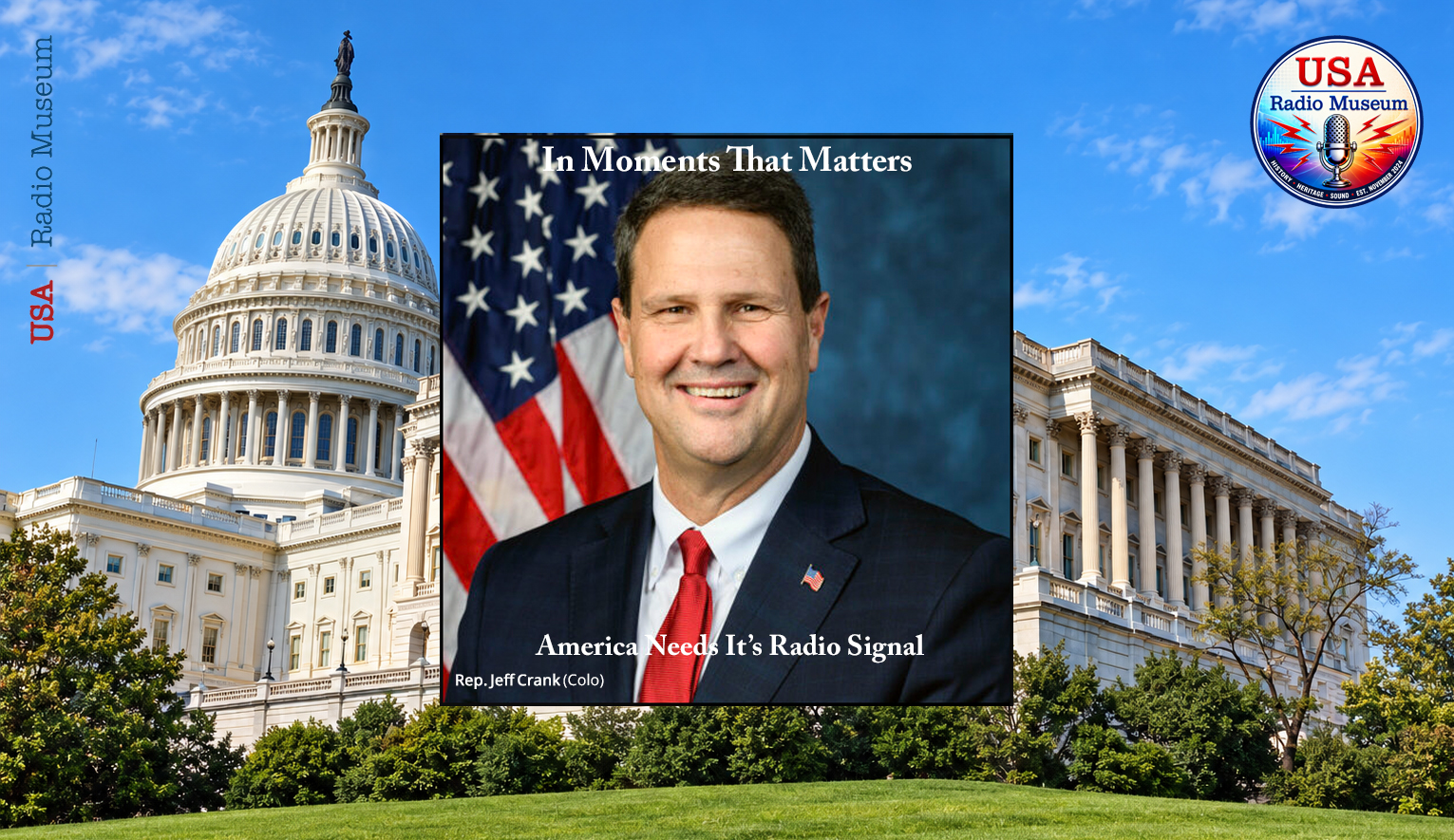
Crank’s Message is Simple: Call Your Senator Now—Before the Country Loses its Most Reliable Signal AM radio has always been the signal America trus
Crank’s Message is Simple: Call Your Senator Now—Before the Country Loses its Most Reliable Signal
AM radio has always been the signal America trusts when everything else fails. It is the medium that cuts through mountains, storms, and distance. It is the voice that remains when cell towers collapse, when broadband flickers, when the digital world proves—yet again—that it is only as reliable as the nearest power source. And in 2026, as automakers move steadily toward dashboards defined by subscription software and silent electric drivetrains, AM radio finds itself fighting for its survival in the very place where it has always mattered most: the American vehicle.
The urgency sharpened again on September 24, when RadioInk reported Congressman Jeff Crank’s direct plea to the public: pick up the phone. Call your senator. Tell them AM radio must remain standard equipment in every new vehicle sold in the United States. Crank’s appeal is not political choreography. It is lived experience—rare in Washington, and rarer still in a debate that has too often been framed as a technological inconvenience rather than a public‑safety necessity.
Before representing Colorado’s 5th District, Crank spent fourteen years behind an AM microphone at KVOR‑AM 740. He spoke to families, ranchers, commuters, and the people who rely on AM not as nostalgia but as lifeline. He learned the rhythm of communities that measure distance not in miles but in hours, where weather can turn lethal in minutes, and where cellular coverage remains a patchwork of hope and dead zones. His background gives him a clarity many lawmakers lack: AM radio is not merely entertainment. It is infrastructure. It is community. It is the last universal, subscription‑free connection between Americans and the information that keeps them safe.
The House recognized this reality on September 16, passing the AM Radio for Every Vehicle Act with broad bipartisan support—an increasingly rare alignment in modern politics. The bill is simple: automakers must keep AM radio as standard equipment. Not as an optional upgrade. Not as a paid feature. As a built‑in, always‑available, no‑fee public service.
Now the Senate holds the bill’s fate. And the danger is not opposition—it is drift. It is the quiet procedural stall that can smother even the most widely supported legislation if public pressure fades. That is why Crank’s message matters. It reminds the country that this fight is not finished, and that the consequences of inaction will be felt far beyond the Beltway.
Automakers have argued that interference in electric vehicles makes AM radio inconvenient. But inconvenience is not justification for dismantling a national safety system. AM radio’s long‑distance reach remains unmatched. Its ability to penetrate terrain, weather, and remote geography is precisely why FEMA, state emergency agencies, and rural communities depend on it. When a wildfire jumps a ridge, when a tornado touches down at 3 a.m., when a blizzard wipes out power for days, AM radio is often the only signal left standing.
Crank understands this because he has lived it. He has hunted in places where cell service disappears. He has driven roads where the only connection to the outside world is a crackling AM signal carrying weather alerts, road closures, and emergency instructions. In those moments, AM radio is not a luxury. It is survival.
But the stakes extend beyond safety. AM radio is cultural memory. It is the medium that carried Roosevelt’s fireside chats, the moon landing, farm reports, high‑school sports, and the voices of communities that never appear on national networks. It is the home of immigrant broadcasters, minority‑owned stations, rural newsrooms, and the small‑town personalities who knit together the fabric of American life. To lose AM in the car is to sever the last place where those voices remain universally accessible.
The USA Radio Museum has documented this fight with museum‑grade clarity for months, preserving the historical, cultural, and civic stakes with the reverence they deserve. But the story is still unfolding. The Senate must act. And the public must keep the pressure on until the bill reaches the President’s desk.
Crank’s call to “pick up the phone” is more than a political exhortation. It is a reminder that AM radio itself has always been about connection—one voice reaching another across distance. Now, the country must return the favor. The signal is still lit. The dial is still alive. But without action, the silence that follows will not be progress. It will be a preventable loss.
_____________________
Sources & Credits
Primary Reporting & Legislative Coverage • RadioInk — Coverage of Rep. Jeff Crank’s public call to action regarding the AM Radio for Every Vehicle Act (September 24, 2026). • U.S. House of Representatives — Legislative record confirming passage of the AM Radio for Every Vehicle Act (September 16, 2026). • FEMA & National Public Warning System documentation — Background on AM radio’s role in national emergency communications. • National Association of Broadcasters (NAB) — Public statements and technical briefs on AM radio retention in modern vehicles.
Historical & Technical Context • USA Radio Museum Archives — AM broadcast history, emergency‑signal documentation, and cultural preservation notes. • FCC Public Safety & Homeland Security Bureau — AM signal propagation and emergency‑alert infrastructure references. • Industry analyses from automotive engineering journals regarding EV interference and dashboard system design.
Special Acknowledgment • Appreciation to the AM broadcasters, engineers, and emergency‑service partners whose work continues to keep America connected when all other signals fail.
_____________________
Contact: jimf.usaradiomuseum@gmail.com
_____________________
© 2026 USA Radio Museum. All Rights Reserved

I Don’t think that the “Savior Of The Free World” won’t listen to him.