

The South African Honor That Marked the Final Triumph of a Global Country Music Icon Few voices in American music have ever traveled as far, as gen
The South African Honor That Marked the Final Triumph of a Global Country Music Icon
 Few voices in American music have ever traveled as far, as gently, or as enduringly as that of Jim Reeves. His sound — warm, unhurried, unmistakably graceful — crossed borders long before globalization became a cultural norm. His manner — humble, sincere, quietly confident — made him beloved not only by country fans, but by listeners across Europe, Africa, Asia, and the Caribbean. And his legacy — shaped by artistry, kindness, and a life cut tragically short — remains one of the most poignant stories in the history of American radio.
This tribute honors Reeves’ life, his global reach, his artistry, and the heartbreaking circumstances of his passing in 1964. It also reflects the man revealed in the Music Business magazine interview from July 18 of that year — an interview that captured Reeves at the height of his international fame, unaware that his life’s final chapter was only weeks away. — USA Radio Museum
A Texas Beginning: The Early Life of a Gentleman
James Travis Reeves was born August 20, 1923, in the piney woods of Galloway, Texas. The youngest of eight children, Reeves grew up in modest circumstances after the death of his father when Jim was still a boy. Yet hardship never hardened him. Those who knew Reeves remembered a gentle, thoughtful young man with a natural warmth that made people feel at ease.
Music surrounded him from childhood — gospel hymns, fiddle tunes, and the quiet ballads sung on front porches across East Texas. Reeves absorbed these sounds instinctively, though his first ambition was not music but baseball. He briefly pursued a professional career until an injury redirected his path.
Radio became his doorway.
Reeves worked as a sports announcer and DJ, his speaking voice already hinting at the velvet tone that would later define his singing. By the late 1940s, he was performing on local stations, blending country sincerity with a smooth, urbane delivery that felt new. His breakthrough came when he joined the Louisiana Hayride, the same program that launched the careers of Hank Williams and Elvis Presley. Reeves’ polished baritone stood out amid the rawer honky‑tonk styles of the era, signaling the arrival of a new kind of country artist.
RCA Victor and the Birth of the Nashville Sound
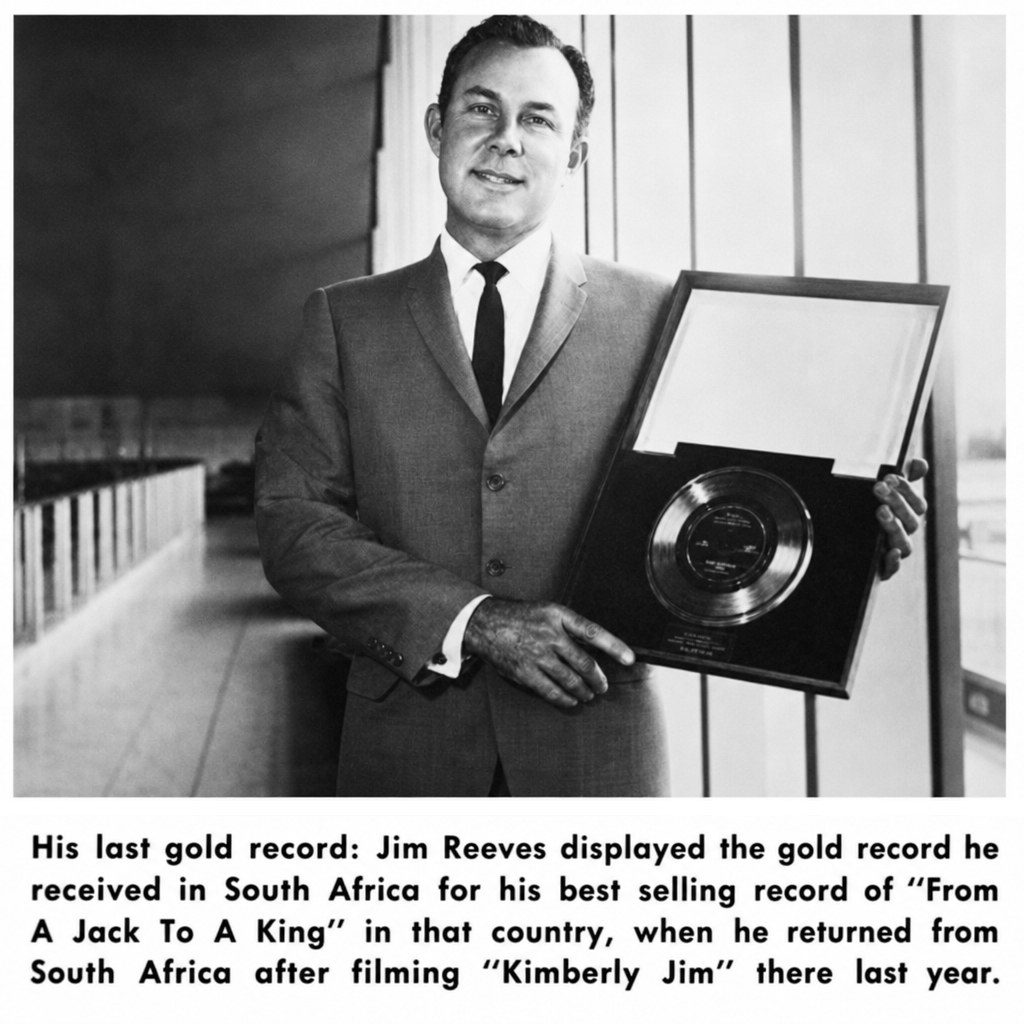
MUSIC BUSINESS: August 15, 1964
Reeves signed with RCA Victor in 1955, a pivotal moment that aligned him with producer Chet Atkins, one of the architects of the emerging “Nashville Sound.” Together, they shaped a style that softened the edges of traditional country — replacing twang with elegance, steel guitars with strings, and rowdy bravado with emotional intimacy.
Reeves didn’t shout. He confided. He didn’t perform at listeners. He sang to them.
His breakthrough hit “Four Walls” in 1957 established him as a major star. Then came “He’ll Have to Go” in 1959, a recording so intimate and conversational that it felt like a whisper across a kitchen table. The song became a global phenomenon, topping charts in multiple countries and cementing Reeves’ place as one of RCA’s most important artists.
Over the next decade, Reeves earned numerous honors, including:
- Multiple Billboard chart-topping singles
- RIAA-certified gold records
- International sales milestones across Europe, Africa, and Asia
- Posthumous induction into the Country Music Hall of Fame (1967)
- Membership in the Texas Country Music Hall of Fame
- Recognition as a foundational architect of the Nashville Sound
But awards only tell part of the story. Reeves’ true achievement was emotional: he made country music feel universal.
A Voice That Resonated from Nashville to Detroit and Beyond
 Reeves’ popularity wasn’t confined to the coasts or the South. In the Midwest — especially in Detroit, a city with one of the most passionate and musically diverse audiences in America — Reeves became a beloved fixture on WEXL, the city’s #1 country station.
At a time when Detroit listeners were equally devoted to Motown, gospel, and country, Reeves’ smooth baritone cut through the noise with unmistakable warmth. WEXL programmers often remarked that Reeves’ records had a “staying power” few artists could match. His songs didn’t just chart — they lingered.
Detroit fans embraced him as one of their own, requesting his music daily, writing letters, and treating his voice as a familiar companion during long commutes, factory shifts, and quiet evenings at home. In a city defined by musical innovation, Reeves’ presence on WEXL affirmed his rare ability to transcend genre boundaries and speak directly to the hearts of everyday listeners.
A Global Star Before Globalization
The Music Business interview which USA Radio Museum recently discovered — published July 18, 1964 — captures Reeves at the height of his worldwide fame. He was, for months, the only American artist on the British Top 10, an extraordinary feat during the height of Beatlemania.
He received 1,000 to 1,600 fan letters a week from Kenya, Surinam, Ceylon, South Africa, the Gold Coast, and throughout Europe. Reeves insisted that every letter be answered.
“If they have the courtesy to write us,” he said, “they deserve a reply.”
 This was not a publicity strategy. It was simply who he was — a man who believed that music was a shared experience, not a transaction.
Reeves’ first film, produced in South Africa, became the highest‑grossing motion picture in that country’s history. Plans for a second were underway, with Cindy Walker writing the score. Reeves was becoming not just a country star, but a global cultural figure.
He saw the future clearly:
“Music has really become international,” he said. And he was right.
The Gentle Life Behind the Fame
Despite his worldwide success, Reeves resisted the relentless touring schedules that defined many artists’ careers. He preferred balance — time with his wife, quiet trips to Texas, hunting, fishing, bowling, golf, and long stretches at home in his personal studio where he experimented with new song ideas.
He toured 75 to 100 days a year, not because he craved the spotlight, but because he cared deeply for his band, the Blue Boys. He wanted them to have steady income. He wanted to stay connected to the friends he had made across the country. He wanted to remain part of the world that had embraced him.
Reeves’ musical tastes were broad and eclectic. He admired Chet Atkins’ virtuosity, Marty Robbins’ versatility, and Dottie West’s rising brilliance. He loved Mantovani’s soft instrumentals. He believed in a “diet” of musical variety — a philosophy that shaped his own gentle, cosmopolitan sound.
The Final Flight: July 31, 1964
 On July 31, 1964, Reeves and his pianist Dean Manuel were returning to Nashville in Reeves’ private single‑engine plane. Caught in a violent storm, the aircraft went down in a wooded area south of the city. Search teams found the wreckage two days later.
Reeves was 40 years old.
The search for Jim Reeves became one of the largest volunteer efforts in Nashville’s history. Stars left their homes and joined the hunt — Marty Robbins, Eddy Arnold, Carl Smith, Minnie Pearl, Stonewall Jackson, and many others.
Arnold scoured the countryside in a jeep. Smith brought horses to cut through the thick brush. Robbins reported hearing a sputtering engine in the storm.
For two days, the woods swallowed every clue. Only when civil defense teams searched on foot did they find the wreckage — heart-breakingly close to a nearby home. The crash site was so heavily wooded that helicopters and planes could not spot it from above.
The impact was violent. Rescue workers found Reeves’ body outside the cabin; Manuel remained inside. Both men died instantly.
Their loss left a void that country music still feels.
This moment remains one of the most emotional chapters in country music history.
The news broke hearts across the world. Fans in Britain, South Africa, India, Sri Lanka, and throughout the Caribbean mourned a man whose voice had become a companion in their daily lives. In Nashville, the loss felt both personal and seismic — Reeves had been preparing new material, new films, new tours. His voice was still evolving, still deepening. His global audience was still expanding.
His passing felt not only tragic, but premature — a gentle light extinguished too soon.
A Legacy That Endures
 Jim Reeves left behind a body of work that remains timeless. His recordings continue to chart internationally. His influence helped shape the Nashville Sound, country‑pop crossover, and the global spread of American country music.
But beyond the music, Reeves left a philosophy — one that radiates through every interview, every anecdote, every quiet moment captured in the 1964 article:
“We just come through here once,” he said. “And I believe in making it a satisfying experience.”
He lived that belief. He sang it. And the world listened.
_____________________
_____________________
A Closing Tribute
Jim Reeves was more than a country star. He was a bridge — between genres, between nations, between the intimate and the universal. His voice carried the gentleness of a friend, the sincerity of a storyteller, and the warmth of a man who believed deeply in kindness.
His legacy belongs not only to Nashville, but to Detroit, to London, to Johannesburg, to Colombo — to the world. And at the USA Radio Museum, his story will always be told with reverence, gratitude, and the quiet glow of a life lived with grace.
_____________________
Sources & Credits
USA Radio Museum — Archival Restoration Series Primary historical references and documentation consulted for this feature:
• Jim Reeves Official Site (Biography & Discography) https://www.jimreevesofficial.com
• South African Recording Industry Historical Notes https://www.risa.org.za
• “Kimberly Jim” Production Background & Release History https://www.imdb.com/title/tt0058249
• Country Music Hall of Fame — Jim Reeves Profile https://countrymusichalloffame.org/hall-of-fame/jim-reeves (countrymusichalloffame.org in Bing)
• RCA Records Legacy Archives (Artist Materials & Press) https://www.rcarecords.com
• General Discography Reference — Discogs https://www.discogs.com/artist/253798-Jim-Reeves (discogs.com in Bing)
_____________________
Contact: jimf.usaradiomuseum@gmail.com
_____________________
A USARM Viewing Tip: On your PC? Mouse/double-click over the images for expanded views. On your mobile or tablet device? Finger-tap all the above images inside the post and stretch image across your device’s screen for LARGEST digitized view. Then click your browser’s back arrow to return to the featured post.
© 2026 USA Radio Museum. All Rights Reserved.
